


Your homeowners insurance probably will not pay a cent if movers drop your television. I tell customers this every week at SOS Moving, and the reaction is almost always the same — disbelief, then concern. The truth is, standard homeowners and renters policies carry exclusions for damage that happens during loading, transit, and unloading, and most people discover this only after filing a denied claim.
This guide compares homeowners coverage against moving company insurance for Los Angeles moves in 2026, breaks down what each option actually protects, and shows you how to close the gaps before moving day — not after.
How Homeowners Insurance Handles Moving Damage
Homeowners and renters policies cover your belongings against named perils: fire, theft, vandalism, certain water damage. Most policies extend this protection to items temporarily away from your home, which is why the assumption exists that you are covered during a move.
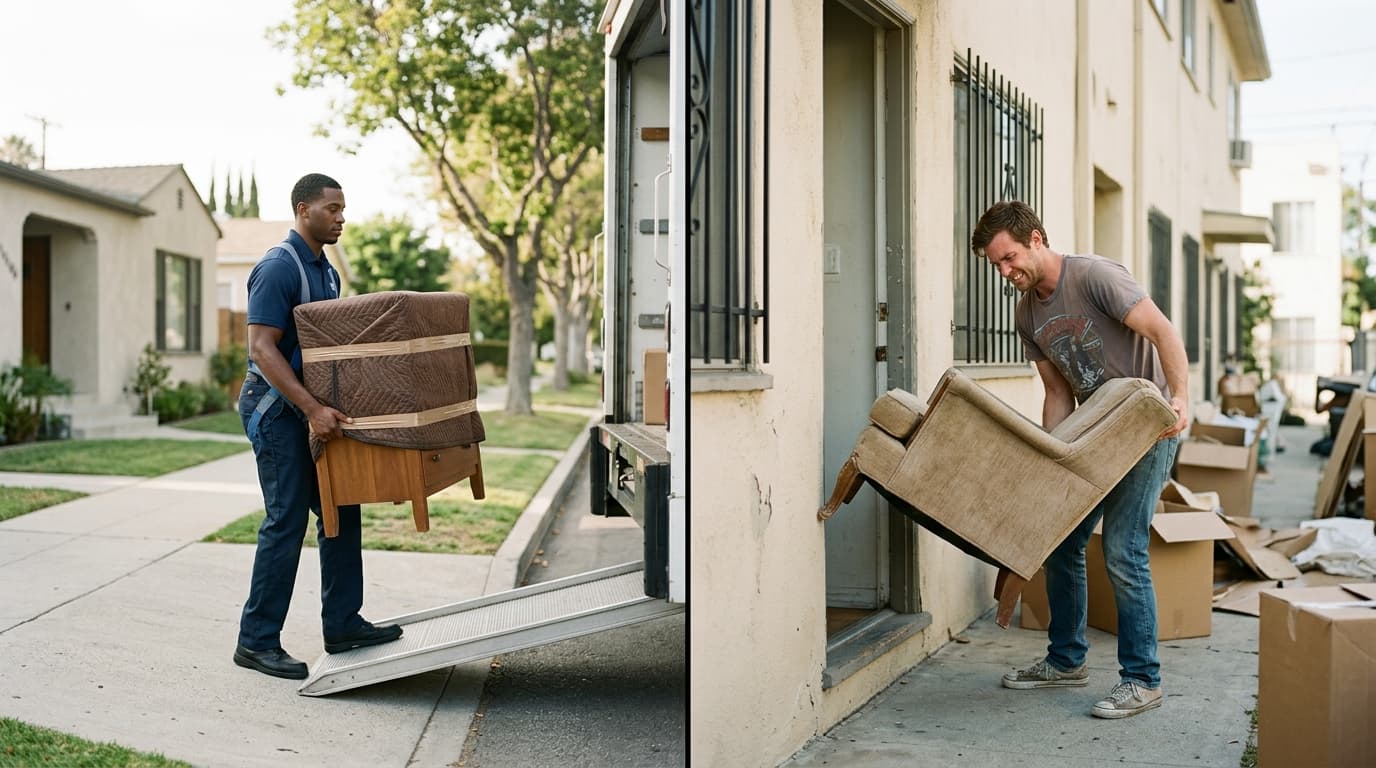
The problem hides in the exclusions. Damage caused by handling, loading, and transport is not a named peril — it is an accident during transit. Your insurer draws a hard line here. A mover drops a dresser and cracks the frame? Denied. Boxes shift in the truck and dishes break? Denied. These are mechanical and handling events, not covered perils.
What about the coverage that does extend off-premises? Most policies cap it at 10 percent of your total insured value, and your deductible still applies. If your deductible is $1,000 and the damage totals $1,200, you are filing paperwork for a $200 check — and risking a premium increase on your next renewal.
There is also a timing gap most people miss entirely. If your old lease ended Tuesday and your new lease starts Thursday, you may have no active residential policy covering those belongings at all. Homeowners insurance protects items at a fixed address. The hours your furniture spends on a truck and in limbo between addresses create a gray zone that insurers interpret in their favor, not yours.
What Moving Companies Are Required to Offer
Every licensed moving company in California must offer cargo coverage under California Public Utilities Commissionregulations. This is not optional — it is a legal requirement. But the default coverage is far thinner than most people realize.
$0.60 per pound per item. That is the default, called released value protection. It comes at no extra charge with every move, and it sounds reasonable until you do the math. Your 30-pound flat-screen TV worth $1,800? Covered for $18. A 50-pound antique mirror worth $3,000? Covered for $30. The payout has almost no relationship to actual value.
Full value protection is the second tier, and this is where real coverage begins. Under this option, your moving company must repair, replace, or reimburse you at current market value for any item lost or damaged during the move. It typically costs 1 to 3 percent of your total declared shipment value, with deductibles ranging from $250 to $500. For a household declared at $50,000, expect to pay $500 to $1,500 for genuine protection.
I help customers choose between these options before every move at SOS Moving. Our weekday rates start at $119 per hour for a two-person crew and $135 per hour on weekends as of early 2026, and those rates already include premium moving blankets, unlimited shrink wrap, furniture wrapping, and the careful handling that prevents most damage from happening in the first place.
The Gap That Costs People Thousands
Here is a scenario I see play out regularly. A couple moves from a two-bedroom apartment in Echo Park to a townhouse in Burbank. During unloading, their $3,000 sectional sofa gets a deep tear and an $800 floor lamp shatters.
They call their renters insurance company. Claim denied — damage during professional moving is excluded. They fall back on the moving company's released value protection. The sofa weighs about 150 pounds: $90 payout. The lamp weighs 10 pounds: $6. Total recovery on $3,800 worth of damage? Exactly $96.
This is not an edge case. It happens when people assume coverage exists without confirming it. The fix is not complicated, but it needs to happen before your move, not after. Either purchase full value protection through your mover, confirm in writing with your homeowners insurer that transit damage is explicitly covered, or buy standalone moving insurance from a third-party provider.
That third option — standalone moving insurance — is something most people do not know exists. Companies that specialize in transit coverage offer policies designed specifically for household goods in motion, with premiums typically running $100 to $300 for a local move.
Side-by-Side: What Each Option Actually Covers
Homeowners / Renters Insurance: Covers belongings against named perils at your residence. Limited off-premises extension, usually 10 percent of total coverage. Does not cover handling or transit damage. Deductible applies. Filing a claim may raise premiums. You are already paying for it.
Released Value Protection (mover's default): Covers every item at $0.60 per pound regardless of actual value. Free, automatic, no deductible. Applies specifically to damage during the move. Payout rarely matches replacement cost.
Full Value Protection (mover's upgrade): Covers items at current market replacement value. Costs 1-3 percent of declared value. Deductible typically $250-$500. Clear claims process directly through the moving company.
Third-Party Moving Insurance: Covers full declared value during transit, loading, and unloading. Independent from both homeowners policy and mover's coverage. Premiums based on total value and distance. Streamlined claims process built for moving damage.
For most LA moves involving furniture and electronics worth more than a few thousand dollars, full value protection through your mover or a third-party policy provides the most reliable coverage.
What to Verify Before Moving Day
Start with a phone call to your homeowners or renters insurance company. Do not skim the policy summary — call an agent and ask directly: "Does my policy cover damage caused during a professional move, including loading, transit, and unloading?" Ask about exclusions. Get the answer documented in your account notes or in an email.
Next, have the coverage conversation with your moving company. A reputable mover explains both released value and full value protection clearly and gives you time to decide before moving day. If a company dodges this conversation or cannot explain their coverage, treat that as a serious warning sign.
Want clarity on exactly what is covered? Call SOS Moving at 909-443-0004 or request your free estimate — I walk every customer through their coverage options before we book anything.

Protecting High-Value and Specialty Items
Standard coverage — from any source — is almost never adequate for items where weight and value have no relationship. A painting worth $10,000 might weigh two pounds. A vintage guitar worth $5,000 weighs eight pounds. Released value protection would cover them for $1.20 and $4.80 respectively.
For individual items worth more than $5,000, consider scheduling them on your homeowners policy as a separate rider. This type of coverage, sometimes called a floater, protects specific high-value items against a broader range of perils — often including accidental damage during a move. Premiums typically run $1 to $2 per $100 of value per year.
Professional white-glove moving service adds another layer of protection through prevention. Custom crating for artwork, specialized wrapping for antiques, and experienced handling for pianos and pool tables reduce risk before insurance even enters the picture. At SOS Moving, our $200 piano moving fee covers a four-person crew with the training and equipment to handle instruments that most general movers will not touch.
Filing a Claim When Damage Happens
Document everything immediately. Photos of the damage, the packaging used, the surrounding area. Note the exact time and what happened. If the crew is still present, have the lead acknowledge the damage on your bill of lading before they leave — this single step makes the biggest difference in successful claims.
Against your mover's coverage: File a written claim within nine months of delivery. The company has 30 days to acknowledge and 120 days to resolve under federal regulations. Keep copies of everything.
Against your homeowners policy: Contact your insurer immediately. Be prepared for them to investigate whether the damage falls under a covered peril or an excluded transit event. Written documentation of what happened strengthens your position significantly.
Against third-party moving insurance: Follow the policy's claims process. These providers typically resolve faster than homeowners insurers because their entire business is built around transit damage.
The one thing that helps across all three: a detailed inventory with photos created before the move begins. Photograph valuable items from multiple angles, note pre-existing wear, and keep receipts or appraisals accessible. This is the difference between a paid claim and a disputed one.
Why the Best Insurance Is a Move Where Nothing Breaks
Every coverage option compensates you after something goes wrong. Prevention means nothing goes wrong in the first place. The question I ask customers who are debating coverage levels is simple: "Would you rather get a check for your broken dresser, or have your dresser arrive intact?"
At SOS Moving, every job includes premium moving blankets, unlimited shrink wrap, heavy-duty packing tape, and wardrobe boxes — no extra charge. Our crews wrap and protect furniture before it leaves your home, disassemble and reassemble what needs it, and use techniques refined over thousands of Los Angeles relocations. The materials and training that prevent damage are built into our rates, not tacked on as optional extras.
Hiring a licensed, insured company with transparent pricing and strong reviews reduces your risk more than any policy can. When you combine a quality mover with appropriate coverage, you have genuine protection — not just paperwork.
Frequently Asked Questions
Does homeowners insurance cover damage during a move?
Most homeowners policies exclude damage caused by handling, loading, and transit during a professional move. Even when limited off-premises coverage applies, deductibles reduce the payout and filing a claim can raise future premiums. Always confirm directly with your insurer before relying on this assumption.
What is the difference between released value and full value protection?
Released value protection is free and covers items at $0.60 per pound regardless of actual worth — a $2,000 TV weighing 30 pounds would pay out just $18. Full value protection costs 1-3 percent of your declared shipment value but covers items at current market replacement cost, which means the mover must repair, replace, or reimburse at real value.
Is third-party moving insurance worth it?
For long-distance moves, high-value households, or situations where your homeowners policy explicitly excludes transit damage, third-party moving insurance fills the gap effectively at $100-$300 for a local move. For local moves with a reputable licensed mover, full value protection through the company is usually simpler and sufficient.
Can I negotiate moving insurance costs?
The released value rate ($0.60/lb) is set by regulation and cannot change. Full value protection costs vary by mover and by the deductible you choose — a higher deductible lowers the premium. Ask your mover to quote multiple deductible levels so you can compare.
What insurance does SOS Moving include with every move?
Every SOS Moving job includes released value protection at no extra charge, full commercial general liability insurance, and workers' compensation for every crew member. Full value protection is available as an upgrade. We also include premium moving blankets, shrink wrap, and professional furniture wrapping with every move — the prevention that keeps most claims from ever being filed. Weekday rates start at $119/hr and weekend rates at $135/hr as of early 2026.
Get Started with Full Transparency
Every SOS Moving customer gets a clear explanation of their coverage options before booking — not after the truck is loaded. Call us at 909-443-0004 or request your free estimate to get a transparent quote and understand exactly how your belongings are protected throughout your entire move.