

A single box of poorly packed kitchen items can turn a smooth move into an expensive disaster. Dishes and glassware account for more moving damage claims than almost any other category of household belongings, and the reason is almost always the same — people underestimate how much protection fragile items actually need inside a moving truck that's braking, turning, and hitting bumps for miles.
After handling thousands of kitchen packs at SOS Moving, I can tell you that the difference between zero breakage and a box full of shattered glass usually comes down to three things: the right materials, the right wrapping technique, and the right loading order inside the box. None of it is complicated, but skipping any step multiplies the risk dramatically.
Gather the Right Materials Before You Start
Packing dishes without the right supplies is like cooking without ingredients — you'll improvise, and the results will show it. Before you touch a single plate, make sure you have everything within arm's reach.
You need packing paper, and you need a lot more than you think. A standard 600-sheet pack covers roughly three to four boxes of dishes. At SOS Moving we sell packing paper at $55 for 600 sheets, and most kitchens require at least one full pack. Newspaper works in a pinch but leaves ink stains on white dishes and crystal that can be surprisingly difficult to remove.
Dish pack boxes — also called dish barrels — are taller and thicker than standard moving boxes. The double-walled cardboard absorbs shock that would crush a regular box. If you're packing more than a few items, these are worth every dollar. Cell dividers that slot into these boxes create individual compartments for glasses and stemware, eliminating the biggest risk factor: items touching each other during transit.
Bubble wrap is your second layer of defense for especially fragile or valuable pieces. Thin crystal, hand-painted ceramics, and antique china all deserve bubble wrap over packing paper. Heavy-duty packing tape seals boxes securely — don't rely on folding the flaps. A box that pops open when a mover lifts it from the bottom is a box that loses its contents.
How to Wrap Plates and Bowls
The wrapping technique matters more than the material. A plate wrapped in expensive bubble wrap but done incorrectly will still break, while a plate wrapped properly in plain packing paper will survive almost anything a moving truck throws at it.
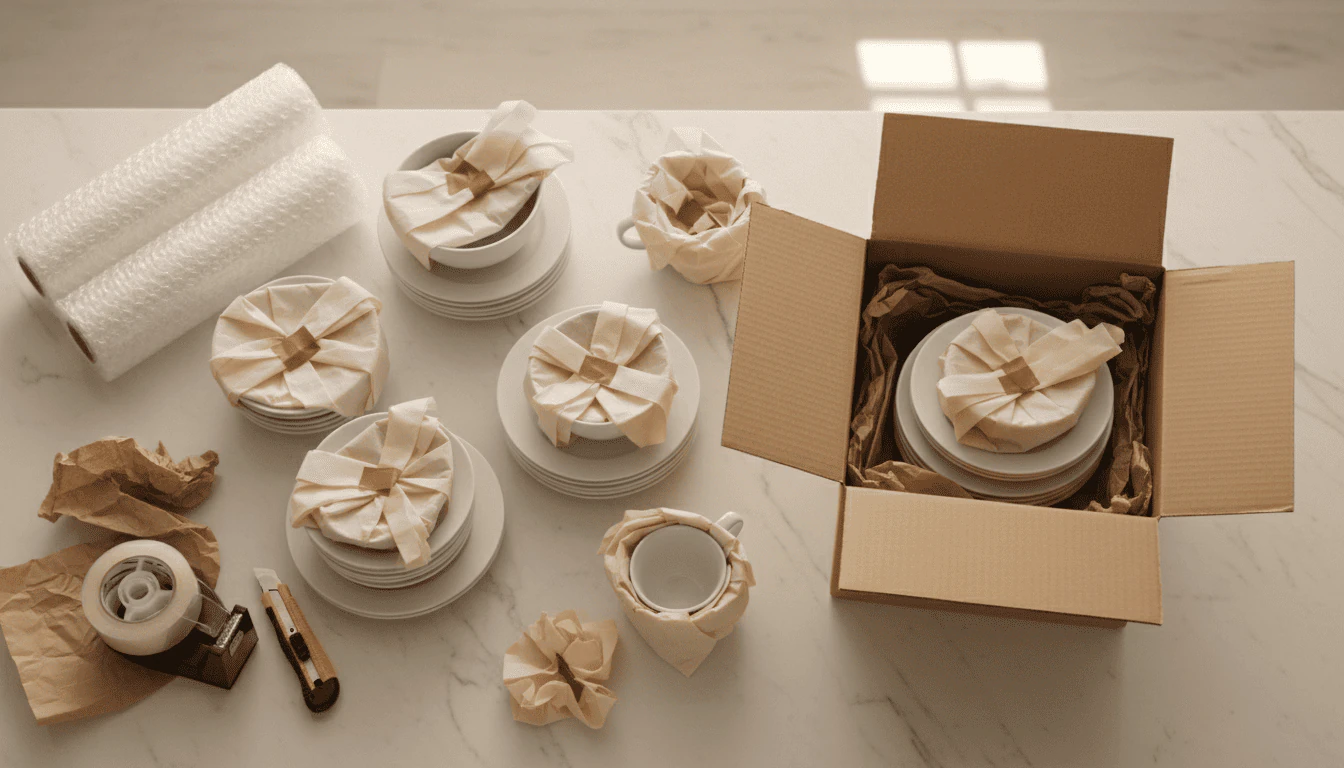
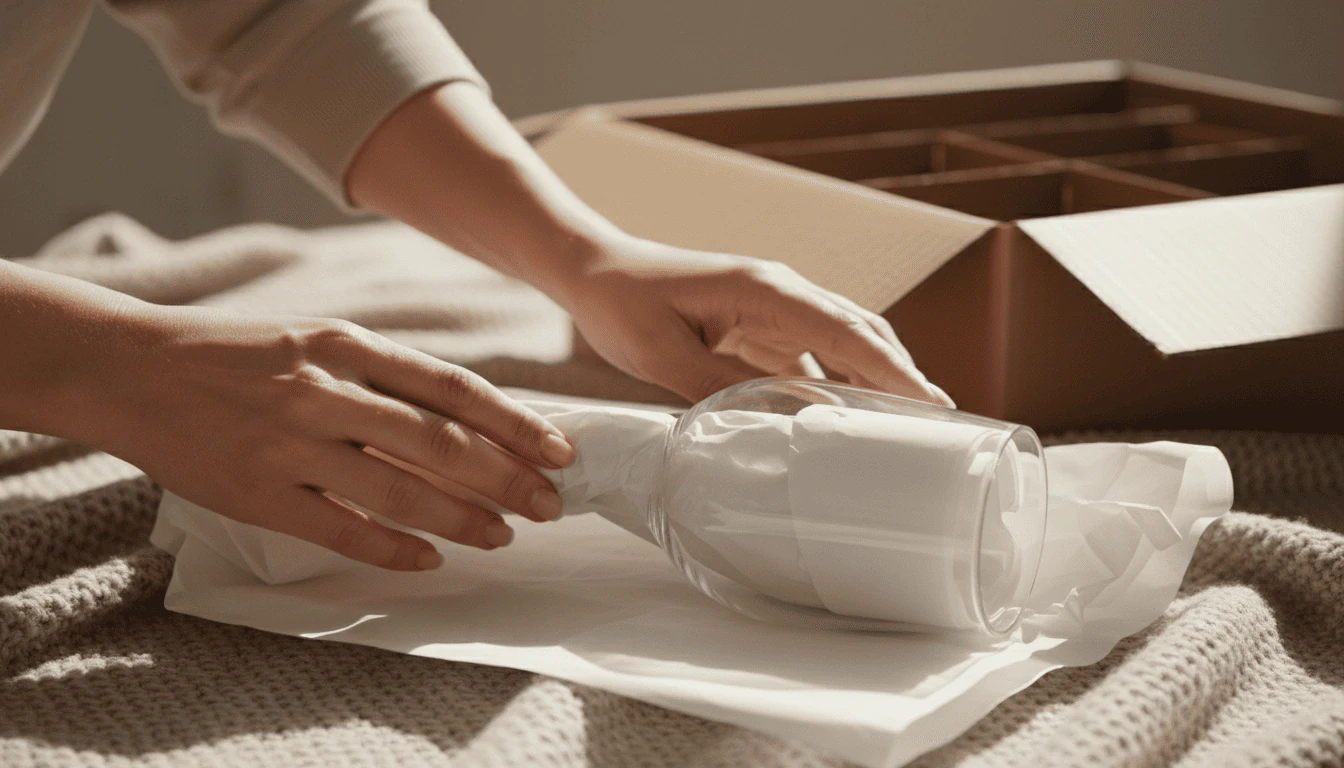
Start by creating a cushioned work surface. Lay a stack of packing paper on a table or countertop — this gives you a clean, soft area that prevents chips while you work. Place one plate in the corner of a packing paper sheet, fold one corner over the plate, tuck the sides in, and roll the plate across the paper until it's fully wrapped. The goal is at least two full layers of paper around every plate.
For bowls, the technique is similar but you'll nest them. Wrap each bowl individually, then stack wrapped bowls inside each other in groups of three or four. Never stack more than four — the weight of a tall stack creates pressure on the bottom bowl that padding can't offset.
Bundle wrapped plates in groups of four to five, then wrap the entire bundle in an additional sheet of paper. This double-layering creates an air cushion between plates and between the bundle and the box wall. Stand plate bundles vertically in the box, like records in a crate. Plates are structurally stronger on their edges than lying flat — a vertical plate distributes impact force across its full diameter rather than concentrating it on one point.
How to Pack Glasses and Stemware
Glasses break during moves more than any other kitchen item, and stemware — wine glasses, champagne flutes, martini glasses — is the most vulnerable of all. The stem is a structural weak point that snaps under lateral pressure, which is exactly the type of force generated when a truck brakes suddenly.
Stuff a small ball of crumpled packing paper inside each glass before wrapping. This internal cushion prevents the glass from collapsing inward on impact. Then wrap the outside with two to three sheets of packing paper, paying extra attention to the stem. For wine glasses, wrap the bowl first, then wrap the stem and base separately with an additional sheet, creating a thicker layer around the weakest point.
Cell dividers are the single best investment for glassware. A cardboard divider grid inside a dish pack box creates individual cells that prevent glasses from touching each other. Every professional mover I know uses these — they eliminate the lateral contact that causes most stemware breakage. Each glass gets its own compartment, surrounded by air and cardboard on all four sides.
If you don't have cell dividers, wrap each glass individually and place crumpled paper between every item. The goal is the same: no glass should be able to touch another glass, no matter how aggressively the box is shaken.
Loading the Box Correctly
How you load the box matters as much as how you wrap each item. A perfectly wrapped glass in a badly loaded box will still break.
Start with a two-inch cushion layer of crumpled packing paper on the bottom of every box. This base layer absorbs the initial impact when the box is set down. Heavier items — plates, serving dishes, heavy mugs — go on the bottom. Lighter items — glasses, teacups, delicate bowls — go on top. This isn't optional. Heavy items on top crush light items underneath, and no amount of wrapping prevents that.
Fill every gap with crumpled paper. Shake the box gently after loading each layer. If you hear anything shifting or clinking, there isn't enough padding. Items that move during transit hit each other, and items that hit each other break. Professional packers at SOS Moving test every box by tilting it at a forty-five degree angle — if anything shifts, more paper goes in.
The top layer needs another two inches of crumpled paper before you close the box. When sealed, the box should feel firm on top — not soft, not hollow. Press down gently with your palm. If the top gives way, add more paper. If you can feel hard objects through the cardboard, add more paper.
Seal the box with tape across the center seam and both edges. Write "FRAGILE — KITCHEN" on the top and at least two sides. Mark which end is up. Movers and helpful friends who carry boxes from the truck can't read labels that only appear on the top when the box is already upside down.
Don't want to risk your grandmother's china? SOS Moving's professional packing team wraps every dish, glass, and fragile item with the same care we'd give our own. Full packing service starts at $119/hour weekdays. Call 909-443-0004 or get your free estimate.
Common Mistakes That Cause Breakage
After unpacking thousands of kitchen boxes — both ones we packed and ones customers packed themselves — the same mistakes show up repeatedly.
Using boxes that are too large is the most common error. A huge box stuffed with heavy dishes becomes dangerously heavy and difficult to carry safely. Dish pack boxes are sized specifically to hold kitchen items at a manageable weight. If you're using standard boxes, fill them only halfway with dishes and use the remaining space for lighter items like dish towels or plastic containers.
Wrapping multiple items together without individual wrapping is the second biggest mistake. Two plates face-to-face with a single sheet of paper between them will chip each other when the box moves. Every item needs its own wrap — no exceptions, no shortcuts.
Laying plates flat instead of standing them on edge costs people their favorite serving platters every moving season. Flat-stacked plates concentrate impact on a single point, and the bottom plate bears the weight of everything above it. Vertical loading distributes force evenly and dramatically reduces breakage.
Using old, weak boxes rounds out the top mistakes. Moving boxes that have already been used once have compromised structural integrity. The bottom of a reused box can give out when lifted, especially with heavy kitchen items inside. New or high-quality moving boxes are worth the investment for fragile items.
Special Items: Crystal, China, and Antique Pieces
High-value kitchen items need additional protection beyond standard wrapping techniques. Heirloom crystal, fine china, and antique ceramics carry both monetary and sentimental value that justifies extra time and materials.
For crystal, wrap each piece in two layers of bubble wrap after the initial packing paper layer. The combination of paper against the surface — preventing scratches — and bubble wrap on the outside — absorbing shock — provides maximum protection. Crystal is sensitive to temperature changes as well, so avoid leaving packed crystal in a truck exposed to direct sun for extended periods. In Southern California summer heat, the interior of a moving truck can exceed 140 degrees.
Fine china with gold leaf or hand-painted details needs packing paper rather than newspaper or printed material, as ink can transfer to decorative surfaces. Place a foam sheet or thick layer of tissue between stacked china pieces with raised patterns, since patterns create pressure points that can chip adjacent pieces.
For truly irreplaceable items — antique serving sets, museum-quality porcelain, items with significant appraisal value — consider custom crating. A custom-built wooden crate with foam inserts provides protection that no amount of paper wrapping can match. The cost of a custom crate is a fraction of the replacement value of items that cannot actually be replaced.
Professional Packing vs DIY: When to Call In Help
Packing a kitchen yourself is entirely doable if you follow the techniques above and give yourself enough time. A full kitchen with dishes, glasses, pots, and small appliances takes most people four to six hours to pack properly. Rush that timeline and quality drops — which is exactly when breakage happens.
Professional packing services make sense when your kitchen contains high-value items, when your timeline is tight, or when the sheer volume of fragile items makes DIY impractical. A three-person crew from SOS Moving can professionally pack a full kitchen in under two hours with materials included — wardrobe boxes, dish packs, packing paper, and bubble wrap.
The math is straightforward. Professional packing for a kitchen runs approximately $200 to $400 depending on size and complexity. Replacing a set of broken dishes, glasses, and serving pieces after a poorly packed DIY effort can easily exceed $1,000 — plus the irreplaceable sentimental items that no insurance check can restore.
Frequently Asked Questions
How many boxes do I need for a kitchen? An average kitchen requires eight to twelve boxes: four to six dish pack boxes for fragile items, two to three medium boxes for pots, pans, and small appliances, and two to three small boxes for utensils, spices, and miscellaneous items.
Can I use newspaper instead of packing paper? Newspaper provides decent cushioning but leaves ink stains on dishes, especially white porcelain and crystal. If you use newspaper, add a layer of plain paper or tissue directly against the dish surface and use newspaper as the outer wrapping layer.
Should plates be packed standing up or lying flat? Standing up, always. Plates are stronger on their edges and distribute impact force more evenly when vertical. Pack them like vinyl records in a crate, not like a stack of pancakes.
Is bubble wrap better than packing paper for dishes? Both serve different purposes. Packing paper goes against the dish surface to prevent scratches. Bubble wrap adds an outer shock-absorption layer. For standard dishes, packing paper alone is sufficient. For crystal, fine china, and high-value pieces, use both — paper first, then bubble wrap.
What should I do with chipped dishes before moving? Don't pay to move dishes you'd throw away after unpacking. Moving is the best time to declutter your kitchen. Donate usable items, recycle what you can, and only pack what you'll actually use in your new home.
Get Started with Professional Kitchen Packing
SOS Moving's crews pack kitchens every day with zero-breakage standards. We bring all materials — packing paper, bubble wrap, dish pack boxes, cell dividers, and tape — so you don't have to shop for supplies or guess quantities. Call 909-443-0004 or request your free estimate to get your kitchen packed safely by professionals who treat your dishes like their own.