

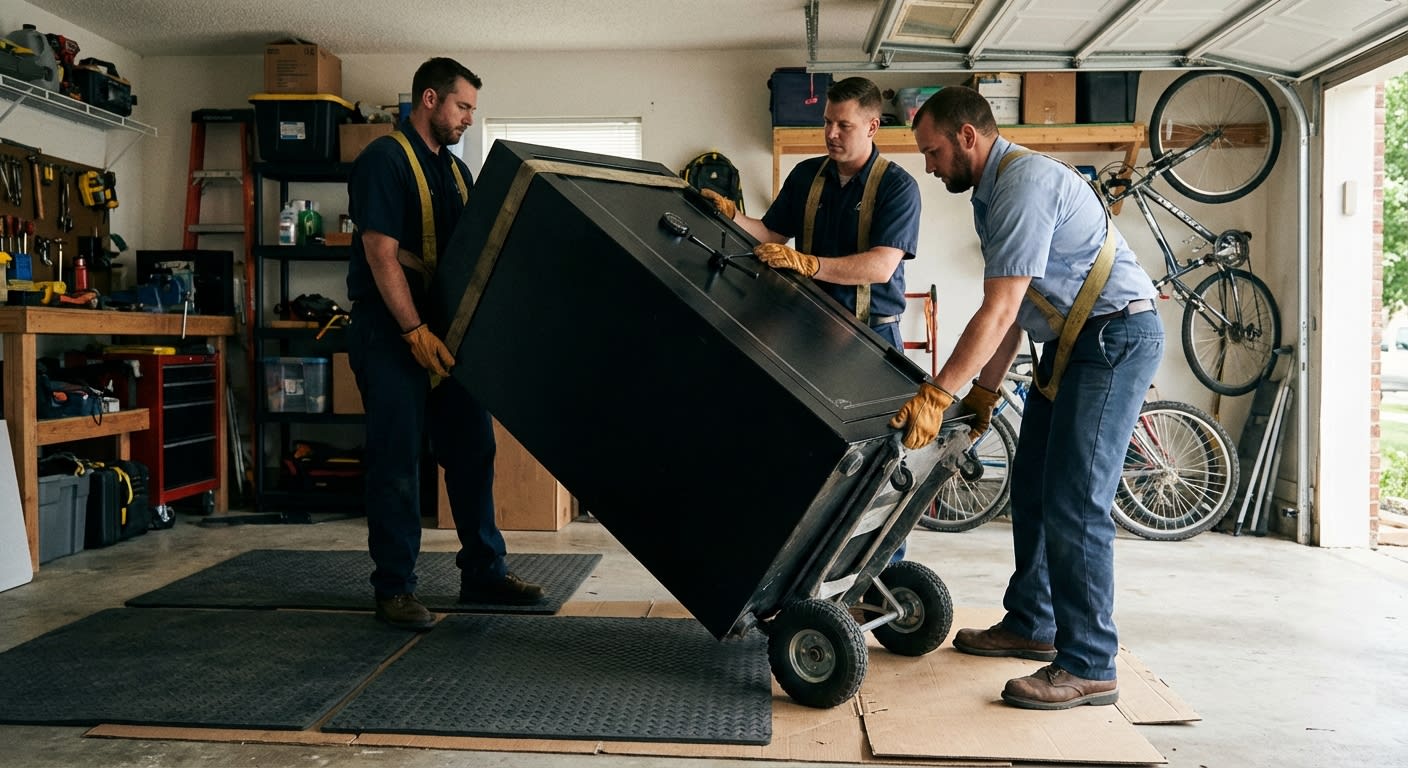
Three weeks ago, I got a call about a Liberty Fatboy safe in a Northridge garage—1,200 pounds of steel bolted to a concrete slab, and the homeowner needed it moved to his new place in Simi Valley before closing. When I walked in and saw it wedged between his workbench and a vintage Mustang with about 14 inches of clearance on each side, I knew this was going to be one of those jobs where every inch matters. We got it out without a scratch on the car, but it took four hours of planning for what ended up being a 45-minute extraction.
I'm Amir, a Senior Move Foreman at SOS Moving, and I've been moving gun safes across Los Angeles and Southern California for over five years now. I've handled everything from 300-pound residential cabinets to 2,500-pound commercial vault doors. Gun safe moving isn't just about muscle—it's about physics, proper equipment, and knowing exactly what you're dealing with before you touch anything.
Understanding Gun Safe Weight Classes and What They Mean for Your Move
The first thing I tell every client is that gun safes aren't created equal, and the weight difference between models can be staggering. As of 2026, residential gun safes typically fall into four weight categories, and each one requires a completely different approach.
Light-duty safes run from 200 to 400 pounds. These are your entry-level models—think Stack-On or basic Sentry safes. Two experienced movers with a heavy-duty appliance dolly can usually handle these without specialized equipment. I still recommend professional moving for anything over 300 pounds, but these are the most manageable category.
Mid-range safes weigh between 400 and 800 pounds. This is where most quality residential safes land—brands like Liberty, Browning, and Winchester. At this weight, you're looking at a three-person crew minimum and stair-climbing equipment if there's any elevation change. A 600-pound safe on a staircase isn't something two people can muscle through safely.
Heavy-duty safes range from 800 to 1,500 pounds. These are serious security investments—Fort Knox, Graffunder, and high-end Liberty models. My crew uses specialized safe-moving dollies with pneumatic tires and sometimes a motorized stair climber for these jobs. We moved a 1,100-pound Graffunder out of a Bel Air basement last month, and it took five hours with a four-person crew.
Commercial and vault-class safes exceed 1,500 pounds. At this level, we're talking about equipment like pallet jacks, hydraulic lifts, and sometimes rigging equipment. I've moved safes over 2,000 pounds that required removing door frames and bringing in a crane for second-story installations.
California Permit Requirements for Gun Safe Transportation
Here's something that surprises most clients: moving a gun safe itself doesn't require a permit in California as of 2026. The safe is just furniture as far as the state is concerned. However, there are several permit and legal considerations you need to understand.
If your firearms are inside the safe during transport, California Penal Code Section 25610 requires that handguns be transported in a locked container—which your safe qualifies as—but long guns have different requirements. I always recommend removing all firearms and transporting them separately according to California law, which means unloaded and in a locked container in your trunk or a locked compartment not accessible from the passenger area.
Street permits are another consideration. In cities like Los Angeles, Santa Monica, and Pasadena, if our truck needs to park in a way that blocks traffic or a bike lane for an extended period, we need to pull a temporary no-parking permit. These typically cost between $50 and $150 depending on the municipality and need to be requested 3-5 business days in advance. I handle this paperwork for clients as part of our service.
Building permits come into play if you're bolting the safe to a foundation or structural element in your new home. Most residential installations don't require permits, but if you're doing any concrete work or structural modifications, check with your local building department. I've seen homeowners in HOA communities get cited for unpermitted concrete pads.
Essential Equipment for Moving Different Safe Sizes
The equipment I bring to a gun safe move depends entirely on the weight class and the access situation. For a 400-pound safe on a single-story home with no stairs, I might only need a heavy-duty appliance dolly rated for 800 pounds, moving straps, and furniture blankets. For that 1,200-pound Liberty in Northridge, I brought a specialized safe dolly, a motorized stair climber, a hydraulic furniture lift, and enough blankets to pad a small apartment.
Safe dollies are different from regular appliance dollies. They have a lower center of gravity, wider wheel bases, and toe plates designed for the specific dimensions of safes. A standard appliance dolly can handle maybe 600 pounds safely—beyond that, you're risking equipment failure and serious injury. My crew's primary safe dolly is rated for 1,800 pounds and cost more than some of the safes we move.
Stair-climbing equipment is where gun safe moving gets technical. For safes under 500 pounds, we can use manual stair climbers—basically a dolly with rotating tracks that grip each stair. Above 500 pounds, I use motorized stair climbers that take the physical strain off my crew. These machines cost upward of $3,000 and require training to operate safely, but they're the difference between a controlled descent and a disaster.
Rigging equipment—come-alongs, pulleys, and lifting straps—comes out for the really challenging installations. I moved a safe into a hillside home in the Hollywood Hills last year where the only access was a 45-degree exterior staircase. We rigged a pulley system from the deck above and controlled the ascent inch by inch. That job took eight hours for a single safe.
Pre-Move Assessment: What I Look for Before Moving Day
I never quote a gun safe move without an in-person assessment or, at minimum, detailed photos and measurements. There are too many variables that can turn a straightforward job into a nightmare if I'm not prepared.
🔒 Need to move a gun safe or other heavy specialty item? My team at SOS Moving specializes in white glove moving services for items that require extra care and expertise. Call us at (909) 443-0004 or request a consultation to discuss your safe moving needs.
First, I measure the safe itself—height, width, depth, and I confirm the weight from the manufacturer's specs or the safe's documentation. Clients often underestimate weight by 200-300 pounds because they're going off memory or guessing based on size. A 36-inch-wide safe can weigh anywhere from 400 to 1,200 pounds depending on the steel gauge and fire rating.
Next, I map the exit path. Every doorway, hallway turn, and staircase gets measured. I'm looking for the narrowest point and calculating whether we need to remove doors, take off hinges, or in some cases, find an alternate route entirely. That Northridge safe I mentioned? The garage door was actually our best exit—we had to wait for the homeowner to move his Mustang to the driveway.
Floor surfaces matter more than people realize. Hardwood floors can be damaged by the concentrated weight of a safe dolly, so I lay down protective runners. Tile can crack under point loads. Carpet can hide transitions or soft spots that make dolly control unpredictable. I've seen a 700-pound safe punch right through a rotten subfloor that was hidden under carpet—that's a $2,000 repair on top of the moving cost.
Finally, I assess the destination. Is the new location ready? Is the floor reinforced if needed? A 1,000-pound safe concentrated on four small feet exerts significant pounds per square inch—most residential floors can handle it, but older homes or rooms with long joist spans might need reinforcement.
The Actual Moving Process: Step by Step
Once I've assessed the job and assembled the right crew and equipment, the actual move follows a precise sequence. Rushing any step is how safes get dropped and people get hurt.
Step one is emptying the safe completely. I know some clients want to leave contents inside to save time, but the weight difference matters, and more importantly, I don't want to be liable for firearms or valuables during transport. Everything comes out, gets inventoried by the client, and travels separately.
Step two is removing the door if possible. Many gun safes have removable doors that can cut 30-40% of the total weight. A 900-pound safe with a 300-pound door suddenly becomes a 600-pound safe body and a manageable door that two people can carry. Not all safes have this option, but when they do, it's worth the extra time to remove and reinstall.
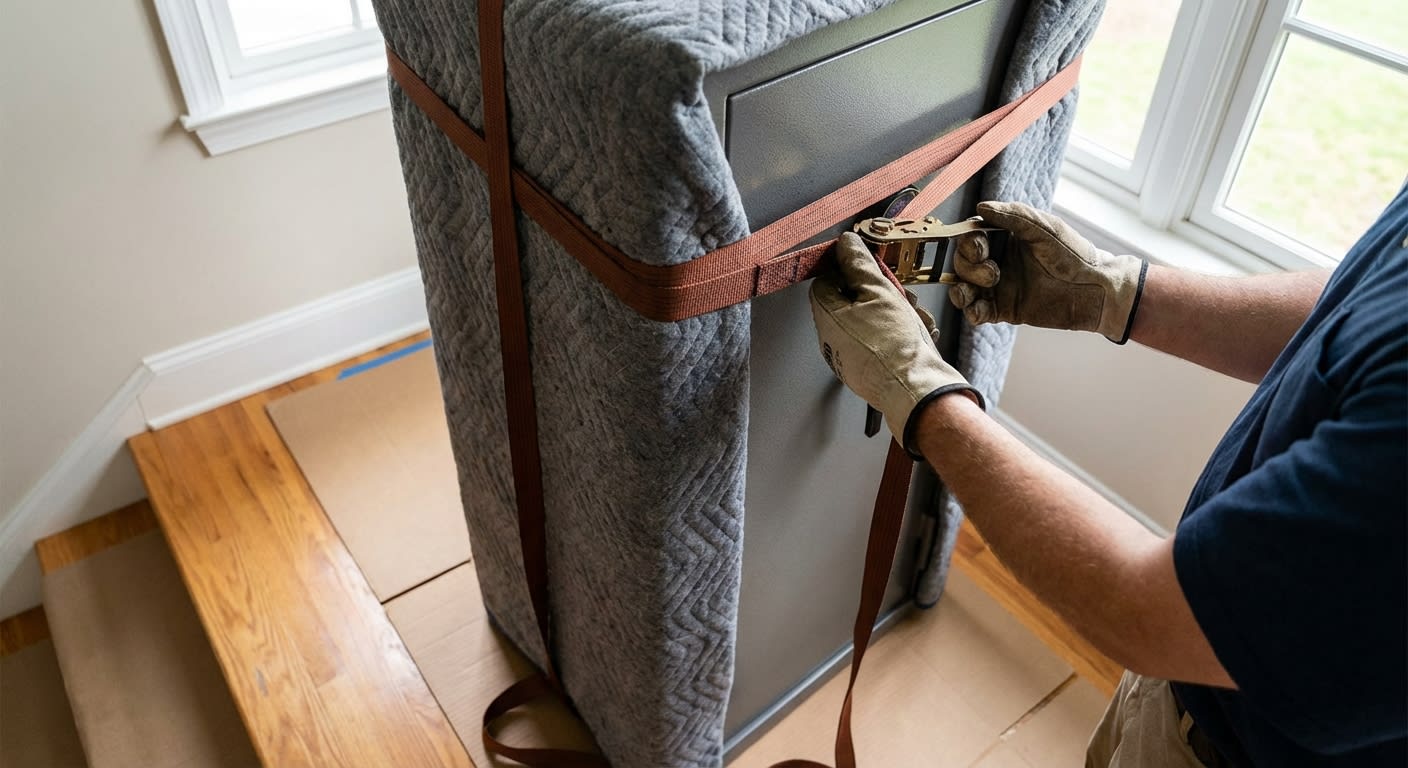
Step three is securing the safe to the dolly. I use heavy-duty ratchet straps rated for at least twice the safe's weight. The safe gets wrapped in moving blankets first—not for the safe's protection, but to protect walls and doorframes we'll be passing. The straps go around the safe and dolly together, creating a single unit that won't shift.
Step four is the actual movement. One person controls the dolly while others spot and guide. Communication is constant—I call out every obstacle, every turn, every change in floor surface. On stairs, the person at the bottom controls the descent while others stabilize from above. We move slowly, deliberately, and we stop immediately if anything feels wrong.
Step five is placement and leveling. Gun safes need to be level to function properly—the door won't seal correctly if the safe is tilted. I carry a torpedo level and shims for final positioning. If the client wants the safe bolted down, that's typically an additional service that involves drilling into concrete or wood and using appropriate anchors.
Common Mistakes I See Homeowners Make
Over the years, I've been called in to fix a lot of DIY gun safe moves that went wrong. The most common mistakes are predictable and preventable.
Underestimating weight is number one. People look at a safe and think "it's only four feet tall, how heavy can it be?" Then they recruit two buddies and a furniture dolly and end up with a safe stuck halfway down the stairs and someone with a back injury. I've done rescue jobs where I'm essentially retrieving a safe from a dangerous position because the homeowner couldn't complete the move.
Using the wrong equipment is equally common. Furniture dollies, hand trucks from the hardware store, and moving straps from Amazon aren't rated for safe weights. I've seen dolly wheels collapse, straps snap, and handles break off. Professional safe-moving equipment exists for a reason.
Ignoring the path is another frequent issue. People focus on getting the safe out of its current location without thinking about every inch of the journey. That 90-degree turn in the hallway? The three-inch lip at the garage threshold? The narrow gate to the backyard? Any of these can stop a safe move cold if you haven't planned for them.
Not securing firearms properly during transport is a legal issue, not just a practical one. I've had clients assume they can just leave loaded guns in the safe and drive across town. In California, that's potentially multiple violations depending on the firearm types and how they're stored. As I mentioned in my colleague Sarah's piece on moving insurance versus homeowners coverage, understanding what's protected and what's your responsibility matters.
Cost Factors for Professional Gun Safe Moving in 2026
When clients ask me what gun safe moving costs, I explain that it's not a simple per-pound calculation. Multiple factors determine the final price, and understanding them helps you budget accurately.
Weight is the baseline factor. As of 2026, most professional movers in the Los Angeles area charge roughly $150-$300 for safes under 500 pounds, $300-$500 for safes between 500 and 1,000 pounds, and $500-$1,000+ for safes over 1,000 pounds. These are ballpark figures—your actual cost depends on the other factors below.
Access difficulty multiplies the base cost. A ground-floor safe with a clear path to the truck is straightforward. Add a flight of stairs and you might add $100-$200. A tight spiral staircase, a second-floor location, or a basement with a narrow door? Those can double the price because they double or triple the time and crew size required.
Distance matters for the transport portion. A local move within Los Angeles is different from taking a safe to San Diego or up to the Bay Area. For long-distance safe transport, you're looking at additional mileage charges and potentially overnight considerations. My colleague Jacob has written about USDOT requirements for long-distance moving that apply to any interstate move.
Special equipment needs affect pricing. If your safe requires a motorized stair climber, rigging equipment, or crane service, those have rental and operation costs that get passed through. A crane for a second-story safe installation can add $500-$1,500 to the job depending on the setup required.
Installation services are typically separate from the move itself. Bolting a safe to concrete, reinforcing a floor, or building a custom platform are additional services with their own pricing. I always quote these separately so clients understand what they're paying for.
Protecting Your Safe and Your Home During the Move
Gun safes are built to withstand break-in attempts, but their exterior finishes can be surprisingly delicate. A high-end safe with a textured powder coat or decorative paint can show scratches easily, and those scratches can lead to rust over time.
My crew wraps every safe in moving blankets before it goes on the dolly. We use corner protectors on the safe's edges and additional padding at any point that might contact doorframes or walls. The goal is zero contact between the safe's surface and any hard surface throughout the move.
Protecting your home is equally important. We lay down floor runners along the entire path—Masonite sheets for hard floors, plastic runners for carpet. Doorframe protectors go on any opening the safe will pass through. Wall corners get padded. I've seen a single unprotected corner gouge a wall badly enough to require drywall repair.
The truck loading is where many moves go wrong. A gun safe needs to be secured against the truck wall with the weight distributed properly. An unsecured safe can shift during transport and damage itself, other items, or even the truck. We use ratchet straps anchored to the truck's E-track system to keep safes completely immobile during transit.
When to Consider Professional Safe Moving vs. DIY
I'm not going to tell you that every gun safe requires professional movers—that wouldn't be honest. If you have a 250-pound safe on a ground floor with a clear path to your truck and a couple of strong friends who know what they're doing, you can probably handle it safely with a rented appliance dolly.
But I draw the line at about 400 pounds for DIY moves. Above that weight, the physics change. A 500-pound safe tipping over generates enough force to break bones, crush feet, or kill someone. It's not about strength—it's about control. Professional crews train for these situations and have equipment designed to maintain control even when things go wrong.
Stairs are an automatic professional job in my opinion, regardless of weight. Even a 300-pound safe on a staircase is dangerous without proper equipment and technique. The safe wants to go down—your job is to control that descent, and if you lose control for even a second, you have a 300-pound projectile heading toward whoever's at the bottom.
If you're moving a safe as part of a larger household move, bundling the safe with your regular moving service often makes sense. At SOS Moving, we're licensed and insured for full-service moving and storage, from $119/hour, with thousands of local and long-distance relocations handled stress-free. Adding a gun safe to an existing move is more cost-effective than scheduling a separate specialty move.
Insurance and Liability Considerations
This is where I hand things over to the paperwork side, but it's important enough that I need to cover it. When you move a gun safe yourself, your homeowner's insurance might cover damage to the safe or your home—but read your policy carefully. Many policies have exclusions for damage caused during DIY moving.
Professional movers carry cargo insurance and liability coverage. At SOS Moving, we're fully insured, which means if my crew damages your safe, your walls, or your floors, our insurance covers the repair or replacement. That peace of mind is part of what you're paying for with professional service.
The contents of your safe are a separate consideration. Most moving companies, including ours, don't cover firearms or ammunition in transit—these are typically excluded items. Your firearms should be transported separately according to California law, and they should be covered under your homeowner's or renter's policy or a separate firearms insurance policy. For more details on coverage options, check out our guide to moving insurance essentials.
FAQ
Can I leave ammunition in my gun safe during a move?
I strongly advise against it. Ammunition adds weight, and more importantly, it's a liability issue. Most moving companies won't transport ammunition, and some states have specific regulations about ammunition transport. Remove all ammunition and transport it yourself in compliance with California law—in your vehicle, in a locked container, separate from any firearms.
How long does it take to move a gun safe?
A straightforward ground-floor move with good access takes my crew about 1-2 hours including setup and securing in the truck. Add stairs and you're looking at 2-4 hours. Complex jobs with difficult access, multiple flights of stairs, or rigging requirements can take a full day. That Northridge job I mentioned took four hours of planning and 45 minutes of actual movement—preparation is most of the work.
Do I need to be present during the gun safe move?
Yes, I require the homeowner or an authorized representative to be present at both locations. You'll need to provide access, confirm placement, and sign off on the completed move. For the destination, you should verify the final position before my crew leaves—moving a safe twice in one day isn't practical.
Can gun safes be moved upstairs?
Yes, but it's one of the most challenging safe-moving scenarios. We use motorized stair climbers for safes over 500 pounds, and for extremely heavy safes, we sometimes use exterior rigging through windows or balconies. I've moved safes to second and third floors, but each job requires careful assessment of the staircase, landing areas, and floor load capacity.
What if my safe is bolted to the floor?
We can remove floor-bolted safes, but it adds time and complexity to the job. Concrete anchors need to be cut or drilled out, and the holes in your floor will need to be patched. At the destination, we can re-bolt the safe if you want, which requires drilling new anchor holes. I recommend having the destination floor prepped before moving day if you want same-day installation.
Should I remove the safe door before moving?
If your safe has a removable door, yes—it significantly reduces weight and makes the move safer. Not all safes have easily removable doors, and some require specialized knowledge to remove without damaging the locking mechanism. I assess this during the pre-move walkthrough and handle door removal if it's beneficial and feasible.
Ready to move your gun safe safely and professionally? SOS Moving serves Los Angeles, Orange County, and the San Francisco Bay Area with specialized heavy-item moving services. Call me at (909) 443-0004, email info@sosmovingla.net, or request your free estimate online. We're licensed and insured, and I'll personally assess your safe move to ensure we have the right crew and equipment for the job.