

When people search for movers in Los Angeles, Two Men and a Truck is one of the first names that appears. The national franchise has built brand recognition through decades of marketing and a presence in markets across the country. But brand recognition and actual service quality are different things, and in a market like Los Angeles — where hundreds of licensed local movers compete for every job — the franchise model carries overhead costs and operational limitations that local companies simply don't have.
At SOS Moving, we get calls every week from customers who received a quote from Two Men and a Truck and want to compare. The comparison consistently favors local movers on price, flexibility, and the kind of personalized service that a franchise operating under corporate guidelines struggles to deliver. This isn't about bashing a competitor — it's about helping LA customers understand why the biggest name isn't automatically the best choice for their specific move.
The Franchise Model vs Local Operations
Understanding how franchise moving companies operate explains why their pricing and service differ from local independent movers.
Two Men and a Truck is a franchise system. Each location is independently owned and operated, but the franchisee pays royalties to the parent company — typically six to eight percent of gross revenue. That royalty covers brand licensing, national advertising, proprietary software systems, and corporate support. The cost of that royalty is built into every customer's quote.
On top of royalties, franchise locations pay marketing fees — usually an additional one to two percent of revenue — that fund national advertising campaigns, website maintenance, and brand promotion. These fees exist regardless of whether the national advertising generates any business for the specific LA location. A customer who finds their local franchise through a Google search is still paying for billboard campaigns in cities they'll never visit.
Local independent movers like SOS Moving don't carry these overhead layers. There are no royalties flowing to a corporate office in Michigan. No national marketing fund. No franchise fees. The savings from eliminated overhead go directly into competitive pricing, better crew compensation, and materials that are included rather than charged separately.
This structural difference doesn't mean franchises are bad — it means their pricing starts from a higher baseline before any service is delivered. When a franchise and a local company offer identical service, the franchise quote is almost always higher because their cost structure demands it.
Price Comparison: Real Numbers
The pricing gap between franchise and local movers in Los Angeles is significant enough to affect your total moving cost meaningfully.
Two Men and a Truck's published rates for the Los Angeles market typically range from $140 to $180 per hour for two movers with a truck. The exact rate depends on the specific franchise location, the day of the week, and seasonal demand. Additional movers are $50 to $60 per hour each. Most locations charge a travel fee — sometimes called a trip charge or truck fee — of $50 to $150 that covers the crew's transit from the company's base to your location.
At SOS Moving, weekday rates are $119 per hour for two movers, $159 for three, and $199 for four. Weekend rates run $135, $175, and $215 respectively. Additional movers are $40 per hour. The gas fee is a flat $30, and the $50 deposit applies toward your total — not added on top. No trip charge, no mileage fee, no surprise line items.
On a practical four-hour weekday move with two movers, the cost comparison looks like this. Two Men and a Truck: $140 to $180 per hour times four hours equals $560 to $720, plus a travel fee of $50 to $100, totaling $610 to $820. SOS Moving: $119 per hour times four hours equals $476, plus a $30 gas fee, totaling $506. The savings range from $104 to $314 on a single move — enough to cover a month of rent on a small storage unit or a significant portion of your packing supplies.
The gap widens on larger moves. A six-hour move with three movers at franchise rates costs $1,140 to $1,380 before fees. The same job at SOS Moving rates costs $954 plus $30 gas, totaling $984. The franchise premium on this single job exceeds $150 to $400.
What's Included — The Real Differentiator
The hourly rate comparison only tells part of the story. What's included in that rate — and what costs extra — determines the actual value you receive.
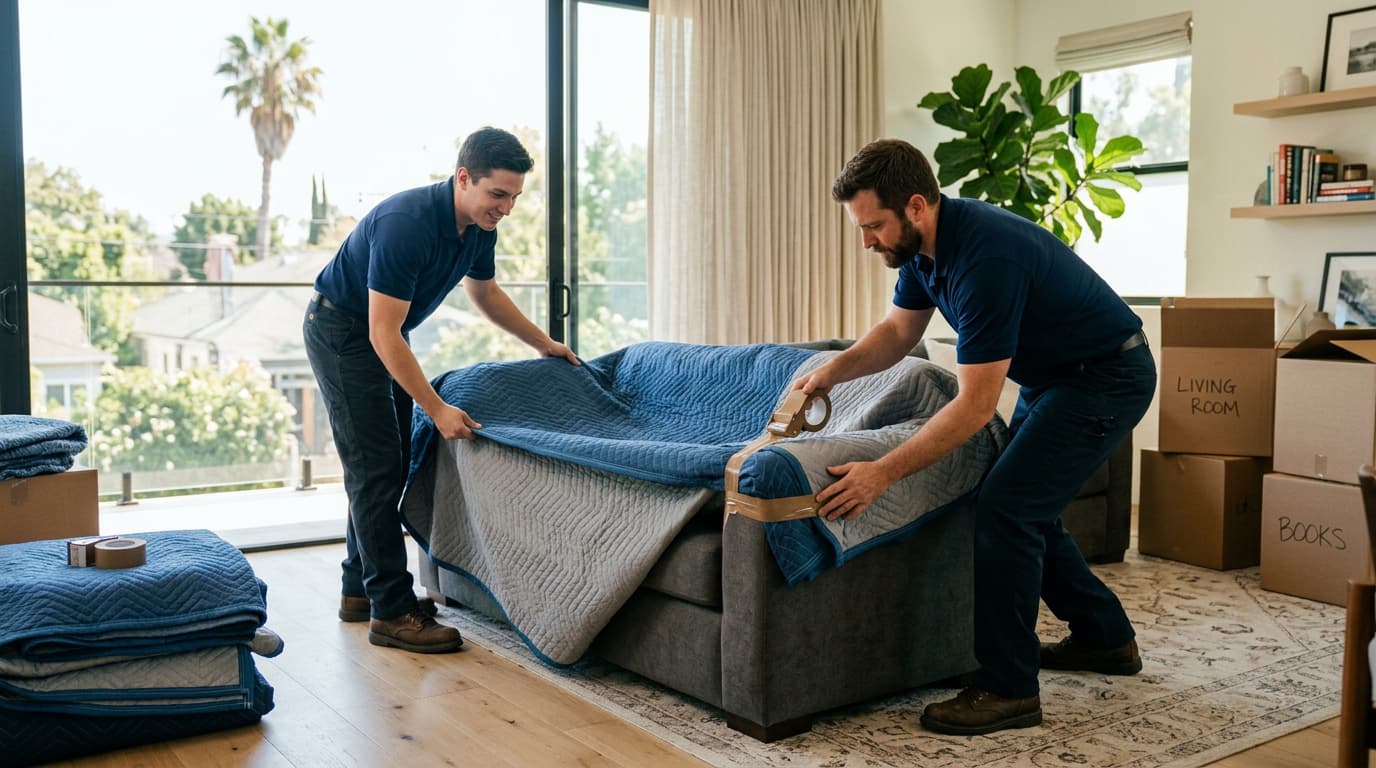
At SOS Moving, every job includes premium moving blankets, unlimited shrink wrap, heavy-duty packing tape, and wardrobe boxes at no additional cost. Furniture wrapping, disassembly, reassembly, TV unmounting, and furniture placement at your destination are all included in the hourly rate. There is no separate materials fee.
Franchise moving companies vary by location on what's included, and the variation can be significant. Some Two Men and a Truck locations include blankets but charge for tape and shrink wrap. Others include basic wrapping but charge extra for furniture disassembly or reassembly. Wardrobe boxes may be available for purchase at $12 to $15 each rather than included at no cost. TV unmounting may be listed as an additional service with its own fee.
The materials question sounds minor until you add it up. A move that requires four wardrobe boxes ($48 to $60 if purchased), two rolls of tape ($16 to $20), and a roll of shrink wrap ($15 to $20) adds $79 to $100 in materials on top of the higher hourly rate. Combined with the rate difference, the total premium for choosing a franchise over a local mover can easily exceed $200 to $400 on a standard two-bedroom move.
Ask every moving company — franchise or local — for a complete list of what's included in their hourly rate. A quote that looks competitive at the hourly level can be significantly more expensive when materials, fees, and surcharges are added to the final bill.
Flexibility and Personalization
Local moving companies have operational flexibility that franchise systems can't easily match, and that flexibility translates into better customer experience.
Scheduling with a local company means talking to someone who controls the schedule. At SOS Moving, booking changes, time adjustments, and last-minute modifications are handled by the same team that manages your move. A request to shift your start time from 8 AM to 10 AM gets resolved in a single phone call.
Franchise scheduling often routes through a centralized system or call center before reaching the local dispatch team. Changes that should take two minutes can take two days as the request moves through corporate software and local approval chains. During peak season, the gap between franchise responsiveness and local responsiveness becomes more pronounced.
Crew consistency is another local advantage. At SOS Moving, the crew assigned to your move works for us directly — not for a staffing agency, not as day laborers, not as temporary workers cycling through for the summer. You get professional movers who work together regularly, know each other's pace, and have experience with LA's specific challenges — tight apartment stairwells, permit-restricted streets, buildings with freight elevator requirements.
Franchise locations, especially during busy season, sometimes supplement their permanent crews with temporary workers to meet demand. The quality difference between a full-time crew that moves furniture daily and a temporary worker on their third day isn't subtle — it shows up in packing speed, furniture handling, and the ability to solve problems that arise during complex moves.
Custom service requests get handled more readily by local operations. Moving a piano? Need to coordinate with building management for a loading dock reservation? Want the crew to disassemble a custom wall unit that doesn't have standard hardware? Local companies adapt their service to your needs. Franchise operations adapt your needs to their service menu.
Looking for a better alternative to franchise pricing? SOS Moving delivers professional service at rates that don't include corporate royalties or national marketing fees. Call 909-443-0004 or get your free estimate to compare for yourself.
Reviews and Reputation
Brand recognition creates a trust shortcut that doesn't always reflect local reality. The national Two Men and a Truck brand has strong overall ratings, but your experience is determined by the specific franchise location serving Los Angeles — and that location's quality may differ significantly from the national average.
When evaluating any moving company — franchise or independent — focus on reviews specific to the location that will actually handle your move. A franchise with 4.8 stars nationally may have a 3.9-star LA location. An independent local mover with no national presence may have a 4.9-star rating built on thousands of LA-specific reviews.
SOS Moving carries a 4.9-star rating with over 1,000 Google reviews from Los Angeles customers. Every review reflects a move handled by our crews, in our trucks, using our materials, within the neighborhoods and buildings we know. The reviews aren't diluted by experiences at locations in other states — they represent exactly the service you'll receive.
Check the BBB for complaint history specific to the LA franchise location, not the national brand. Check Yelp, Google, and the CPUC license database for the specific company entity — the legal name of a franchise location differs from the parent brand, and complaints filed against the parent don't appear in the local entity's record.
The volume of reviews also matters. A company with 50 reviews and a 5.0 rating has a smaller sample size than a company with 1,000 reviews and a 4.9 rating. The larger sample provides more statistical confidence that the rating reflects consistent service rather than a handful of favorable experiences.
When a Franchise Might Make Sense
Honest analysis requires acknowledging that franchise movers serve certain customers well despite the pricing premium.
Interstate moves where you need coordination between two distant cities benefit from a national network. If you're moving from Chicago to LA and want a single company handling both ends, a franchise with locations in both cities provides end-to-end coordination that a local LA mover can't offer for the Chicago loading. However, many local movers — including SOS Moving — coordinate with partner companies in other cities to provide the same service without the franchise overhead.
Corporate relocations where the employer specifies an approved vendor list sometimes require using a franchise because the company has a national contract. If your employer's relocation package names Two Men and a Truck as the preferred provider, you may not have a choice — though it's worth asking HR whether local alternatives are permitted, especially if you can demonstrate cost savings.
People who prioritize brand familiarity over price comparison may prefer the comfort of a recognized name. There's nothing wrong with this preference — it simply comes with a cost premium that you should be aware of rather than paying unknowingly.
Frequently Asked Questions
Is Two Men and a Truck more expensive than local movers in LA? Generally yes. Franchise overhead — royalties, national marketing fees, corporate systems — adds to the cost structure, which is reflected in higher hourly rates. The premium over local movers like SOS Moving ranges from $20 to $60 per hour depending on the specific franchise location and service level.
Does SOS Moving offer the same services as Two Men and a Truck? Yes, and more. SOS Moving provides full-service local and interstate moving, packing and unpacking, furniture disassembly and reassembly, TV unmounting, storage, and white-glove specialty item handling. Materials including blankets, shrink wrap, tape, and wardrobe boxes are included at no extra cost.
How do I verify a local moving company's legitimacy? Check for a valid CPUC license at cpuc.ca.gov (California moves) and a USDOT number at safer.fmcsa.dot.gov (interstate moves). Verify insurance coverage by requesting a certificate. Read Google and Yelp reviews specific to the company. SOS Moving's CPUC license is CAL-T0192140 and our USDOT number is 3398018.
Can a local mover handle a long-distance move as well as a franchise? Yes. Local movers with interstate operating authority (USDOT number and MC number) are legally authorized and operationally equipped for long-distance moves. SOS Moving holds both and regularly coordinates moves across California and to other states. The USDOT requirements are the same regardless of company size.
Why are franchise movers more recognizable than local companies? National advertising. Franchise systems pool marketing dollars from hundreds of locations to fund TV commercials, billboard campaigns, and online advertising at a scale that no single local company can match. Recognition doesn't equal quality — it equals marketing budget.
Get Started with LA's Local Alternative
SOS Moving provides the same professional service level that national franchises promise — at rates that don't include franchise royalties, corporate fees, or national advertising surcharges. Our 4.9-star rating from over 1,000 LA customers reflects the real experience you'll receive on your moving day. Call 909-443-0004 or request your free estimate to see the difference that local expertise and honest pricing make.