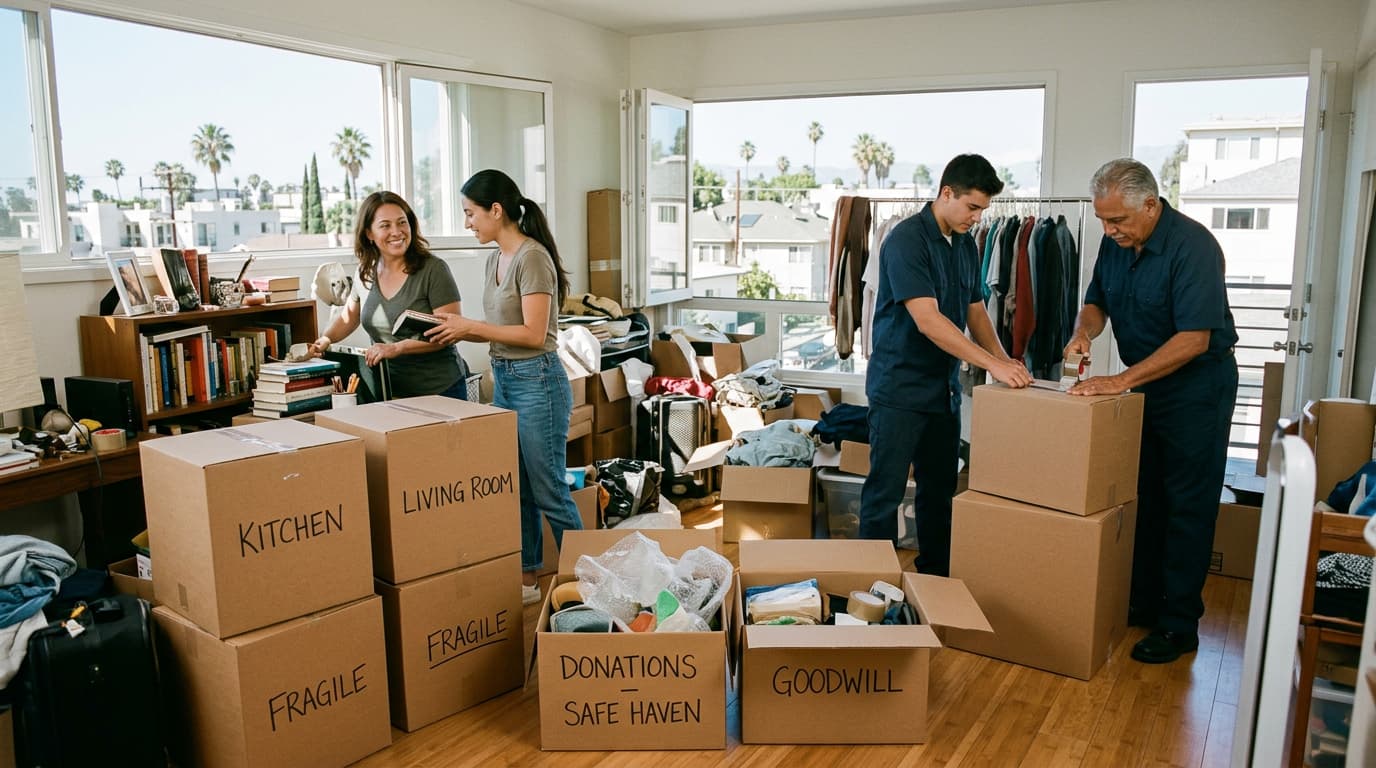


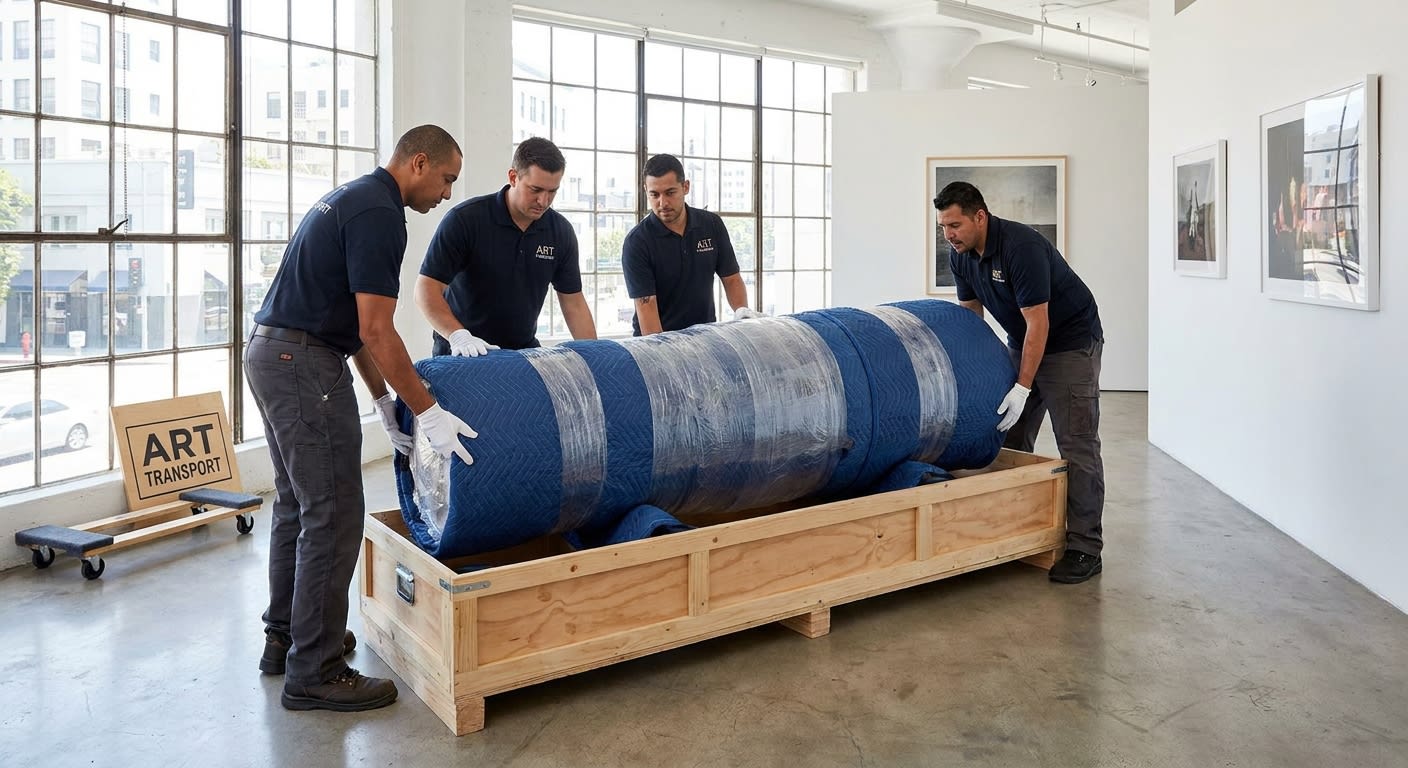
Three weeks ago, I got a call from a collector in Hancock Park who needed to move a 7-foot bronze sculpture by a contemporary LA artist from her living room to a new residence in Brentwood. The piece weighed 340 pounds, had extending arms that created a 4-foot wingspan, and the new home had a spiral staircase as the only entry point. By the time we finished planning the rigging, building a custom cradle, and coordinating the crane rental for exterior entry through a second-floor balcony, I'd spent more hours on logistics than most people spend planning a vacation. That's the reality of moving fine art Los Angeles collectors trust us with every week.
I'm Amir, a Senior Move Foreman at SOS Moving, and I've been handling specialty items—pianos, antiques, sculptures, and fine art—for the past six years across Los Angeles County. My crew and I have moved everything from museum pieces valued at six figures to emerging artists' works being transported to their first gallery show. The techniques I'm sharing here come from hands-on experience, including the mistakes I learned from early in my career.
Why Fine Art Requires Specialized Moving Techniques
I can't tell you how many times I've arrived at a job to find that a previous mover wrapped an oil painting in regular moving blankets and stacked framed pieces flat against each other. These aren't rookie mistakes—they're the result of treating art like furniture. Fine art responds to pressure, humidity, vibration, and temperature changes in ways that a sofa simply doesn't.
Oil paintings can take years to fully cure, and even older pieces retain a sensitivity to pressure that can cause cracking or paint transfer. Sculptures may have patinas that fingerprints can permanently damage. Glass pieces can shatter from vibration frequencies you wouldn't even notice during transit. When I'm moving fine art Los Angeles streets—with their potholes on Melrose, the speed bumps through residential Silver Lake, and the stop-and-go traffic on the 10—every element of the journey poses a potential risk.
The difference between general moving and art moving comes down to understanding materials at a molecular level. I've trained my crew to think about what happens to bronze when it heats up in an unventilated truck during an August move through the Valley. We consider how a canvas stretcher bar responds to the humidity difference between a climate-controlled Beverly Hills estate and a Downtown LA loft with no AC. This level of attention is why collectors specifically request crews with fine art experience.
Assessing Your Collection Before the Move
Before I touch anything, I conduct a thorough inventory and condition assessment. This isn't just for insurance purposes—though that matters—it's because I need to understand exactly what I'm dealing with to plan the right approach. Last month, I assessed a collection in Los Feliz that included a mixed-media piece with feathers, a kinetic sculpture with moving parts, and an encaustic painting that couldn't handle temperatures above 85 degrees. Each piece required a completely different strategy.
During my assessment, I document dimensions, weight estimates, material composition, and existing damage. I photograph pieces from multiple angles with a measuring tape in frame. For three-dimensional work, I sketch the base configuration and note any attachment points. I identify which pieces need custom crating versus museum-quality wrapping, and which items require climate-controlled transport.
I also evaluate the origin and destination spaces. That Hancock Park sculpture I mentioned? The assessment revealed that the homeowner's existing doorways were too narrow, and the staircase had a 90-degree turn that made interior transport impossible. Knowing this before moving day let us arrange the crane and coordinate with the building management in Brentwood weeks in advance. Surprises cost money and risk damage—assessment prevents both.
Crating Methods: Museum-Grade Protection
Custom crating is the gold standard for transporting valuable artwork, and I've built hundreds of crates in my career. The basic principle is simple: the artwork should float within the crate, suspended by materials that absorb shock without transferring pressure to the piece itself. The execution is anything but simple.
For framed paintings, I build crates using 3/4-inch plywood with internal battens that create an air gap between the artwork and the crate walls. The painting sits on padded blocks and is secured with foam strips that contact only the frame—never the canvas or glass. For pieces with glass, I apply painter's tape in an asterisk pattern to prevent shattering and contain fragments if breakage occurs. Temperature-sensitive pieces get additional insulation layers.
Sculptures require crates designed around their specific geometry. I've carved custom foam cradles for irregular shapes, built internal suspension systems for particularly fragile pieces, and designed crates with removable panels for pieces that can only be loaded from specific angles. One marble bust I moved last year required a crate with a false floor containing a foam nest that distributed the 180-pound weight evenly across the base. The crate alone took my team four hours to construct—but that bust arrived in Malibu without a scratch.
🎨 Moving valuable artwork or sculptures? Our white glove moving team specializes in fine art transport with custom crating and climate-controlled options. Call (909) 443-0004 or request a consultation.
Wrapping Techniques for Paintings and Framed Works
Not every piece needs a custom crate—some moves involve shorter distances or works that respond better to soft packing. But "soft" doesn't mean casual. My wrapping protocol for paintings involves multiple layers, each serving a specific purpose, and the sequence matters.
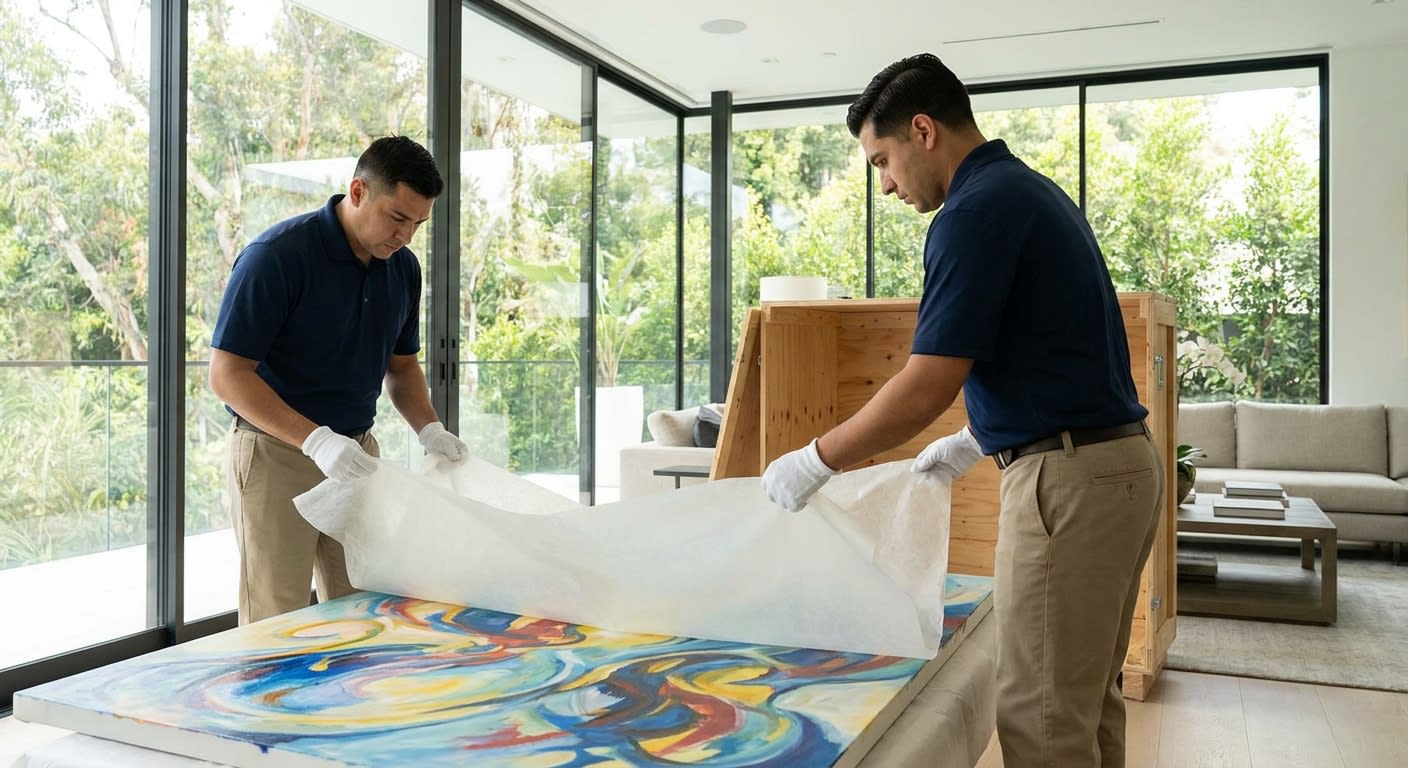
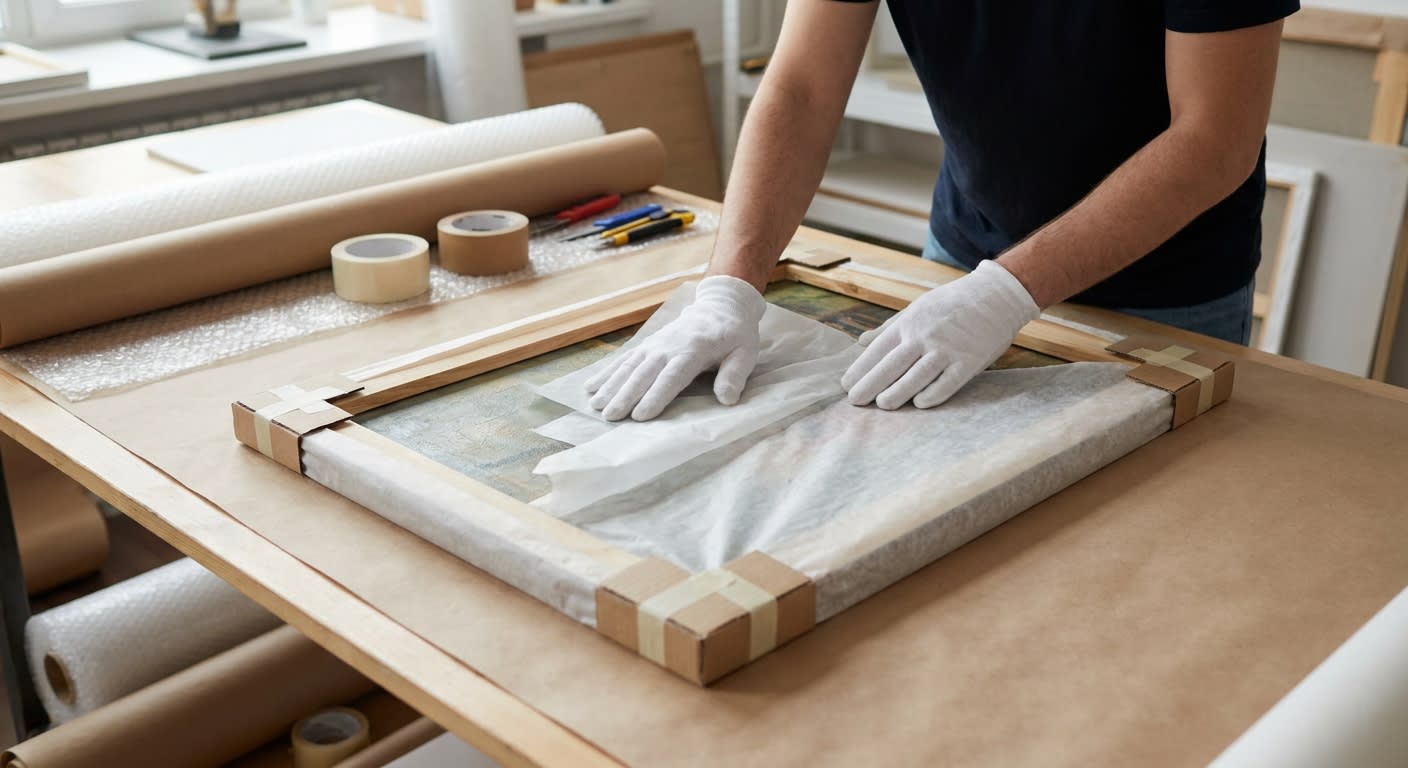
First, I apply glassine paper or acid-free tissue directly over the painted surface. This creates a barrier that prevents any other material from contacting the artwork. For oil paintings, I use silicone-release paper that won't stick to tacky surfaces. Next comes a layer of foam sheeting—usually 1/8-inch closed-cell polyethylene—wrapped around the entire piece and taped to itself, never to the frame. The third layer is corrugated cardboard corner protectors, custom-cut to fit the frame dimensions exactly.
The outer layer depends on the situation. For mirror boxes (telescoping cardboard containers designed for flat artwork), I'll add another foam sheet before sliding the piece in. For hand-carrying to a truck, I wrap in moving blankets secured with rubber bands—never tape on the blanket, which can slip and contact the piece. Every wrapped painting gets marked with "FRAGILE" and "THIS SIDE UP" orientation arrows.
My colleague William covers the general principles of protecting furniture during moves in his article about moving blankets, but art requires materials beyond standard blankets—acid-free papers, archival tapes, and foam densities rated for weight distribution rather than just cushioning.
Handling Three-Dimensional Sculptures
Sculptures present challenges that two-dimensional work doesn't: weight distribution, multiple contact points, center of gravity issues, and components that extend in unexpected directions. I've moved bronze figures, marble busts, ceramic installations, welded steel abstracts, and glass pieces that made me hold my breath the entire time.
The first rule is understanding where the piece can and cannot be touched. Bronze sculptures often have areas where the patina is delicate—I look for wear patterns that indicate previous handling points. Stone sculptures may have veining or micro-fractures that make certain areas load-bearing risks. Glass pieces might have attachment points that are stronger than they look, but I always assume the worst.
For moving, I create a lifting plan before anyone touches the piece. This includes identifying grip points, assigning team positions, planning the path of travel, and establishing commands. Heavy sculptures require coordinated lifts where my crew moves as a single unit—one person calls the lift, the shifts, and the set-down. We practice the lift before actually moving the piece to ensure everyone understands their role.
Transportation for sculptures often involves custom rigging. I've used furniture dollies with added padding, hand trucks modified with soft straps, and for the heaviest pieces, mechanical lifts. That 340-pound bronze I mentioned earlier? We built a plywood pallet with recessed cradle, wrapped the entire piece in foam, and used a pallet jack to move it to the loading position. From there, the crane operator took over while I guided the piece through the balcony opening.
Climate Control During Los Angeles Transport
Los Angeles might seem like an easy climate for art transport—no extreme cold, no snow—but the reality is more complicated. Summer temperatures can hit 100+ degrees in the Valley, and an unventilated truck sitting in traffic on the 405 becomes an oven. I've measured temperatures of 140 degrees inside standard moving trucks during August moves. That's hot enough to warp wood, melt certain waxes, and cause paint layers to separate.
For temperature-sensitive pieces, I only use climate-controlled trucks—refrigerated vehicles that maintain a consistent 68-72 degrees regardless of external conditions. These trucks cost more, but for art valued at tens of thousands of dollars, the premium is minimal compared to the risk. I schedule summer moves for early morning whenever possible, completing loading before 10 AM and unloading before the afternoon heat peaks.
Humidity is the other factor people forget. Moving a piece from an air-conditioned gallery to an outdoor loading dock introduces moisture that can affect canvases, cause metal to oxidize, and lead to mold growth on organic materials. I maintain humidity-controlled environments during packing and minimize transition times. For pieces requiring precise conditions, I use portable data loggers that record temperature and humidity throughout the move—documentation that's sometimes required for insurance purposes or when working with institutional clients.
Insurance and Valuation for Art Transport
Standard moving insurance—the basic $.60 per pound coverage that comes with most moves—is meaningless for fine art. A painting might weigh two pounds but be worth $50,000. At standard coverage, you'd receive $1.20 if it was destroyed. That's why anyone moving valuable art needs to understand their insurance options before the truck rolls.
Full value protection is the minimum I recommend, where the mover is liable for the current market value of damaged items. But even this has limits—most moving companies cap their total liability, and high-value art can exceed these caps quickly. For collections worth more than $50,000, I advise clients to purchase fine art floater policies through their insurance broker, which cover the pieces during transit, loading, and unloading.
My colleague Sarah has written extensively about moving insurance versus homeowners coverage, and her breakdown of valuation tiers applies directly to art transport. The key takeaway: document everything before the move, have pieces appraised recently, and ensure your policy specifically covers "transit" and not just "in residence" scenarios. I've seen claims denied because the policy had a transit exclusion the owner didn't know about.
Working with Galleries and Institutional Clients
About 30% of my fine art moves involve galleries, museums, or corporate collections rather than private residences. These clients have specific requirements that go beyond what most collectors need: condition reports signed at pickup and delivery, chain-of-custody documentation, specific crating standards that meet international shipping specifications, and sometimes escort vehicles or security personnel.
When I'm moving fine art Los Angeles galleries trust us with, I follow protocols that match their internal standards. This means white cotton gloves at all times—no exceptions—and crate opening in controlled environments rather than on loading docks. It means photographers present during packing to document the process, and condition report sign-offs from gallery staff before any piece leaves their premises.
I've moved pieces for shows between galleries in Culver City and institutions in Santa Monica, handled temporary loans from private collections to museum exhibitions at The Broad, and transported installation components for artists working with galleries in the Arts District. Each situation requires understanding not just the physical handling, but the procedural requirements that protect everyone involved from disputes later.
Common Mistakes I See When People Move Art Themselves
I get calls every month from people who tried to move art themselves and now need professional help for the next phase—or worse, need restoration referrals because something went wrong. Here are the mistakes I see most often, so you can avoid them.
Using newspaper as packing material is the classic error. The ink transfers to surfaces, and I've seen valuable prints permanently damaged by newsprint contact. Bubble wrap directly against painted surfaces is another one—the texture can imprint on uncured paint, and the plastic can chemically react with certain pigments. Always have a barrier layer between bubble wrap and artwork.
Laying paintings flat for transport seems logical but causes problems. Flat storage puts pressure on the canvas from its own weight, and in a moving truck, it means other items could potentially land on top. Paintings should travel vertically, like records in a crate, with padding between each piece. Sculptures shouldn't touch each other during transport—even wrapped pieces can shift and cause damage at contact points.
The worst mistake is underestimating weight. That metal sculpture might be hollow, or it might be solid—and the difference could mean 50 pounds versus 300 pounds. I've seen people try to lift pieces that required four movers, resulting in dropped artwork and personal injuries. Always err on the side of caution and get help.
Planning Your Fine Art Move: Timeline and Checklist
A successful art move starts weeks before moving day, not the night before. Here's the timeline I recommend for any significant art collection:
Four weeks out: Complete inventory and condition documentation. Contact your insurance provider about transit coverage. Get appraisals updated for any pieces that haven't been valued in the past two years. Identify pieces requiring custom crating and get crate construction scheduled.
Two weeks out: Finalize moving date and confirm climate-controlled truck availability if needed. Arrange for any specialty equipment—cranes, rigging, forklifts—that the assessment identified. Confirm access at both locations, including elevator reservations, parking permits for trucks, and building management notification.
One week out: Complete all custom crating. Verify insurance documentation is in order. Do a walkthrough at the destination to confirm exactly where each piece will be placed. Prepare condition report forms for signing at both pickup and delivery.
Moving day: Begin early, especially in summer. Have all packing materials staged and ready. Complete condition reports before wrapping begins. Maintain climate control throughout the process. Don't rush—art moves take longer than standard moves, and that's intentional.
FAQ
How much does it cost to move fine art in Los Angeles?
Art moving costs depend heavily on piece size, value, and requirements. A simple soft-pack and transport of a few framed works might run $200-$400, while custom crating for a major sculpture can cost $800-$2,000 for the crate alone, plus transport. My best advice is to get an in-person assessment—photos rarely tell the full story, and accurate quotes require seeing pieces in their actual environment.
Do I need special insurance for moving valuable artwork?
Yes, absolutely. Standard moving coverage is based on weight, not value, making it essentially worthless for art. You'll want either full value protection from your mover with a declared value for each piece, or a fine art floater policy from your insurance carrier. For collections over $50,000, a dedicated fine art policy is strongly recommended.
Can I use regular moving boxes for framed prints?
I don't recommend it. Regular boxes aren't designed for the weight distribution of framed pieces and don't provide adequate corner protection. Mirror boxes (telescope boxes designed for flat items) are the minimum, and even those require proper internal padding. For valuable prints, custom crating offers the best protection.
How do you move sculpture with extending parts?
Extending elements require custom solutions—either detachment if the piece was designed to disassemble, or custom cradles that support the extensions without putting stress on attachment points. I've built crates with internal arms that mirror a sculpture's extensions, holding each component in its exact position during transport.
What temperature should artwork be kept at during a move?
Most art professionals recommend maintaining 68-72 degrees Fahrenheit with 45-55% relative humidity during transport. Climate-controlled trucks can maintain these conditions regardless of external weather. For particularly sensitive pieces, I use data loggers to document conditions throughout the move.
How long does a fine art move typically take?
Significantly longer than standard moves. Proper wrapping of a single large painting can take 20-30 minutes. Custom crating for a sculpture might require an entire day. For a modest collection of 10-15 pieces, expect the packing alone to take 4-6 hours, plus transport and careful installation at the destination.
Ready to move your art collection safely? SOS Moving serves Los Angeles, Orange County, and San Francisco Bay Area with licensed & insured full-service moving and storage, from $119/hour. Call (909) 443-0004, email info@sosmovingla.net, or get your free consultation today.