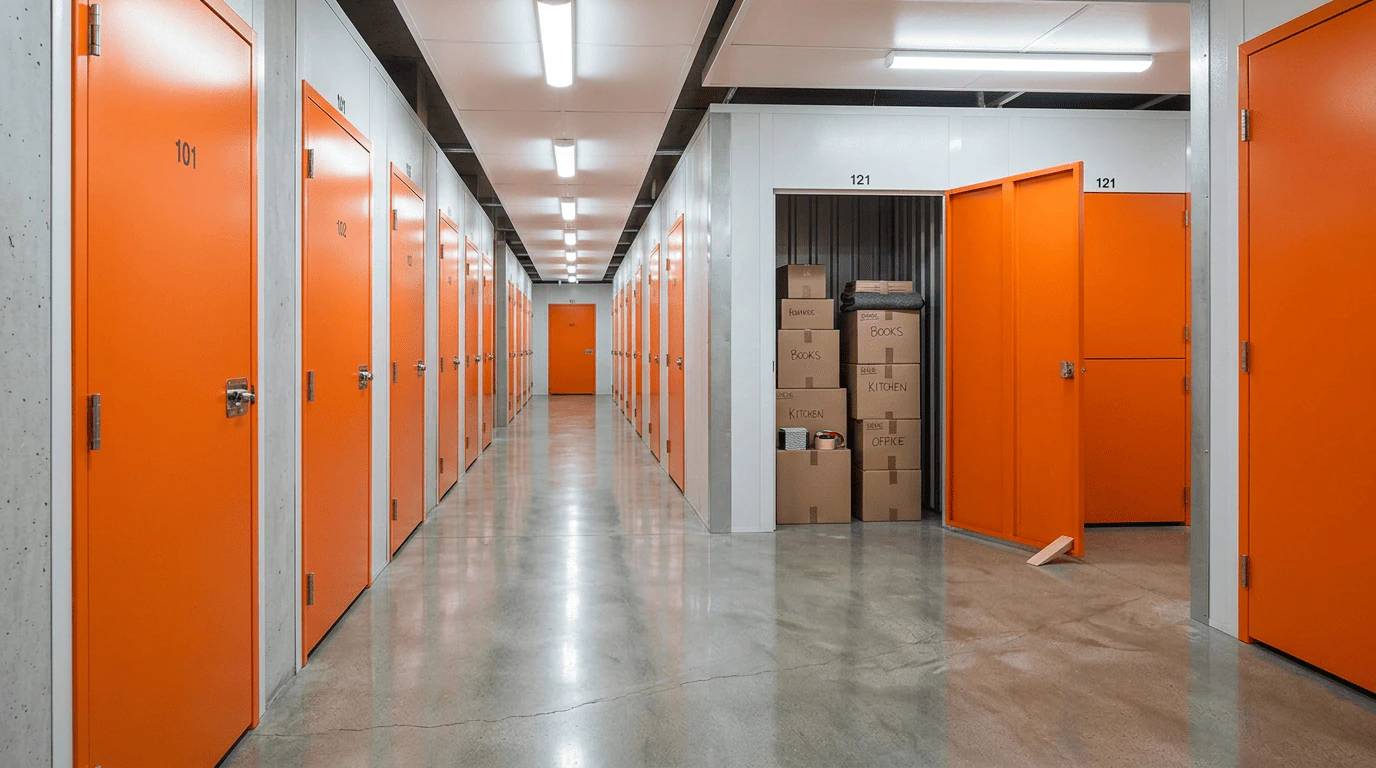



The search for "small storage units near me" in Los Angeles returns hundreds of results — and almost all of them assume you want the same thing: a box in a building where you stack your stuff and pay monthly until you need it back. For some situations that's exactly right. But for a growing number of movers in LA, consolidation services offer an alternative that eliminates the storage unit entirely by reducing what you're storing, reorganizing what you're keeping, and integrating the storage step into the moving process itself rather than treating it as a separate project.
At SOS Moving, customers regularly ask whether they should rent a storage unit or use a service that helps them downsize and consolidate before the move. The answer depends on how long you need storage, how much you're actually keeping, and whether the items sitting in a unit are worth more than the monthly rent you're paying to store them.
What Small Storage Units Actually Cost in LA
Small storage units — typically 5x5 feet or smaller — are the entry-level option in the self-storage market. They're marketed as affordable solutions for people who need just a little extra space, but the real cost goes beyond the monthly rate.
A 5x5 unit in Los Angeles rents for $50 to $100 per month depending on location and whether it's climate controlled. Coastal areas like Santa Monica and Marina del Rey push toward the higher end. Inland areas and the Valley offer rates at the lower end of the range.
But the monthly rate is just the starting point. Most facilities charge an administrative or setup fee of $15 to $30 when you open the account. Mandatory insurance through the facility — if your renter's insurance doesn't cover off-premises storage — adds $10 to $25 per month. Late payment fees, lock purchase requirements, and taxes push the effective monthly cost of a $70 unit to $85 to $110.
The hidden cost most people overlook is time. Every visit to your storage unit — to drop off items, retrieve something, reorganize, or check on conditions — costs you a trip. In LA traffic, a storage facility twenty minutes away means forty minutes of round-trip drive time per visit. If you visit twice a month over six months, you've spent eight hours just driving to and from a box full of things you might not even need.
The accumulation trap is real. A $70 per month unit feels inconsequential in any given month, but over twelve months it's $840. Over two years — the average duration people keep a small storage unit — the total reaches $1,680. At that point you need to honestly evaluate whether the items inside are worth $1,680, because that's what you've paid for the privilege of not deciding what to do with them.
What Consolidation Services Offer
Consolidation services take a fundamentally different approach to the "I have too much stuff" problem. Instead of adding space to accommodate everything, they help you reduce, reorganize, and optimize what you have so that external storage becomes unnecessary — or at minimum, smaller and shorter-term.
Professional organizers who specialize in moving transitions work with you to categorize belongings into keep, donate, sell, and discard groups. The process is similar to estate sorting but framed around your current lifestyle rather than someone else's. The organizer helps you make faster decisions by asking practical questions: have you used this in the past year? Does it fit your new space? Would you buy it again today? These questions cut through the emotional attachment that keeps people paying $70 per month to store a treadmill they haven't touched since 2023.
Some consolidation services are offered by moving companies as part of a full-service move package. The crew arrives, helps you sort, packs what you're keeping, and hauls away donations and discards in the same trip. This integrated approach eliminates the storage step entirely for many clients — everything either goes to the new home, to a donation center, or to disposal.
The donation logistics alone justify the service for many people. Scheduling Goodwill or Salvation Army pickups in LA can take two to three weeks. Hauling items to a donation center yourself requires a truck or SUV and several trips for a household's worth of furniture and goods. A consolidation service handles removal and donation routing as part of the process, saving you the logistical headache.
For items with resale value — furniture, electronics, sporting equipment, designer clothing — some services include consignment coordination. They photograph items, list them on appropriate platforms, and handle the sale. The proceeds offset the service cost, and items that don't sell within a set period are donated. This turns dead storage into recovered cash.
When a Storage Unit Is the Right Choice
Storage units earn their rent in specific situations where consolidation doesn't solve the underlying problem.
Temporary gaps between housing are the most legitimate use case. Your old lease ends on the 30th, your new apartment isn't available until the 15th, and you need somewhere to keep everything for two weeks. A small storage locker or a short-term hold with your moving company bridges the gap at a fraction of the cost of alternative arrangements like extended hotel stays or temporary furnished apartments.
Seasonal storage for items you genuinely use cyclically makes financial sense if the alternative is a larger, more expensive apartment. Surfboards, ski equipment, holiday decorations, and off-season wardrobes take up closet space that costs $200 to $400 per month in LA rent premiums for a larger unit. If a $70 storage unit lets you comfortably live in a $2,400 one-bedroom instead of needing a $2,800 one-bedroom, the storage unit pays for itself.
Renovation or remodeling projects that require temporarily emptying rooms need storage that consolidation can't replace. You're not getting rid of the furniture — you're parking it for three months while your floors are refinished or your kitchen is rebuilt. A storage unit sized to the displaced items and rented for the project duration is the practical solution.
Long-term storage of genuinely valuable items that don't fit your current lifestyle but will fit your future plans — inherited furniture you'll use when you buy a house, a child's belongings while they're away at college, business inventory between seasons — represents legitimate storage need where the monthly cost is an investment rather than an avoidance mechanism.
When Consolidation Is the Better Answer
Consolidation replaces storage when the underlying problem isn't insufficient space — it's excess stuff.
Downsizing moves are the primary use case. Moving from a two-bedroom to a one-bedroom, or from a house to an apartment, forces a reduction in belongings that a storage unit merely delays. The divorce moving scenario where a shared household splits into two smaller ones is a classic example — renting a storage unit for the overflow from a household that needs to shrink just postpones the sorting process while adding monthly cost.
Post-move storage that extends beyond three months is a signal that consolidation would have been better. If items have been in a storage unit for six months and you haven't needed them, the probability that you'll need them in month seven is low. The cost-effective decision is to sort, donate what you won't use, sell what has value, and close the storage account. Consolidation services facilitate this decision-making process that most people avoid because it feels overwhelming to do alone.
Moving to a furnished apartment or corporate housing means most of your furniture becomes redundant for the duration. Rather than storing everything at $150 to $300 per month, consolidating — selling furniture you'd replace anyway, storing only the items with genuine sentimental or irreplaceable value — dramatically reduces both the unit size and the monthly cost.
The psychological component matters. Storage units become repositories for deferred decisions. Every item inside represents a choice that was too hard to make during the move, so you paid to postpone it. Consolidation forces those decisions in a structured, supported environment — and most people discover that making the decision feels better than indefinitely avoiding it.

Not sure if you need storage or just need to downsize? SOS Moving helps clients sort, consolidate, and move in a single coordinated process. We'll tell you honestly whether you need a unit or whether a smarter packing strategy eliminates the need entirely. Call 909-443-0004 or get your free estimate.
Cost Comparison: Storage vs Consolidation
The numbers make the case clearly when you compare total costs over realistic timeframes.
A small storage unit for twelve months: $70 per month base rate plus $15 insurance plus taxes equals roughly $1,020 to $1,200 per year. Add two moving sessions — one to load the unit, one to unload it later — at $357 to $476 each (three to four hours at SOS Moving's weekday rate of $119/hour). Total twelve-month cost: $1,734 to $2,152.
A consolidation service integrated into your move: professional organizer session at $300 to $600, donation hauling included in the moving service, and the move itself without the separate storage loading and unloading sessions. Total cost: $300 to $600 above the base moving cost, with no ongoing monthly payments.
The break-even point is roughly three to four months. If you'd use the storage unit for less than four months, the unit is cheaper. Beyond four months, consolidation plus a smaller or no unit costs less — and you get your belongings resolved rather than deferred.
For people who rent a unit "temporarily" and keep it for two years — which is the industry average — the storage-only approach costs $3,468 to $4,304 versus $300 to $600 for consolidation. The financial case is overwhelming once you acknowledge that "temporary" storage rarely stays temporary.
How to Decide
A simple decision framework helps you choose the right approach for your situation.
Ask yourself three questions. First: will I need these specific items within the next three months? If yes, a storage unit for the defined period makes sense. If no, consolidation is likely the better path.
Second: if this storage unit burned down tomorrow, which items would I replace with my own money? The items you'd repurchase are worth storing. The items you'd shrug off losing are costing you money to avoid a decision. Be honest — most people discover that 60 to 70 percent of their storage unit contents fall into the "wouldn't replace" category.
Third: is the storage solving a timing problem or a volume problem? Timing problems — lease gaps, renovations, temporary relocations — have end dates and storage is the right tool. Volume problems — too much stuff for your space — don't have end dates and storage is an expensive postponement of the real solution.
At SOS Moving, we discuss these questions with every client who mentions storage during the booking process. Sometimes the answer is a storage unit. Sometimes it's a different packing strategy that makes everything fit. Sometimes it's a consolidation conversation that saves the client $1,000 or more over the following year. The right answer depends on your situation, not on which service generates more revenue for us.
Frequently Asked Questions
How small is the smallest storage unit available in LA? Most facilities offer 5x5 units (25 square feet) as their smallest option. Some offer locker-sized units as small as 3x3 or 4x4 feet. A 5x5 unit holds roughly fifteen to twenty boxes and a few small furniture pieces.
What is a consolidation service for moving? A consolidation service helps you reduce, sort, and reorganize belongings before or during a move so you need less storage or no storage at all. It typically includes professional organizing, donation coordination, and integration with the moving process.
How long do people typically keep storage units? The industry average is approximately two years. Many people rent a unit intending to keep it for a month or two and end up paying for years because the contents never become urgent enough to sort through.
Can my moving company help me decide if I need storage? Yes. At SOS Moving, we evaluate your inventory and new space dimensions to advise whether storage is necessary or whether a consolidation strategy eliminates the need. Our goal is the right solution, not the most expensive one.
Is it worth paying for a professional organizer before a move? For moves involving downsizing, divorce, or any situation where you're moving to a smaller space, a professional organizer typically saves more in avoided storage costs than their fee. A $400 organizer session that eliminates a $70/month storage unit pays for itself in six months.
Get Started with the Right Storage Strategy
SOS Moving helps you figure out the storage question before your move, not after. Whether you need a short-term unit, a full consolidation, or just a smarter packing plan that makes everything fit, we'll give you an honest recommendation based on your specific situation. Call 909-443-0004 or request your free estimate to start the conversation.