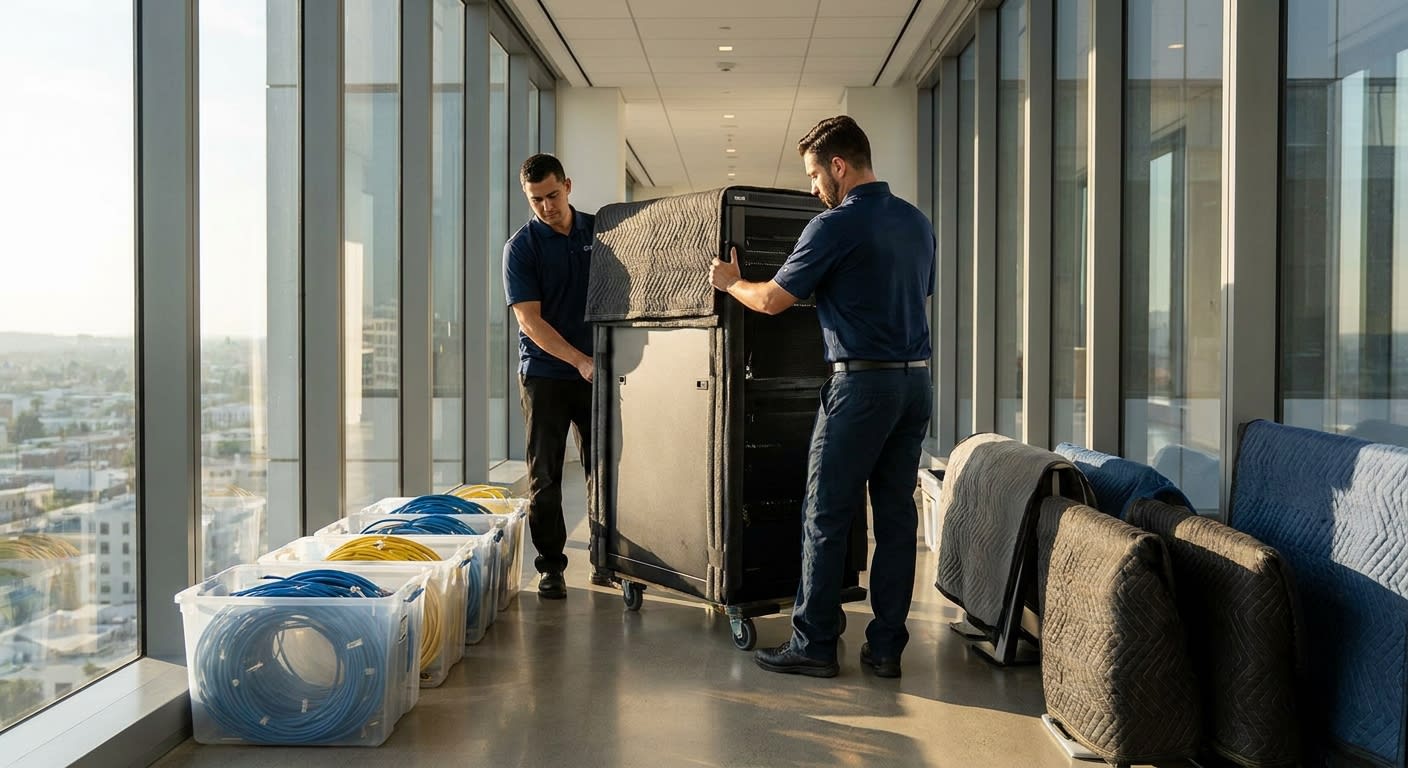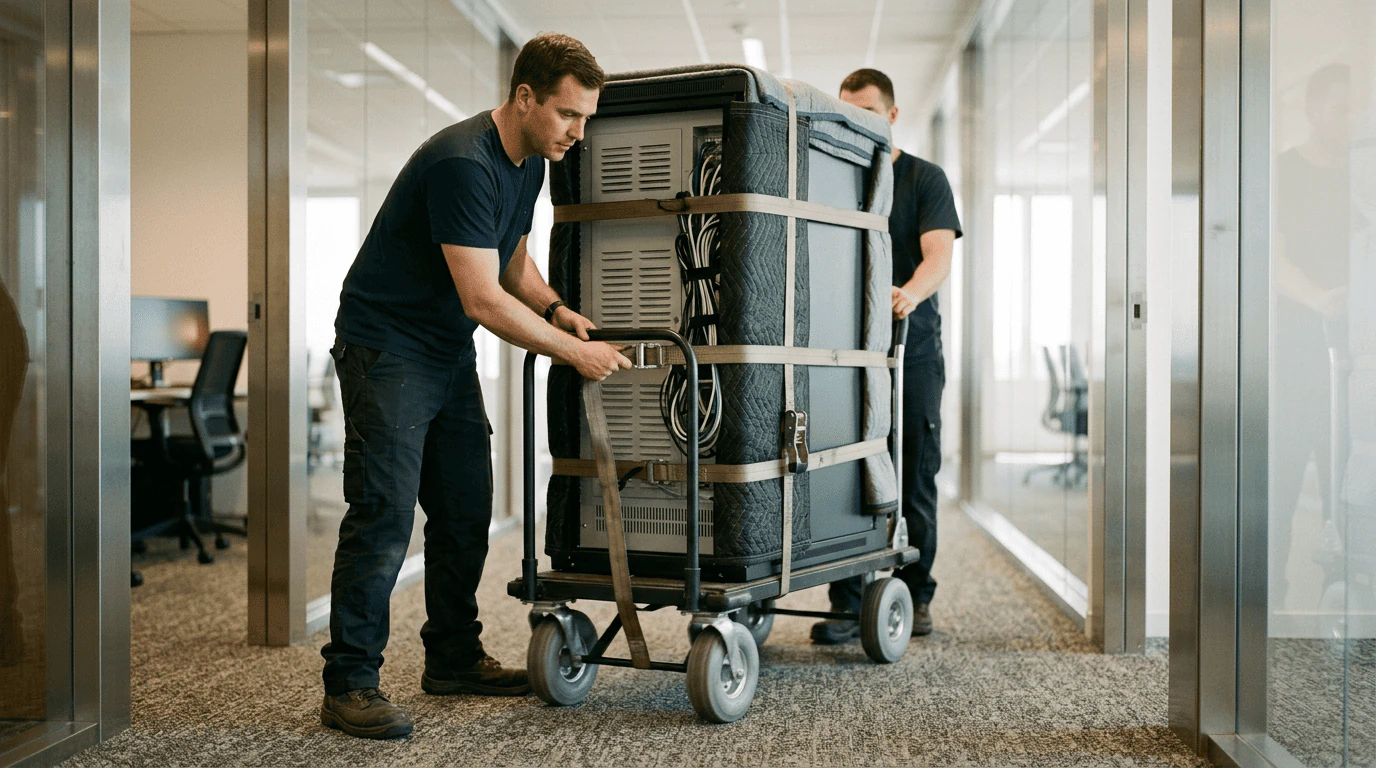



Three weeks ago, I coordinated the relocation of a 45-person marketing agency from their cramped space on Wilshire Boulevard to a newly renovated building in El Segundo — right in the middle of July, our busiest month of the year. The CEO called me in a panic because their lease was up August 1st with zero flexibility. We had exactly 52 hours over a single weekend to move 47 workstations, a full server room, and a recording studio. I've run this exact scenario dozens of times, and I can tell you that business relocation timing strategy isn't about avoiding peak season — it's about knowing how to navigate it.
I'm William, the Operations Manager at SOS Moving, and over the past five years I've planned and executed over 800 commercial relocations across Los Angeles, Orange County, and the Bay Area. I've moved law firms on holiday weekends, relocated entire tech startups during product launches, and helped medical practices transition without missing a single patient appointment. When it comes to business relocation during peak season, timing isn't just important — it's everything.
Understanding Peak Season in Commercial Moving
Let me give you the real numbers from my dispatch logs. Peak season for commercial moving in Southern California runs from May through September, with absolute chaos hitting in June and July. During these months, I see a 65% increase in relocation requests compared to winter months. In 2026, we're tracking even higher demand because of the wave of lease expirations that were signed during the 2021 commercial real estate boom.
Here's what most business owners don't realize: commercial and residential moving compete for the same resources. My crews, my trucks, my equipment — everything gets stretched thin when residential customers are flooding us with apartment moves, family relocations, and house purchases. A 26-foot truck that's perfect for your 3,000 square foot office is also ideal for a 4-bedroom house in Pasadena.
The key difference is flexibility. Residential customers can usually shift their move date by a few days if needed. But when you've got a lease ending, employees expecting to work Monday morning, and clients scheduled for meetings — you don't have that luxury. That's why your business relocation timing strategy needs to account for resource scarcity before anything else.
I track crew availability on a 60-day rolling forecast. Right now, for August 2026, I've already got 78% of my weekend slots booked for commercial work. If you're thinking about relocating your business during peak season, you need to be talking to a moving company at minimum 6-8 weeks out, ideally 10-12 weeks for larger operations.
The Weekend Window: Your Best Strategic Option
Every business owner I talk to asks the same question: "Can you move us without shutting down?" In most cases, the answer is yes — but only if we use the weekend window correctly. I've developed a timing framework based on running hundreds of these moves, and it breaks down like this.
Friday close of business to Monday morning at 7 AM gives you roughly 62 hours. That sounds like a lot until you factor in elevator access restrictions, building security protocols, and the simple reality that my crew needs to sleep. For a typical 5,000 square foot office with 25-30 workstations, I budget the operation across those 62 hours:
Friday 6 PM - 11 PM: Disconnect and pack all technology, wrap furniture, load non-essential items. Saturday 7 AM - 8 PM: Primary move of all furniture, equipment, and boxed items. Sunday 7 AM - 6 PM: Unload, position furniture, reconnect technology, test systems. Sunday 6 PM - Monday 6 AM: Buffer time for IT troubleshooting and final adjustments.
This schedule has about 85% success rate for Monday morning operations. The other 15% usually involves IT complications that have nothing to do with the physical move — server configurations, network switches, phone systems that need carrier involvement.
Booking Strategy: When to Secure Your Date
I'm going to share the exact booking strategy I recommend to every business client, especially during peak season. This is based on what I see in my scheduling system and what actually gets results.
For moves under 5,000 square feet, book 8 weeks in advance during peak season. For moves between 5,000-15,000 square feet, book 10-12 weeks out. For anything larger, you need 16+ weeks lead time, and honestly, you should be talking to me before you even sign the new lease.
Here's the insider timing hack: if you have any flexibility at all, target the first or last weekend of the month. Mid-month weekends during summer are when residential moves pile up — that's when families with kids want to move so they're settled before school activities ramp up. First weekend of the month? Most residential leases start on the 1st or 15th, so people are moving then. Last weekend? Everyone's scrambling to get out before their lease ends.
But commercial clients who can move on the second or third weekend of any month during peak season get better crew availability and often better rates. I had a client last month who shifted from July 19-20 to July 12-13, and I was able to assign my most experienced commercial crew instead of pulling from the general pool.
Crew Sizing for Peak Season Efficiency
During off-season, I might send a 4-person crew to handle a 30-workstation office over a relaxed two-day schedule. During peak season, that same job gets an 8-person crew and a single 14-hour push. The math works out better for everyone — you get your space operational faster, and I free up resources for other jobs.

📦 Need help planning your business relocation? Our commercial moving team specializes in weekend office transitions with minimal downtime. Call (909) 443-0004 or request your free estimate.
Let me walk you through how I calculate crew requirements for peak season commercial moves. The baseline formula I use: one mover per 400-500 square feet of office space for a single-day move, or one mover per 800-1,000 square feet for a two-day move. But that's just the starting point.
Factors that increase crew size: elevator-only buildings (add 2 people minimum for staging), server rooms or data centers (add 2 specialized movers), executive furniture or custom millwork (add 1-2 white glove specialists), tight delivery windows (add enough crew to run parallel operations).
For that El Segundo job I mentioned at the start? I ran an 11-person crew. Four on the truck at origin, four on the truck at destination, two floating between locations, and one dedicated to IT equipment handling. We finished Sunday at 4 PM, giving the client's IT team 14 hours of buffer before Monday morning.
Building Coordination: The Hidden Time Killer
I've seen perfectly planned business relocations fall apart because someone forgot to coordinate with building management. During peak season, this becomes critical because property managers are juggling multiple move-ins and move-outs.
Here's my building coordination checklist that I run through with every commercial client at least three weeks before move day. First, elevator reservations — get them in writing with specific time blocks. Most LA high-rises require 48-72 hours notice for freight elevator reservations, but during summer months, I've seen buildings require two weeks. Second, loading dock scheduling — if you're in a multi-tenant building, you might be competing with other businesses moving the same weekend. Third, COI requirements — certificate of insurance. Every building has different requirements, and some take 5-7 business days to process through their management company.
Fourth, and this is one people forget: the destination building. You need all the same coordination at your new location. I had a move last summer where the origin building was perfectly prepped, but the new building's freight elevator was down for maintenance that weekend. We had to hand-carry everything up seven flights of stairs. Added 9 hours to the job.
As I detailed in our guide to weekend office relocation, building logistics often determine success more than the actual moving process.
Technology Disconnection and Reconnection Timing
The number one cause of Monday morning chaos isn't the furniture being in the wrong place — it's the technology not working. I've developed a technology timing protocol that I share with every business client, especially those with complex IT setups.
Your IT team or contractor needs to start disconnection no later than 4 PM Friday. Not 5 PM when everyone leaves. Not 6 PM when the building "quiets down." Four o'clock, full stop. Here's why: in a 30-workstation office, proper cable labeling, photography documentation, and systematic disconnection takes 3-4 hours. If they start at 5 PM, they're finishing at 9 PM, exhausted, and my crew has been standing around for hours burning your budget.
At the destination, I always recommend having IT arrive at least 2 hours before my trucks. They need to verify that internet service is active (you'd be shocked how often it isn't), confirm electrical circuits are labeled, and set up a staging area for equipment testing.
The reconnection phase is where timing gets tricky. For every 10 workstations, budget 30-45 minutes of IT reconnection time after furniture is placed. That's just basic setup — monitors, docking stations, phones. Server rooms and specialized equipment add hours to this timeline. My advice: build in a full Sunday evening for IT work, even if you think you won't need it.
The Phased Relocation Alternative
Not every business can afford a full weekend shutdown, even 62 hours. For those clients, I've developed a phased relocation approach that spreads the move across 2-3 weekends. This works particularly well during peak season when single-weekend availability is tight.
Here's how phased relocation typically breaks down. Weekend one: non-essential items, archived files, stored equipment, break room contents, decorative items. Your office looks a bit bare, but everyone can work normally Monday through Friday. Weekend two: half the workstations — usually one department or floor at a time. Those employees work remotely Friday and Monday. Weekend three: remaining workstations and final items.
I ran a phased move for a law firm in Century City earlier this year. They couldn't have any downtime during an active trial, so we moved half the office each weekend over three weeks. The partners who were actively working the case stayed at the old location until the trial wrapped, then we did a final push for their offices. Total timeline: 22 days from first truck to final box unpacked.
Phased moves cost about 15-20% more than single-weekend moves because of repeated mobilization, multiple building access fees, and extended project management. But for some businesses, that premium is worth it to maintain continuous operations.
Peak Season Pricing Realities
I'm going to be straight with you about pricing during peak season, because I think transparency helps everyone make better decisions. Our rates at SOS Moving start from $119/hour for residential work, but commercial moves during peak season typically fall into flat-rate project pricing based on scope.
During June, July, and August, you can expect commercial moving rates to run 15-25% higher than off-season pricing. This isn't price gouging — it's basic supply and demand. My crews are working overtime, I'm bringing in additional trucks from partner carriers, and the logistics complexity increases significantly when every moving company in LA is running at capacity.
However, here's where smart business relocation timing strategy can save you money: if you can move during the last week of September or first week of October, you'll often get peak-season availability (because everyone else waited too long to book) with off-season pricing. I call it the "shoulder season sweet spot."
For a deeper look at what impacts costs, my colleague covers this thoroughly in the article on minimizing business downtime during office moves.
Holiday Weekend Strategy
Memorial Day, Fourth of July, and Labor Day weekends give you an extra day, which sounds great until you realize everyone else has the same idea. Here's my honest take on holiday weekends for business relocation.
Labor Day weekend (early September) is actually your best bet. It's technically still peak season, but residential moving has slowed because school has started. You get three days, crews are available, and you're moving into the start of Q4 when most businesses want to be settled.
Fourth of July weekend is tricky. Many building managers take vacation, security staffing is thin, and if anything goes wrong, you're dealing with skeleton crews everywhere. I've done July 4th weekend moves, but I always build in extra buffer time.
Memorial Day weekend is the worst for commercial moves. It kicks off peak season, residential demand is surging, and pricing is at its highest. Unless you have no other option, I steer clients away from Memorial Day moves.
Weather Contingency During Summer Months
LA doesn't get much rain in summer, but heat is a real factor. When temperatures hit 95°F or higher, which happens regularly in June through September, I modify crew rotations and pacing. A crew that can do an 8-hour push in February might need 10 hours for the same workload in August with mandatory cooling breaks.
My summer moving protocol includes: hydration stations at both locations (I bring coolers with water and electrolyte drinks), 15-minute breaks every 90 minutes instead of every 2 hours, and early starts when possible — 6 AM beats 8 AM when you're loading trucks in direct sun.
For temperature-sensitive equipment like servers, medical devices, or specialized electronics, I coordinate climate-controlled trucks. These are premium vehicles with refrigeration units that maintain stable temperatures throughout transport. During peak season, these trucks book out 3-4 weeks in advance, another reason to plan your business relocation timing strategy early.
FAQ
How far in advance should I book a business relocation during peak season?
For peak season commercial moves, I recommend minimum 8 weeks for offices under 5,000 square feet, 10-12 weeks for mid-sized offices, and 16+ weeks for anything over 15,000 square feet. The earlier you book, the better crew assignments you'll receive and the more flexible we can be with your specific requirements.
Can my employees work during a phased business relocation?
Absolutely. Phased relocations are designed specifically for businesses that can't afford downtime. We move departments sequentially, usually over 2-3 weekends, while the remaining staff works normally. Affected employees typically work remotely for one or two days during their department's transition.
What's the real cost difference between peak season and off-season business moves?
In my experience, peak season commercial moves run 15-25% higher than the same move would cost in November through February. This reflects increased labor costs, equipment demand, and logistics complexity. However, booking 12+ weeks out even during peak season can sometimes secure better rates.
How do you handle IT equipment during a weekend office move?
I coordinate directly with your IT team or contractor to establish a disconnection timeline starting by 4 PM Friday. All cables are labeled, components photographed, and equipment wrapped in anti-static materials. At the destination, we position everything according to IT's floor plan, then they handle reconnection while we complete furniture staging.
What happens if our move runs longer than the weekend window?
This is exactly why I build buffer time into every commercial relocation schedule. If we're running behind, I have on-call crew members ready to extend operations, and I communicate proactively with your team about realistic Monday morning readiness. Most delays come from IT complications, not physical moving, which is why I recommend having IT arrive early at the destination.
Is it better to move during a holiday weekend for the extra day?
Labor Day weekend is your best option — three days, lower residential competition, and stable crew availability. Fourth of July works but requires extra planning for reduced building staff. Memorial Day is my least recommended holiday weekend due to it being the start of peak season with maximum pricing and minimum availability.
Ready to Plan Your Peak Season Business Relocation?
Whether you're moving a small office or relocating an entire corporate headquarters, getting your business relocation timing strategy right makes the difference between Monday morning chaos and a seamless transition. SOS Moving serves Los Angeles, Orange County, and the San Francisco Bay Area with licensed and insured commercial moving services starting from $119/hour. Call me directly at (909) 443-0004, email info@sosmovingla.net, or get your free estimate online — we've handled thousands of moves and we'll handle yours with the same operational precision.