

Last quarter I spent two weeks fielding calls from a sustainability officer at a 90-person tech firm in Culver City who was relocating to a new floor in Playa Vista. She didn't want a standard quote. She wanted a carbon report — diesel gallons burned, cardboard tonnage diverted, and whether our crew could swap single-use boxes for reusable bins. By the time we finished her move, we'd cut roughly 1,400 pounds of cardboard waste and trimmed the equivalent of a cross-town round trip in fuel by consolidating two loads into one. That conversation is happening more and more in 2026, and it's reshaping how I quote office relocations.
I'm Sarah Mitchell, a Customer Relations Manager at SOS Moving, and I've spent the last few years watching eco friendly commercial moving LA shift from a niche request to a standard line item on corporate RFPs. Below I'll walk you through exactly what companies are doing right now to cut emissions during relocations — and what's worth paying for versus what's greenwashing.
Why Office Moves Generate So Much Waste
A typical 50-person office move in Los Angeles burns through roughly 300-500 cardboard boxes, dozens of rolls of plastic tape, hundreds of pounds of bubble wrap, and 40-80 gallons of diesel between the truck runs and crew vehicles. Multiply that across the thousands of commercial moves happening in LA County each year and the math gets uncomfortable fast.
What I tell my clients is that the waste isn't evenly distributed. About 60% of the environmental footprint comes from two places: single-use packing materials and inefficient truck routing. A crew that makes three trips because they undersized the truck doubles the fuel burn of one that loads correctly the first time. And cardboard that goes straight to a dumpster after one use — common when companies hire the cheapest bidder — represents both the embedded carbon of manufacturing and the methane from landfill decomposition.
The good news is that these are the easiest emissions to cut. Reusable plastic crates eliminate 90% of the packing waste. Proper truck sizing and route planning can shave 25-40% off fuel burn. And electric or renewable-diesel fleets are finally widely available in the LA market as of 2026. None of this requires the client to compromise on service — it just requires asking the right questions during the estimate.
The Rise of Reusable Crate Programs in 2026
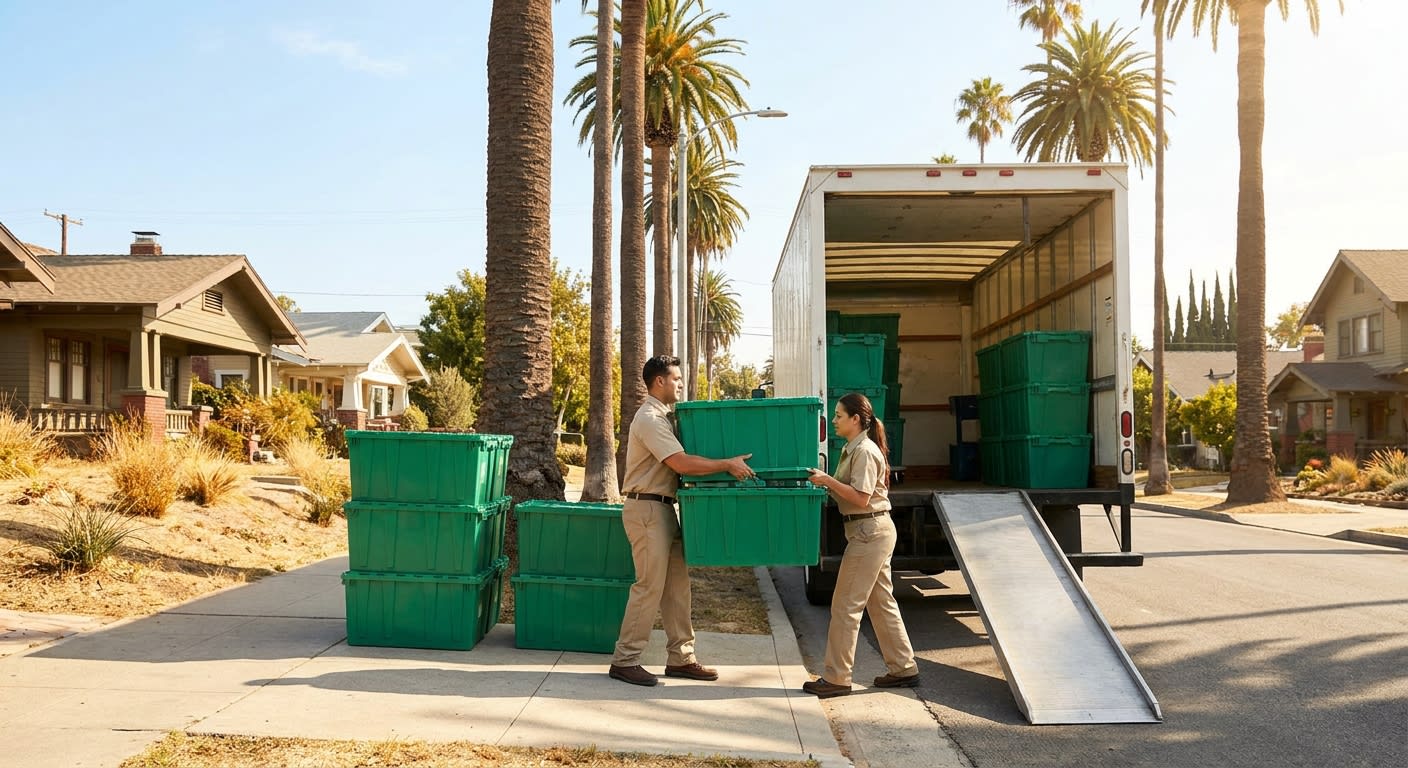
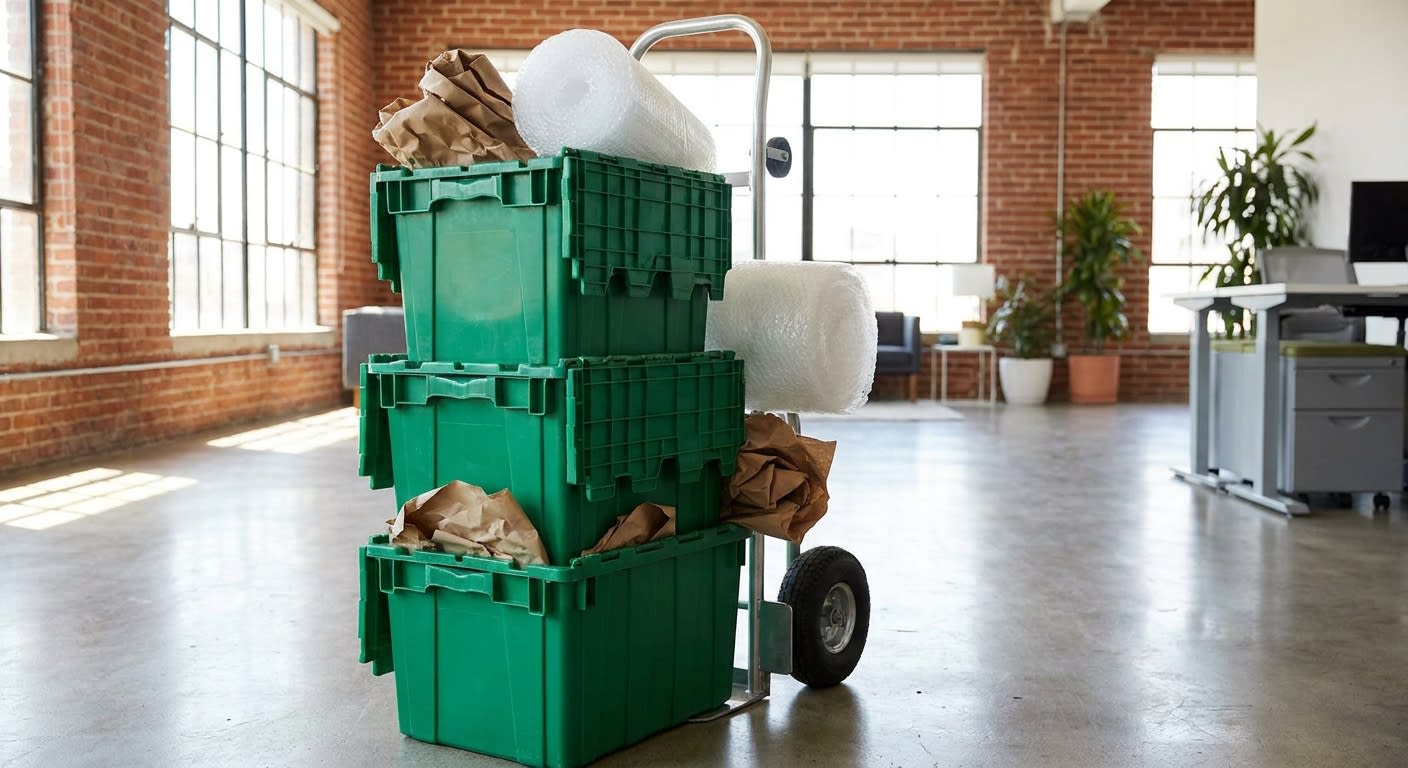
Reusable plastic crates are the single biggest change I've seen in commercial moving over the last 18 months. Instead of folding and taping cardboard, my coordinators drop off stacks of interlocking plastic bins 3-5 days before the move. Employees pack their desks directly into the bins, label them with reusable tags, and the crates get returned and sanitized after delivery. Each bin can survive 300+ moves before it's recycled.
For a 90-person Culver City office, that swap eliminated the need for roughly 450 cardboard boxes. The cost difference? Usually within 5-10% of traditional packing, and sometimes cheaper once you factor in labor — bins assemble in seconds versus the minutes it takes to fold and tape a box. My colleague's reusable container comparison breaks down the rental math in detail in our guide on reusable moving container systems in LA, which I send to almost every commercial client during the estimate phase.
The pushback I sometimes get is about books, files, and oddly shaped items. The honest answer is that bins don't replace 100% of cardboard — specialty items like artwork, server equipment, and lobby furniture still need custom crating. But for the 80% of an office that's books, files, monitors, and desk contents, reusable bins are the cleanest win available right now.
Fleet Electrification and Renewable Diesel
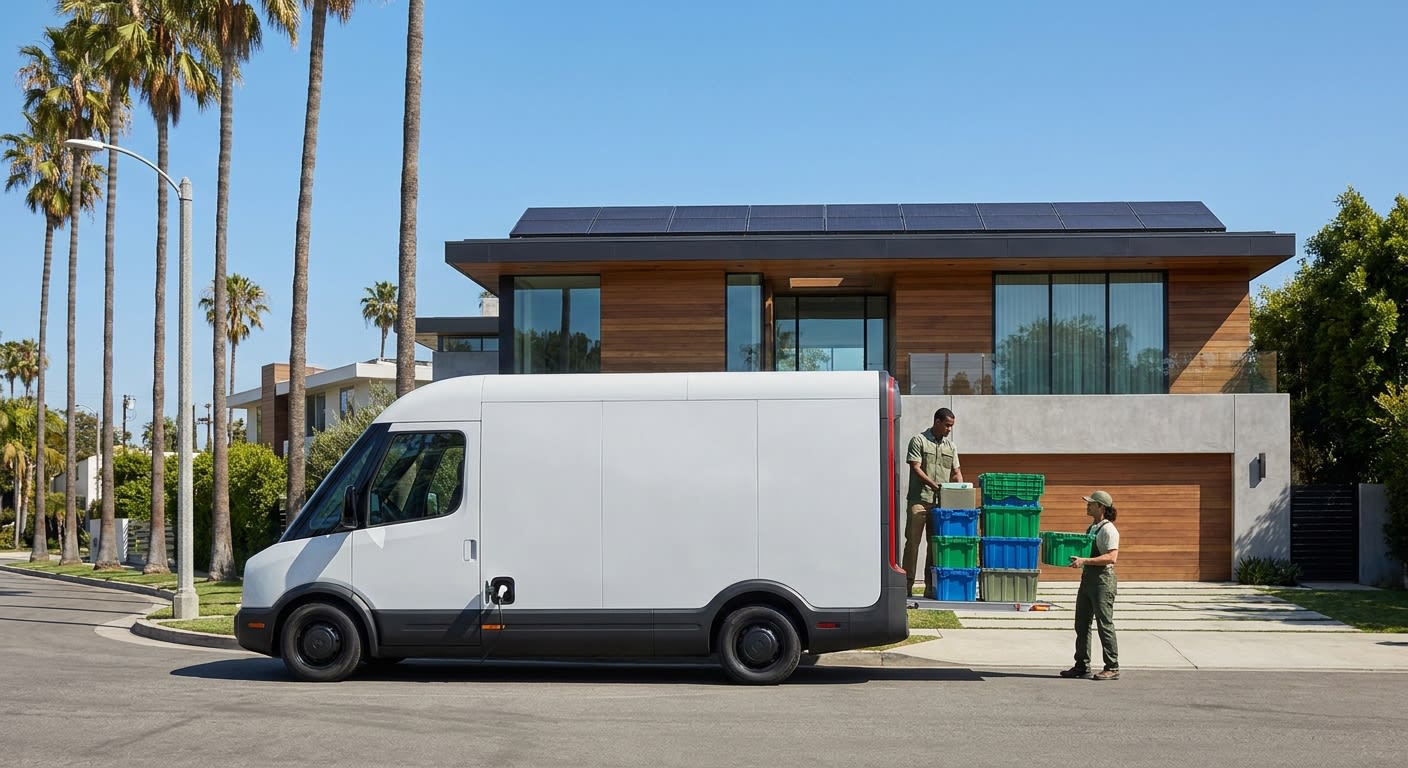
The fleet conversation got real in 2026. California's Advanced Clean Fleets rule is pushing commercial movers toward zero-emission trucks on an accelerating timeline, and the practical result is that you can now book moves in LA on electric box trucks or renewable-diesel-fueled vehicles without paying a premium that breaks the budget.
Renewable diesel — chemically identical to petroleum diesel but made from waste fats, oils, and plant materials — cuts lifecycle greenhouse gas emissions by roughly 65-80% compared to standard diesel. It drops right into existing truck engines with no modification. As of 2026, renewable diesel is available at multiple fleet fueling stations across LA County, and most of the larger, professional movers I work with have transitioned at least part of their fleet over.
For full battery-electric moving trucks, range is the limiting factor — most current Class 6 electric box trucks handle 150-200 miles on a charge, which works for local LA moves but not long-haul. If your move stays inside LA, Orange County, or short hops to the Bay Area corridor, electric is realistic. For longer routes, renewable diesel is the bridge solution today.
🌱 Planning a green office relocation? My commercial moving team can spec reusable crates, renewable-diesel trucks, and a carbon report tailored to your move. Call (909) 443-0004 for a free estimate.
Route Optimization and Crew Consolidation
The least glamorous emissions reduction is also one of the most effective: not driving as much. Route planning software has gotten genuinely good in the last two years, and the operations team I work with now factors in real-time traffic, loading dock availability, and consolidated stops to minimize miles driven per move.
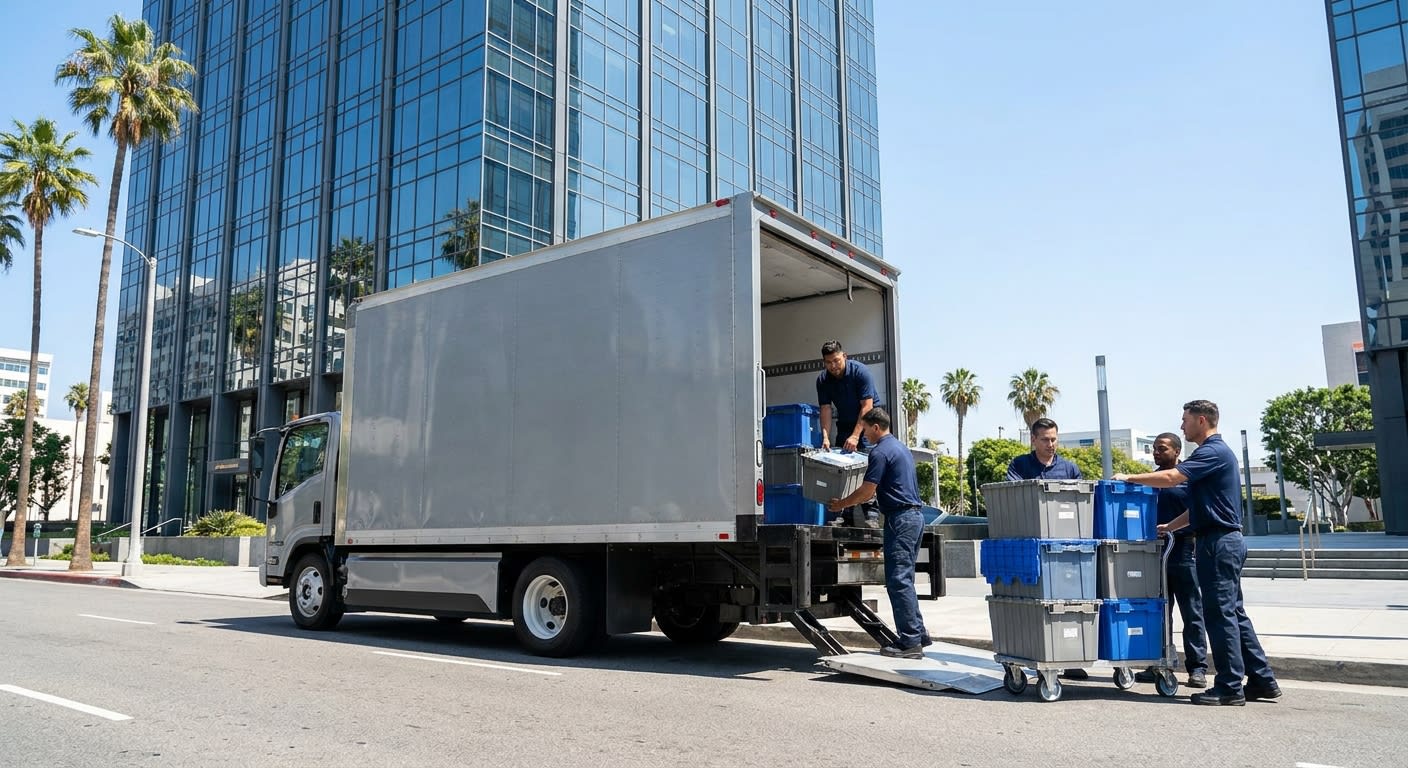
For commercial relocations, the biggest win is right-sizing the truck. A 26-foot box truck that runs at 70% capacity in one trip beats two 16-foot truck runs almost every time on fuel-per-cubic-foot. I had a client last spring who'd been quoted three truck loads by another mover for a downtown LA office relocation. We re-measured the inventory and did it in one 26-foot load plus a sprinter for IT equipment. That alone saved roughly 35 gallons of diesel.
Consolidated moves — where multiple smaller commercial clients share truck space on the same route — are also growing. They take more coordination, but for businesses moving fewer than 8-10 employees' worth of contents, sharing a truck with another company on a similar corridor cuts per-move emissions in half. I price these as discounted moves because the fuel and crew costs genuinely are lower.
What Carbon Offsets Actually Mean
Every week I get asked about carbon-neutral certifications, and I want to be straight with my clients here: offsets matter, but they're the last step, not the first. Reducing actual emissions through fleet, packing, and routing changes always beats paying to offset emissions you didn't need to create.
That said, residual emissions are real — even an electric truck has a manufacturing footprint, and renewable diesel still emits some CO2 at the tailpipe. Legitimate offsets, verified through registries like Verra or Gold Standard, fund forestry, methane capture, or direct air capture projects that genuinely sequester carbon. The price as of 2026 is typically $15-25 per metric ton of CO2, and a standard 50-person office move generates roughly 1-2 metric tons of emissions end-to-end. So a $30-50 offset line item is realistic.
What I warn clients about is unverified offsets — generic "tree planting" claims with no registry behind them, or vague "carbon neutral" marketing without a published methodology. My colleague William covers this distinction in detail in the carbon neutral moving companies comparison guide, and it's worth reading before you sign anything that uses the phrase "net zero."
What Eco Friendly Commercial Moving LA Actually Costs
Here's the question every sustainability officer eventually asks: does eco friendly commercial moving LA actually cost more? In 2026, the honest answer is "marginally, sometimes nothing." From my perspective at SOS Moving, where we offer licensed & insured full-service moving and storage, from $119/hour, thousands of local and long-distance relocations handled stress-free, the green options usually fall within 5-12% of the standard quote — and that gap is shrinking each quarter as reusable crate rentals scale and renewable diesel pricing comes down.
The biggest cost drivers for a green office move are: reusable crate rental (typically $4-8 per crate for a 7-day window), renewable diesel surcharge (often $0.50-1.00 per gallon over standard diesel, or built into the hourly rate), and optional carbon offsets ($30-100 depending on move size). For most mid-sized office moves I quote in LA, that's a few hundred dollars on a $4,000-12,000 invoice.
What companies save on the other side: reduced cardboard disposal fees, fewer damage claims because plastic bins protect contents better than cardboard, and — increasingly — measurable progress toward corporate sustainability targets that show up in annual ESG reports. For publicly traded clients, that last piece is worth more than the line-item premium.
How to Vet a Mover's Green Claims
Greenwashing is real in this industry. Any mover can put a leaf icon on their website. What I tell my clients to ask for is documentation: a published fleet inventory showing electric or renewable-diesel vehicles, a reusable crate program with rental terms in writing, a carbon offset methodology with registry links, and ideally a post-move report that quantifies the actual emissions and waste diverted from your specific job.
I also recommend asking about packing materials beyond crates. Are they using recycled paper instead of bubble wrap? Reusable moving blankets instead of plastic stretch wrap? Biodegradable tape? These small choices add up across a 50-person move.
Finally, check licensing. A legitimate California mover will have a CAL-T number from the CPUC for intrastate work and a USDOT number for interstate moves. Green marketing without proper licensing is a red flag that the company is cutting corners elsewhere too — and you'll find that pattern documented in many of the consumer complaints filed each year.
FAQ
Is electric moving really practical for LA office relocations in 2026?
For local moves inside LA, Orange County, and short Bay Area hops, yes — current Class 6 electric box trucks handle the range comfortably. For longer-distance relocations, renewable diesel is the more practical option right now because it offers similar emissions reductions without range limitations.
How much waste does a typical office move generate?
A 50-person office relocation using traditional cardboard packing produces roughly 300-500 boxes worth of cardboard waste, plus tape, bubble wrap, and stretch film. Switching to reusable plastic crates eliminates about 90% of that packing waste in one decision.
Are reusable crates more expensive than cardboard boxes?
Usually within 5-10% of traditional packing costs, and sometimes cheaper once labor is factored in. Bins assemble instantly versus the minutes required to fold and tape cardboard. The rental window is typically 5-7 days, which covers most office moves.
Do carbon offsets actually work?
Verified offsets through registries like Verra or Gold Standard do fund real sequestration projects. They should be the last step after reducing actual emissions, not a substitute. Unverified "tree planting" claims without a registry methodology should be treated skeptically.
Can I get a carbon report for my office move?
Yes — more clients are asking for these in 2026, especially publicly traded companies with ESG reporting requirements. A good mover will quantify fuel burned, waste diverted, and residual emissions, and offer verified offsets for the remainder.
Ready to plan a sustainable office relocation? SOS Moving serves Los Angeles, Orange County, and the San Francisco Bay Area with reusable crates, renewable-diesel fleet options, and detailed carbon reporting. Call (909) 443-0004, email info@sosmovingla.net, or get a free quote. Licensed & insured — fully credentialed for California commercial moves.