

Two Saturdays ago I was on the phone with a client in Mid-Wilshire who had just opened a box from a self-pack move she'd done with a discount crew. Three of her grandmother's hand-painted Limoges dinner plates were in pieces, and the claim form she'd signed put her recovery at sixty cents per pound. Those plates weighed about a pound each. Her settlement, for heirlooms she valued at $4,800, was going to be roughly $1.80. I get a call like this almost every week, and almost every time it traces back to the same thing — how the kitchen got packed.
I'm Sarah Mitchell, a Customer Relations Manager at SOS Moving, and I spend most of my days walking clients through the exact decisions that prevent that phone call. The kitchen is the most claim-heavy room in any move I've seen — it accounts for roughly 60% of damage claims I review as of 2026. Below is the system I teach clients who want to pack their own fragiles, and what my crews do differently when we handle it.
Why the Kitchen Breaks More Than Any Other Room
When I review damage reports, the pattern is almost always the same. Kitchens have the highest density of fragile items per cubic foot of any room in your home — stemware, ceramic, glass bakeware, small appliances with glass carafes, ceramic knife blocks, and the random heirloom serving platter that lives on the top shelf. They also get packed last, usually in a rush, often the night before the move while you're tired and the truck arrives at 8 a.m.
The second reason is weight distribution. A standard dish pack box weighs around 45-55 pounds when packed correctly. I see clients use grocery store boxes that aren't rated for that load, so the bottom blows out somewhere between the kitchen and the truck. The third reason is the road itself. The 405 between the Westside and the South Bay, the 101 through the Valley, the surface streets in Beverly Grove — they're rough. Even a careful driver in a well-loaded truck delivers vibration to every box. Packing fragile kitchen items moving across LA means assuming your box will be jostled hard for the entire trip, and packing accordingly.
The Supplies That Actually Matter
I'll save you a Home Depot trip. For an average 2-bedroom kitchen, here's what I tell clients to buy as of 2026:
- Four to six dish pack boxes (double-walled, 5.2 cu ft, roughly $8-11 each)
- One bundle of unprinted newsprint packing paper — at least 25 pounds. Newspaper ink transfers and you'll be washing every dish at the new place.
- One roll of small bubble wrap (3/16") for general cushioning and one roll of large bubble wrap (1/2") for heavy items
- Cell dividers or kits for stemware — these are the cardboard grids that slot into a box
- Two rolls of 2-inch packing tape (the clear kind, not masking tape — masking dries out and releases)
- Permanent markers in two colors
- Foam pouches for stemware bowls (optional but cheap insurance)
If you'd rather skip the supply run entirely, my colleague's team guide on eco-friendly moving boxes walks through where to source reusable and recycled options around LA. For valuables I always recommend new materials, but storage and pantry items are fair game for used boxes.
Wrapping Stemware, Plates, and Bowls the Right Way
This is the section where most self-packers go wrong. The rule I teach: every fragile item gets wrapped individually, and every wrapped item gets cushioned from every other wrapped item. No two glass surfaces should ever touch directly.
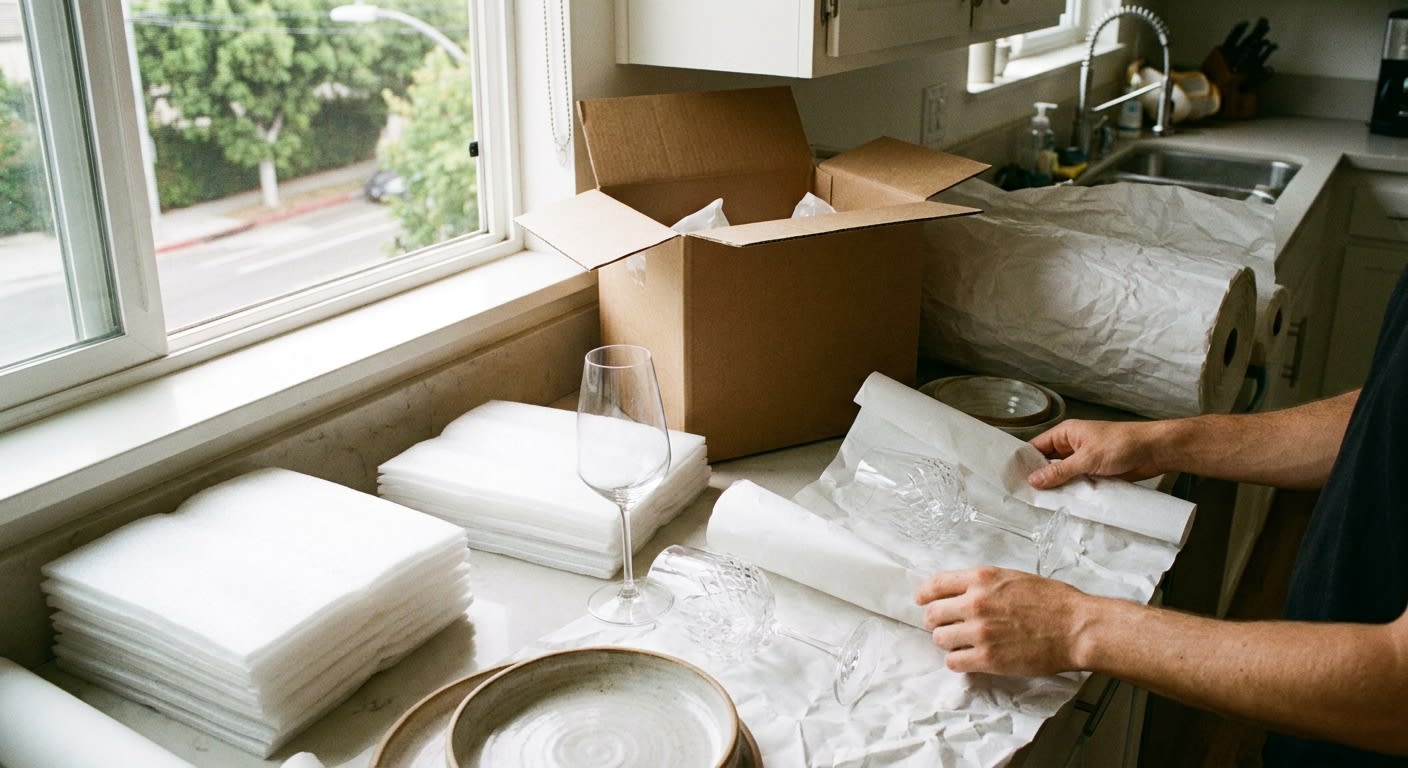
For plates, lay three sheets of paper flat, place the plate in the center, fold one corner over, then stack the next plate at a 45-degree offset, fold the next corner, repeat until you have a bundle of four to five plates. Tape the bundle. Plates always go in the box on their edge — vertical, like records in a crate — never stacked flat. Stacked flat, the bottom plate carries the weight of every plate above it plus road vibration, and it cracks.
For stemware, use cell dividers. Wrap each glass in two sheets of paper, stuffing a wad gently into the bowl first. Wrap from the base up, twisting the paper around the stem. Stand each glass upright in its own cell. Heavy goblets go in the bottom row, delicate flutes on top.
Bowls nest only if you put two sheets of paper between each one. Mixing bowls, especially ceramic, are deceptively heavy and crack each other when nested dry.
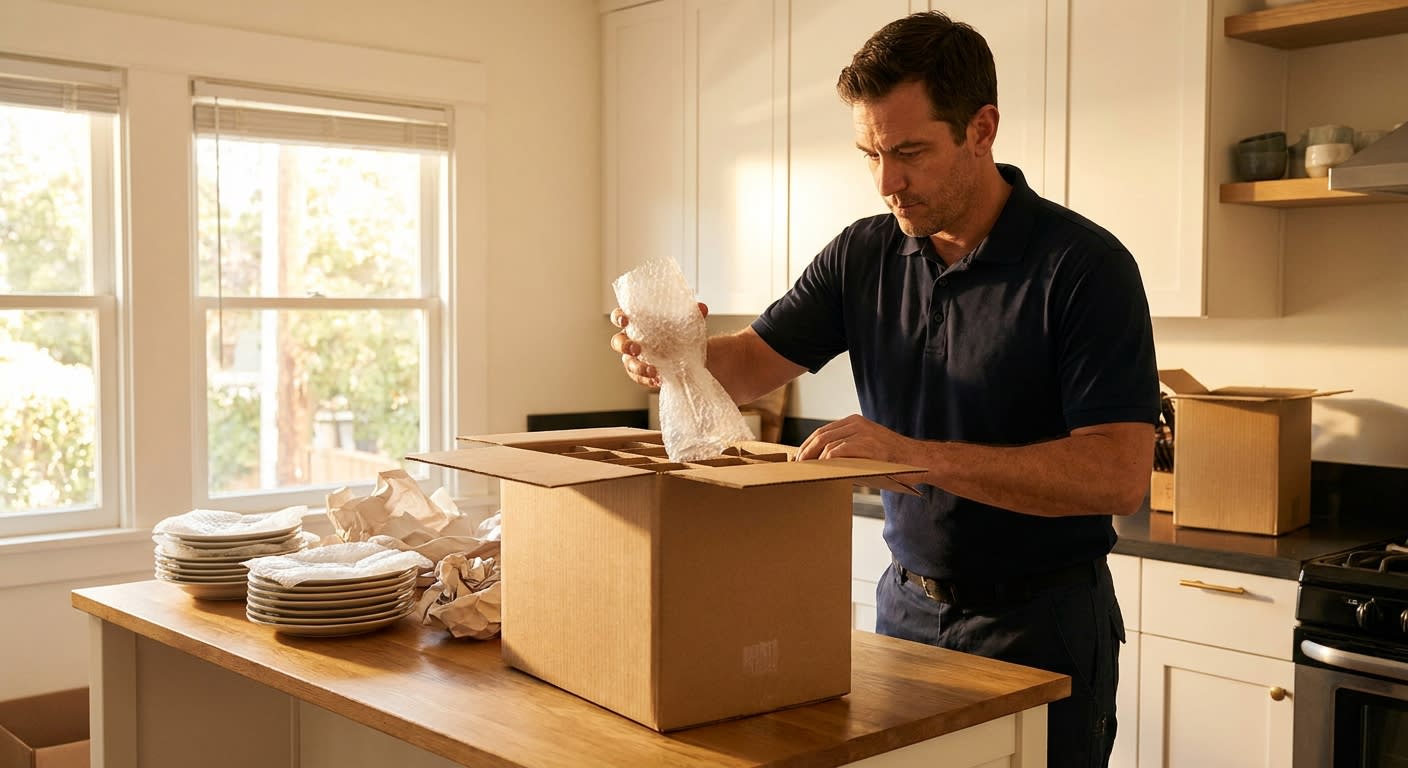
📦 Don't want to spend three nights packing your kitchen yourself? My team's professional packing service handles every fragile item with the same system I just described, and we're licensed and insured. Call (909) 443-0004 for a free estimate.
Loading the Box: Bottom, Middle, Top
Box construction matters as much as wrapping. Here's the layered approach my foremen use:
Bottom layer: Two to three inches of crumpled paper. This is your shock absorber. Don't skip it, don't compress it flat — you want air pockets. Then place your heaviest items: cast iron, ceramic serving dishes, plates standing on edge.
Middle layer: An inch of crumpled paper, then medium-weight items — bowls, mid-size glassware, small appliances with glass parts wrapped in bubble wrap.
Top layer: An inch of paper, then your lightest fragiles — wine glasses in cell dividers, delicate teacups, anything you'd cry about.
Final step: Crumpled paper on top until you cannot push anything down. If items shift when you shake the box gently, you haven't packed enough fill. Tape across the top seam, then perpendicular across that, then around the perimeter where the flaps meet the box wall. This is called the "H-tape" pattern, and it doubles the load rating of the box.
Every box gets labeled in two colors: room ("KITCHEN") in black, and "FRAGILE — THIS SIDE UP" in red, on three sides. The top can be obscured when boxes stack, so label the sides.
The Items That Need More Than a Box
Some kitchen items shouldn't go in a standard dish pack at all. Marble mortar and pestle sets, heavy stand mixers, espresso machines with internal water reservoirs, and any ceramic or stoneware over ten pounds need their own treatment.
For a KitchenAid mixer, I have my crews remove the bowl and attachments, wrap them separately, then wrap the mixer body in two moving blankets and place it in a small box with the head locked down. For espresso machines, empty the water tank fully — I've seen Breville machines short out from residual water sloshing across a 1,200-mile interstate route. Pull the portafilter, wrap it separately, drain the drip tray.
For genuinely valuable items — a Le Creuset set you've collected over 20 years, hand-thrown ceramics, vintage Pyrex — I'd recommend looking at our white glove service for those specific pieces. We custom-crate fine kitchen pieces the same way we crate sculpture. It's not the cheapest option, but neither is replacing a $400 Dutch oven.
Insurance and What Actually Gets Paid Out
This is the conversation I have most often. California has two basic valuation tiers as of 2026, and you choose at booking:
Released Value Protection is the default. It's free, and it pays sixty cents per pound per item. A 4-pound dinner plate that breaks pays $2.40, regardless of what the plate cost. This is what my Mid-Wilshire client had — and why she was looking at $1.80 for three plates.
Full Value Protection costs roughly 1-2% of the declared value of your shipment as of 2026. If you declare $40,000 in household goods, you'd pay $400-800. If something breaks, the mover either repairs it, replaces it with a like item, or pays the current cash value. This is what I recommend for any move where the kitchen contains items you genuinely couldn't replace easily.
Important: items packed by the owner (PBO on the inventory) have limited claim eligibility unless you can prove the box was visibly damaged. Items packed by the mover (PBM) are covered regardless. If you have heirloom pieces, having my crew pack just those — even if you pack everything else — changes the claim outcome dramatically. For the full breakdown on coverage rules, my colleague Sarah's earlier work and our team guide on moving insurance vs homeowners coverage goes deeper into when each kicks in.
Local LA Logistics That Affect Fragile Loads
The way your fragile boxes survive depends on what happens between the box being sealed and the truck doors closing. A few LA-specific things I'd warn clients about:
If you're in a high-rise downtown or in Koreatown, freight elevator reservations matter. Boxes sitting in a hallway for 90 minutes waiting for an elevator window get bumped, kicked, and stacked under heavier loads. Reserve the elevator for a tight window.
Hillside neighborhoods — Silver Lake, Echo Park, parts of Mt. Washington — have narrow streets where my crew has to shuttle boxes by hand from the truck to the door. Each hand-off is a chance for a bump. Label aggressively.
Summer moves in the Valley regularly hit 105°F inside a closed truck. Glass and ceramic generally handle that fine, but anything with adhesive (taped-together vintage pieces, glued ceramic repairs) can fail in extreme heat. Mention these to your foreman.
For longer moves out of state, the rules shift — I covered some of the cross-country specifics in our team's guide on cross country moving insurance, which is worth a read if your kitchen is heading further than the Bay Area.
What I'd Do Differently as a Client
If I were moving my own kitchen tomorrow, here's the order I'd follow. First, I'd photograph every shelf and every fragile item before packing — for both inventory and claims purposes. Second, I'd pack pantry and rarely-used items two weeks out, daily-use items the morning of the move. Third, I'd hand-pack only the items I felt confident with and hire my own crew to handle stemware and heirlooms — packing fragile kitchen items moving safely is a skill, and an hour of professional packing on the truly delicate pieces costs less than one broken Wedgwood platter.
That hybrid approach — owner-packed pantry, mover-packed fragiles — is what I see produce the lowest claim rates. It's also part of why my company handles thousands of local and long-distance relocations stress-free; we built the service tiers around what actually causes damage, not what's easiest to upsell.
FAQ
How many boxes do I need for an average kitchen?
For a typical 2-bedroom LA apartment kitchen, I plan for 6-9 medium boxes for non-fragiles and 4-6 dish pack boxes for fragiles. Larger kitchens with a lot of bakeware or specialty appliances run 10-14 dish packs. Always over-buy by two — leftover boxes are easier to return than running out at 11 p.m.
Can I use towels and dishcloths instead of packing paper?
For sturdy bowls and pots, yes. For glass, stemware, and ceramic plates, no. Towels are uneven and don't grip the item — they shift in transit and leave glass surfaces touching. Use paper for fragiles, and pack your towels separately so you can find them at the new place.
What happens if I pack a box and it breaks during the move?
If you packed it (PBO), claims are limited to cases where the box itself shows damage — crush marks, water, a torn corner. If the box arrives intact and items inside are broken, most carriers deny the claim because they can't verify the packing quality. This is why full value protection plus mover-packed fragiles is the safest combination.
Should I move my refrigerator and oven contents separately?
Yes. Defrost the fridge 24 hours before. Move perishables in coolers in your own car. Glass shelves should come out of the fridge and be wrapped individually like plates — they're the most commonly broken fridge component.
How long does professional kitchen packing take?
A standard LA kitchen takes my two-person crew 2-3 hours. Larger kitchens or homes with extensive china and crystal collections run 4-5 hours. We bring all materials, so you're not running to a supply store the night before.
Ready to get your kitchen packed and moved without the claim-form conversation? SOS Moving serves Los Angeles, Orange County, and the San Francisco Bay Area from $119/hour. Call (909) 443-0004, email info@sosmovingla.net, or get a free quote. Licensed & insured full-service moving and storage.