

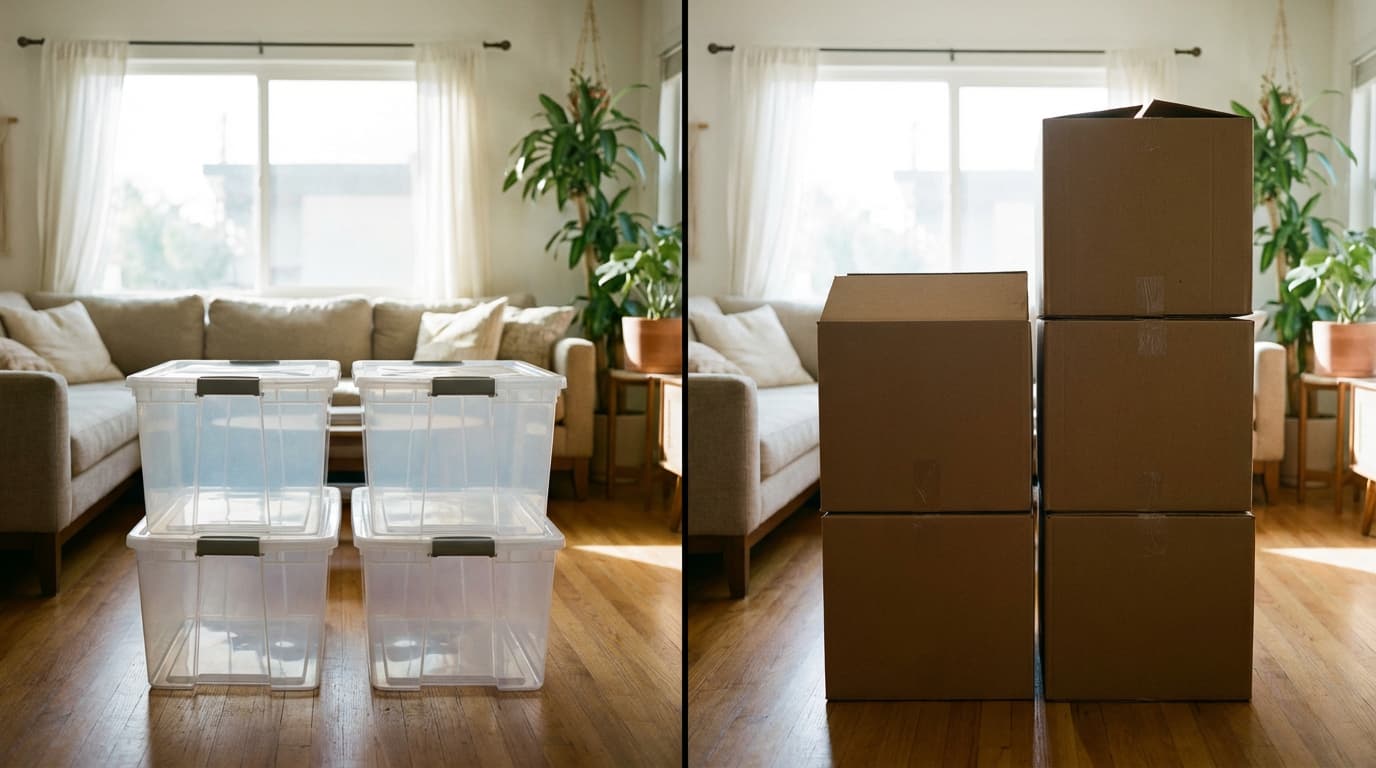
The moving box debate used to be simple — you grabbed whatever cardboard boxes you could find for free and dealt with the tape, the collapsing bottoms, and the recycling pile afterward. But plastic moving bin rental services have changed the equation in Los Angeles, and now every person planning a move faces a genuine choice between two fundamentally different approaches to containing their belongings during transit.
At SOS Moving, customers show up with both. Some rent stacks of green plastic bins from a delivery service. Others buy fresh cardboard from a supply store. A few show up with a mix of both plus whatever random containers they found around the house. Each approach has clear advantages and equally clear trade-offs — and the right choice depends on your specific move, not on which option sounds better in theory.
The Case for Cardboard Boxes
Cardboard moving boxes have been the default for a reason: they're cheap, universally available, customizable by size, and disposable when you're done. Every moving company in the country is built around handling cardboard boxes, and the entire infrastructure of loading, stacking, and securing a moving truck is optimized for rectangular cardboard containers.
Cost is cardboard's strongest advantage. New moving boxes from a supply store or your moving company cost $4 to $6 each depending on size — at SOS Moving, we sell small boxes at $4, medium at $5, and large at $6. A full one-bedroom apartment requires roughly twenty to thirty boxes, putting the total investment at $100 to $150. Free moving boxes from liquor stores, grocery stores, and online marketplaces reduce that cost to zero if you're willing to invest the time collecting them.
Cardboard boxes come in standardized sizes designed for specific contents. Small boxes are built for heavy items like books and dishes. Medium boxes handle kitchen items, small appliances, and general household goods. Large boxes are sized for lightweight bulky items like bedding, pillows, and lampshades. Specialty boxes — wardrobe boxes, dish packs, mirror cartons, TV boxes — protect specific items better than any generic container. This size variety doesn't exist in the plastic bin world.
Truck loading efficiency is higher with cardboard boxes because they're rectangular with flat tops and consistent dimensions. A wall of same-size medium boxes stacks perfectly to the ceiling of a moving truck with no wasted space. Professional movers build these walls daily, and the structural predictability of cardboard boxes is a meaningful loading advantage. At SOS Moving, our crews can load a truck with uniform cardboard boxes roughly twenty percent faster than a mixed load of irregularly shaped containers.
The disposal advantage is real for people who don't want storage containers cluttering their new apartment. After unpacking, cardboard boxes flatten in seconds and go straight into recycling. No return scheduling, no pickup coordination, no pile of empty plastic bins taking up half your living room while you wait for the rental company to collect them.
The Case for Plastic Bins
Plastic moving bins address cardboard's weaknesses directly: they don't collapse under weight, they're waterproof, they stack securely without tape, and they produce zero waste after the move.
Structural integrity is plastic's biggest advantage. A cardboard box packed with heavy items can have its bottom give out if the tape fails, the cardboard gets wet, or the box was previously used and structurally weakened. Plastic bins don't fail this way. A properly rated plastic bin holds its contents regardless of humidity, stacking weight, or handling roughness. For people who've had the experience of a cardboard box bottom giving out and dishes crashing onto a hardwood floor, the switch to plastic is emotional as much as practical.
Waterproofing matters more in Los Angeles than people realize. Rain during the November-to-March wet season turns cardboard into a liability. A rainy moving day with cardboard boxes means plastic sheeting over every box, taping vulnerable seams, and still risking moisture damage if the rain is heavy enough. Plastic bins are impervious to rain — your belongings stay dry regardless of weather conditions.
Rental services deliver plastic bins to your door a few days before your move and pick them up from your new address a few days after. The bins come clean, pre-stacked, and ready to pack. After unpacking, you stack them by the door and the service retrieves them. No box shopping, no tape buying, no recycling trips, no flattening dozens of boxes. The convenience factor is significant for people whose time has a high value.
Environmental impact favors plastic bins for people who care about sustainability. Each plastic bin is reused hundreds of times across hundreds of moves before being recycled. Cardboard boxes are recyclable, but the manufacturing, transportation, and single-use lifecycle produces a larger carbon footprint per move than a reusable bin that serves five hundred customers over its lifetime.
Cost Comparison: The Real Math
The cost comparison isn't as straightforward as sticker price versus rental fee. Here's how the numbers actually land for a standard one-bedroom move in Los Angeles.
Cardboard boxes purchased new: twenty-five boxes at an average of $5 each costs $125. Add two rolls of packing tape at $8 each, a marker, and optional packing paper at $55 for 600 sheets. Total materials cost: $150 to $200. If you find free boxes, the cost drops to $50 to $75 for tape and paper alone.
Plastic bin rental: most LA services charge $1.50 to $3.00 per bin per week. Twenty-five bins for two weeks runs $75 to $150. No tape needed — bins have attached lids. No packing paper needed for most items since the rigid walls prevent crushing. Total rental cost: $75 to $150 with no additional supply purchases.
The initial comparison looks roughly equal. But factoring in time changes the equation. Assembling and taping twenty-five cardboard boxes takes thirty to forty-five minutes. Plastic bins arrive ready to pack — zero assembly time. After the move, breaking down and recycling twenty-five boxes takes another twenty to thirty minutes. Plastic bins stack by the door in five minutes and the rental company handles the rest. For someone whose free time is limited, the hour saved has real value.
The cost gap widens for larger moves. A three-bedroom house requiring sixty to eighty boxes pushes cardboard costs to $350 to $450 new, while the same quantity of plastic bins rents for $180 to $300. The per-unit economics favor plastic at higher volumes because you avoid buying specialty boxes — most items that would need a dish pack or book box fit safely in a standard plastic bin due to the superior structural protection.
When Cardboard Wins
Despite plastic's advantages, cardboard boxes are the better choice in several specific scenarios.
Long-distance and interstate moves favor cardboard because rental bin services are local — they deliver and pick up within a specific metro area. If you're moving from LA to Phoenix, Denver, or San Francisco, there's no bin rental company operating across both cities. Cardboard boxes travel with you regardless of distance.
Moves with storage requirements need containers that stay with your belongings for weeks or months. Plastic bin rentals charge ongoing weekly fees that accumulate quickly during extended storage. A month of bin rental for forty bins costs $240 to $480. The same forty cardboard boxes purchased once cost $200 total with no ongoing fees. For any storage period beyond two weeks, cardboard is more economical.
Specialty packing needs favor cardboard's variety. Wardrobe boxes, dish pack boxes, mirror cartons, and mattress bags don't exist in the plastic bin world. If your move includes a closet full of suits, a collection of fine china, large framed artwork, or king-size mattresses, you need specialty cardboard containers regardless of what you use for general packing.
Tight truck loads work better with cardboard. Uniform rectangular boxes create a dense, stable wall inside the truck. Plastic bins — while stackable — have slightly different dimensions across brands, often have tapered sides for nesting when empty, and include lid flanges that prevent perfectly flush stacking. A truck loaded entirely with matching cardboard boxes uses space more efficiently than the same volume of plastic bins.
Not sure which option fits your move? SOS Moving works with whatever containers you choose — cardboard, plastic, or a mix. We also sell boxes at $4 to $6 each and include wardrobe boxes free on every job. Call 909-443-0004 or get your free estimate.
When Plastic Wins
Plastic bins earn their rental fee in scenarios where their specific advantages outweigh cardboard's flexibility.
Short local moves with a tight timeline are plastic's sweet spot. Bins arrive pre-assembled, pack faster without taping, and unpacking means lifting a lid instead of cutting tape and breaking down boxes. For a studio or one-bedroom move where you're packing Friday evening and moving Saturday morning, plastic bins save an hour or more compared to cardboard's assembly and taping process.
Rainy season moves between November and March in LA benefit from waterproof containers. Rather than wrapping every cardboard box in plastic sheeting — which adds time and material cost — plastic bins handle wet weather without any modification. If your moving day forecast shows rain, plastic bins eliminate an entire category of weather preparation.
Eco-conscious movers who want zero-waste moving choose plastic bins for the environmental advantage. No cardboard manufacturing, no single-use disposal, no recycling processing. The bins are reused hundreds of times, creating a dramatically smaller environmental footprint per move.
Frequent movers — military families, corporate relocators, renters who move annually — benefit from the rental model because it eliminates the accumulation of boxes between moves. Rather than storing flattened cardboard in a closet or buying new boxes every year, bin rental is a consistent, predictable expense that scales to each move's size.
The Hybrid Approach
Most experienced movers in Los Angeles end up using both, and there's a logical reason for that.
Plastic bins handle the bulk of general packing — kitchen items, bathroom supplies, office contents, closet miscellany, and living room decor. Their structural protection, waterproofing, and no-tape convenience make them ideal for the majority of household items that don't require specialty containers.
Cardboard handles the specialty items that plastic bins can't accommodate. Wardrobe boxes for hanging clothes. Dish pack boxes for fine china and crystal. Mirror cartons for large framed artwork. Mattress bags for beds. TV boxes for flat screens. These specialty containers exist because standard containers — whether cardboard or plastic — don't adequately protect these specific items.
The hybrid approach costs slightly more than all-cardboard but less than all-plastic when specialty items are factored in. Rent twenty plastic bins for general packing at $60 to $90 for two weeks. Buy four wardrobe boxes, two dish packs, and a mirror carton for $50 to $70. Total: $110 to $160, with the best protection characteristics of both systems.
At SOS Moving, we work with hybrid loads regularly. Our crews adapt loading strategies to accommodate both container types in the same truck — cardboard walls for uniformity where possible, plastic bins stacked in remaining spaces with straps for stability.
Frequently Asked Questions
Are plastic moving bins worth the cost? For short local moves in LA, yes — the time savings from zero assembly, no taping, and easy unpacking typically offset the rental cost. For long-distance moves or moves requiring storage, cardboard boxes are more economical.
How many plastic bins do I need for a one-bedroom apartment? Twenty to twenty-five bins cover most one-bedroom apartments. This is comparable to the cardboard box count for the same space. Rental companies can advise on exact quantities based on your inventory.
Can movers work with plastic bins as easily as cardboard? Professional movers handle both routinely. Cardboard loads slightly faster due to uniform stacking, but the difference is minor — roughly ten to fifteen minutes over a full truck load. Let your crew know what you're using so they can plan the load accordingly.
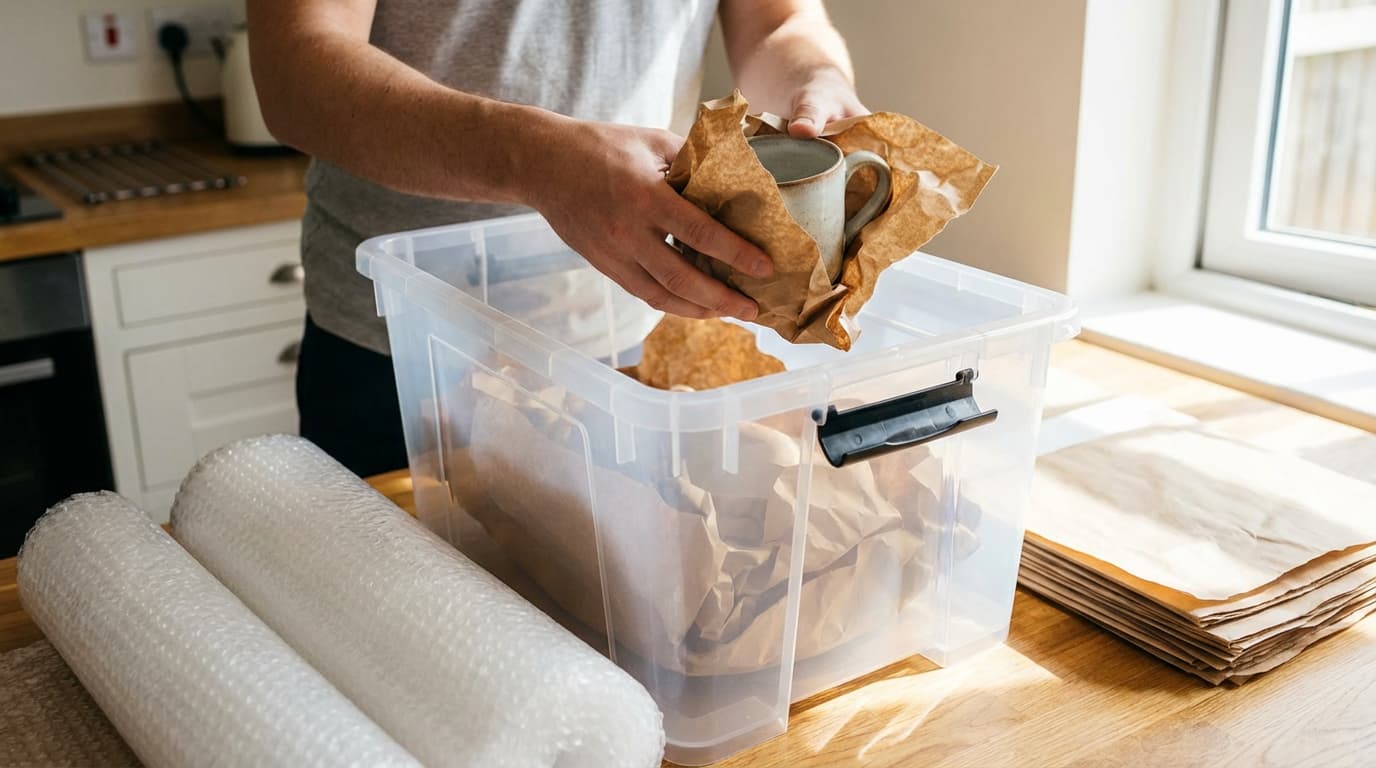
Do I still need packing paper with plastic bins? For most items, no — the rigid walls prevent crushing that paper is designed to prevent in cardboard boxes. For genuinely fragile items like wine glasses, ceramics, and crystal, wrapping in paper before placing in plastic bins adds a layer of protection that the bin walls alone don't provide.
What about specialty items like hanging clothes and mirrors? Plastic bins don't replace specialty cardboard containers. Use wardrobe boxes for hanging clothes, mirror cartons for framed artwork, and dish pack boxes for fine china. Combine these with plastic bins for general items to get the best of both systems.
Get Started with Your Move
SOS Moving handles every type of container — cardboard, plastic, mixed, or the creative combination of suitcases, bins, and boxes that most real moves end up being. We sell boxes at $4 to $6 each, include wardrobe boxes free, and bring unlimited shrink wrap and blankets on every job. Call 909-443-0004 or request your free estimate to book a crew that works with whatever you've packed.