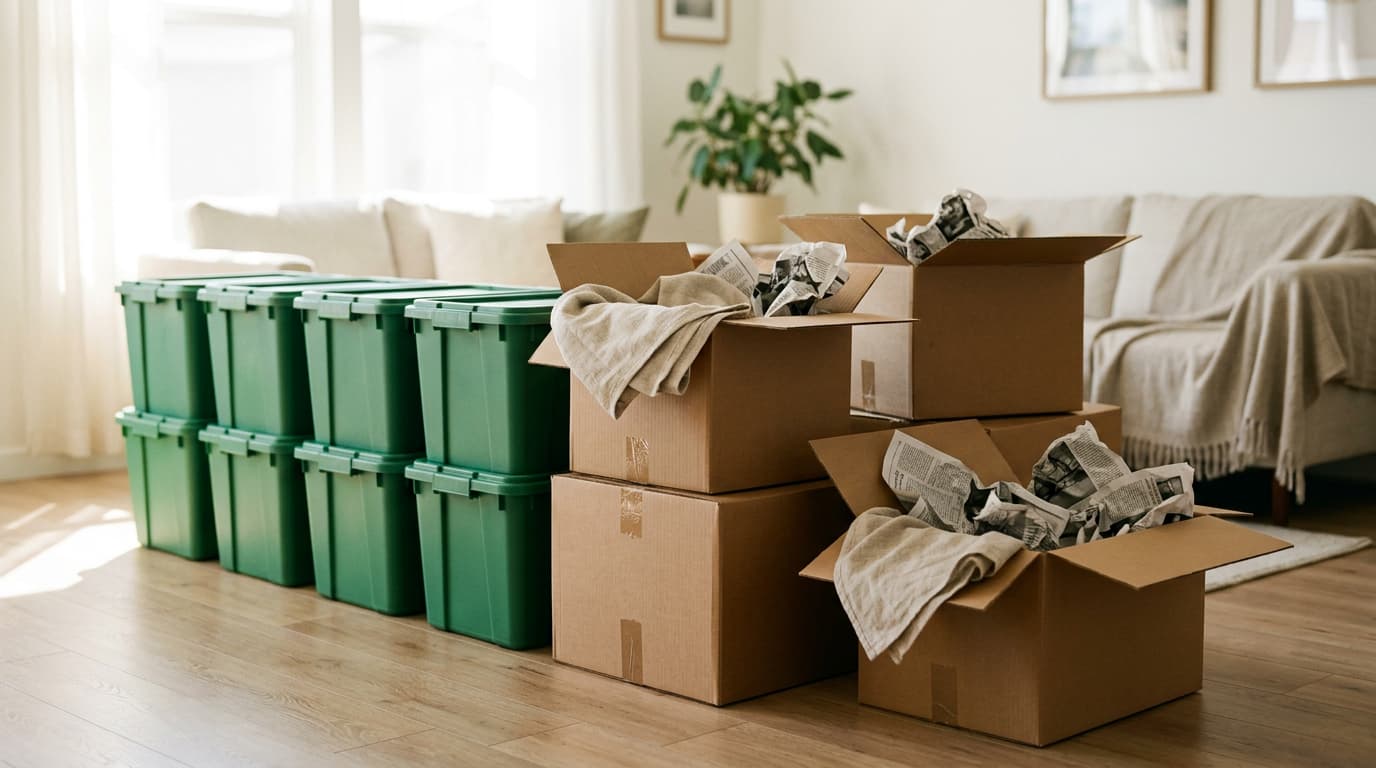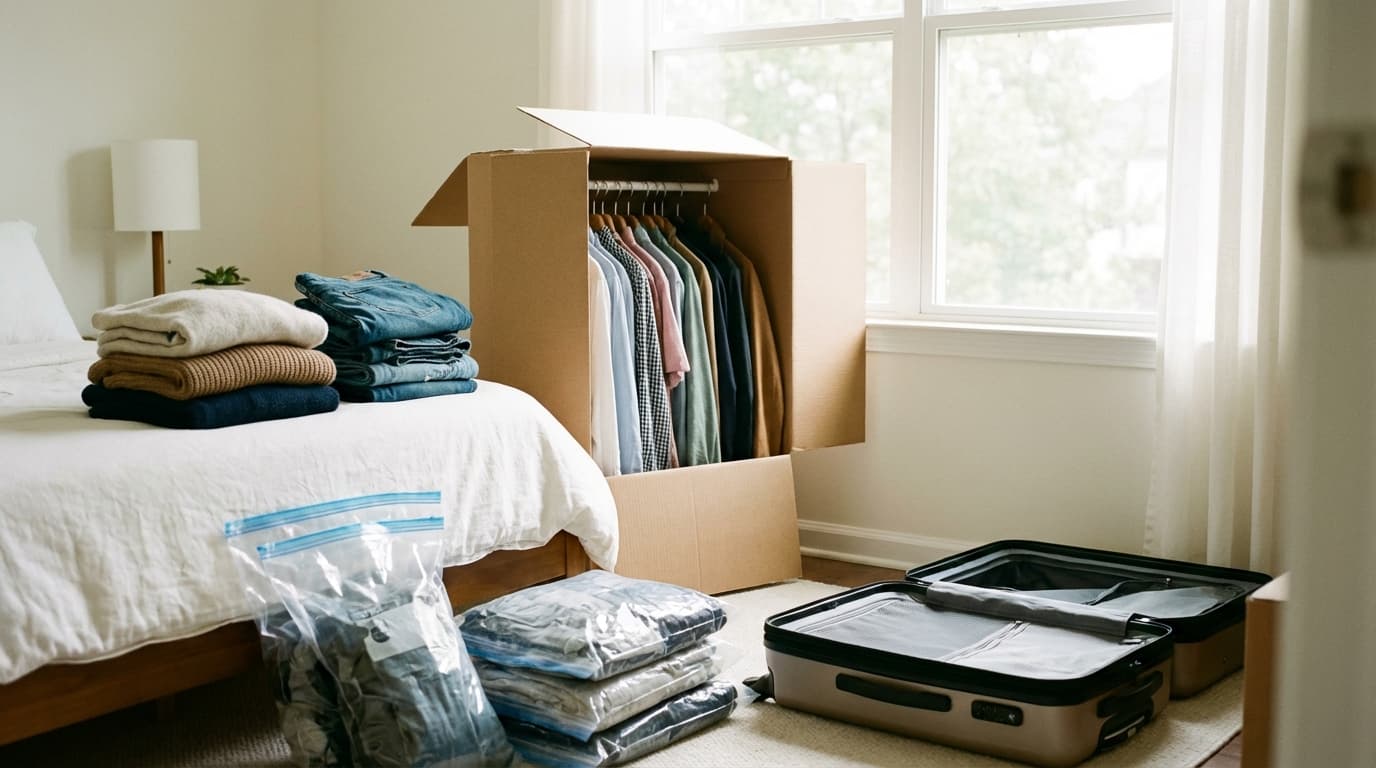



You packed fifty-three boxes over the course of a week. You wrote "kitchen" on twelve of them and "bedroom" on fifteen. The rest say "stuff" or "misc" or nothing at all because you ran out of energy at 11 PM on the last night. Now you're standing in your new apartment surrounded by identical brown boxes and you need your coffee maker, your phone charger, and your sheets — and they could be in any one of those fifty-three boxes.
This happens on almost every move I coordinate at SOS Moving. People spend hours packing carefully but spend thirty seconds labeling, and the result is an unpacking process that takes three times longer than it should. A good labeling system costs nothing except a marker and five extra seconds per box, but it transforms moving day from a guessing game into an organized operation where every box goes exactly where it belongs on the first try.
Why Most Labeling Fails
The standard approach — writing the room name on the top of the box — fails for three specific reasons that become obvious the moment boxes start stacking.
First, the top of a box disappears when another box is stacked on it. Your movers or helpers can't read the label without unstacking, which defeats the purpose. Writing the room name on at least two sides of the box solves this immediately. A box that says "kitchen" on the front and one side is readable from any angle, whether it's on the floor, on a stack, or being carried through a doorway.
Second, "kitchen" tells your movers where the box goes but tells you nothing about what's inside. Three weeks after moving, when you need the immersion blender that you used once a year, "kitchen" doesn't help. "Kitchen — small appliances" does. The extra two seconds of specificity during packing saves twenty minutes of searching during unpacking.
Third, not all boxes in the same room have the same priority. The box with your sheets, pillow, and pajamas needs to be unpacked the first night. The box with your decorative throw pillows can wait a month. Without a priority indicator, all bedroom boxes look equally important, and the one you need is always the last one you open.
The Color-Code System
Color coding is the single most effective upgrade to any labeling system because it works at a distance without reading. A mover carrying a box through a doorway can glance at a colored sticker and know which room it belongs to without stopping to read small handwriting.
Assign one color per room. The specific colors don't matter as long as everyone involved knows the assignment. A practical setup for a standard apartment looks like this: blue for kitchen, red for bedroom, green for bathroom, yellow for living room, orange for office or study, and purple for storage or miscellaneous.
Colored tape is the cheapest and most visible option. A roll of colored duct tape costs $4 to $6 and covers dozens of boxes. Wrap a six-inch strip around the top of each box and the color is visible from every angle, even across a room. Colored dot stickers from any office supply store work too — place one on the top and one on each labeled side.
The implementation step most people skip is posting the color key at the new apartment before the movers arrive. A simple sheet of paper taped to the front door — "Blue = Kitchen, Red = Bedroom, Green = Bathroom" — lets every person carrying boxes sort them correctly without asking you which room gets what. This is especially valuable when friends are helping and don't know your new layout, or when the moving crew is working fast and needs instant visual cues.
For multi-story homes, add a floor indicator. A single stripe means ground floor, a double stripe means second floor. Your crew can sort boxes by floor during unloading before carrying them upstairs, which is far more efficient than making individual trips for every box.
The Numbering System
Color tells your movers where each box goes. Numbers tell you what's in each box and whether anything is missing.
Number every box sequentially as you pack it — 1 through however many boxes your household generates. Keep a master inventory list, either handwritten or on your phone, that maps each number to its contents. Box 1: kitchen plates and bowls. Box 2: kitchen glasses. Box 3: bedroom sheets and pillowcases. This takes ten seconds per box during packing and creates a searchable index of your entire household.
The inventory list serves three purposes beyond organization. First, it lets you locate specific items without opening boxes. Need the box with your work laptop? Check the list, find the number, find the box. Second, it gives you a total count for accountability — if you packed forty-seven boxes and only forty-six arrive at your new apartment, you know immediately that something is missing. Third, it's documentation for moving insurance claims if anything is lost or damaged. A numbered inventory with descriptions is exactly what insurance companies request when processing a claim.
Write the number large and clear on at least two sides of the box, next to the color code and room label. A complete box label looks like this: the color stripe across the top, the number in large digits on two sides, the room name below the number, and a brief contents description below that. Total labeling time per box: fifteen seconds. Time saved during unpacking: incalculable.
The Priority System
Not every box is equal. Some need to be opened the first night, others the first week, and some can sit sealed for a month until you get around to them. A priority system prevents you from tearing through thirty boxes at midnight looking for your toothbrush.
Use a simple three-tier system. Priority 1 means open first night — essentials like bedding, toiletries, medications, phone chargers, a change of clothes, basic kitchen items for morning coffee, and pet supplies if applicable. Priority 2 means open first week — clothing, kitchen cookware, work setup, cleaning supplies. Priority 3 means open when settled — decorations, books, seasonal items, rarely used equipment.
Mark priority with a simple symbol that's fast to write. A single star for Priority 1, two stars for Priority 2, no star for Priority 3. Or use P1, P2, P3 next to the box number. The specific notation doesn't matter — consistency does.
At SOS Moving, we recommend packing all Priority 1 items into the fewest possible boxes and loading them onto the truck last. Last on means first off — they're the first boxes carried into your new apartment and immediately available. Our crews can identify priority boxes during unloading if they're clearly marked and place them in the most accessible spot in each room.
A practical Priority 1 packing list for a one-bedroom apartment fits into two to three boxes: one bathroom box with toiletries, towels, toilet paper, and medications. One bedroom box with sheets, pillows, pajamas, and phone chargers. One kitchen box with a coffee maker, two mugs, paper towels, dish soap, and a few snacks. Everything else can wait until morning.

Want your boxes sorted perfectly on arrival? SOS Moving crews use your labeling system to place every box in the right room on the first carry. Color codes, numbers, priority marks — we follow them all. Call 909-443-0004 or get your free estimate.
Labeling Tools and Materials
The tools you use for labeling affect both speed and legibility. Investing five dollars in the right supplies pays for itself immediately.
Thick black permanent markers — the kind with a chisel tip — are the only acceptable writing tool for moving boxes. Ballpoint pens are invisible from more than two feet away. Thin markers fade into the brown cardboard. A chisel-tip marker creates thick, readable text that's visible across a room. Buy at least three — one will disappear during packing, one will dry out, and the third will survive to finish the job.
Colored duct tape or packing tape handles the color-coding system. Six rolls of different colors cost $20 to $30 total and cover an entire household. Alternatively, colored dot stickers — available in packs of several hundred for under $10 — work if you prefer a cleaner look. The stickers are less visible from a distance than tape but photograph well if you're documenting your inventory.
Pre-printed moving labels are available from office supply stores and online retailers. These include checkbox fields for room, contents, priority, and fragile indicators. They're convenient if you want a standardized look but entirely optional — a marker and colored tape achieve the same result faster for most people.
One tool that professionals use and most renters don't consider is a label on the inside of the box. A small note placed on top of the contents before sealing — listing the same information as the exterior label — serves as a backup if the outside label gets damaged, wet, or obscured during transit. It takes three seconds and has saved countless hours of confusion on jobs where rain smudged the exterior markers.
How Movers Use Your Labels
Understanding how a moving crew interacts with your labeling system helps you design labels that actually get used rather than ignored.
During loading, the crew lead scans box labels to make truck-loading decisions. Heavy boxes go on the bottom, fragile boxes stay on top or in protected positions, and Priority 1 boxes go near the truck door for first-off unloading. Clear, consistent labeling lets the crew lead make these decisions in real time without opening boxes or asking you about every item.
During unloading at your new apartment, labels become the crew's GPS. A box marked "Kitchen — blue" goes straight to the kitchen. A box marked "Bedroom 2 — red — P1" goes to the second bedroom and gets placed where you'll find it immediately. Without labels, every box gets placed in the first available space — usually the living room — creating a mountain of identical boxes that you spend days sorting.
At SOS Moving, our crews actively look for labeling systems and follow them. The better your labels, the faster and more accurately we can sort your boxes during unloading. A well-labeled fifty-box move can be fully sorted into the correct rooms in under thirty minutes. An unlabeled fifty-box move results in every box going to the living room floor, where it becomes your problem entirely.
If you're using a professional packing service, communicate your labeling preferences before the packers start. Professional packers have their own systems but will adopt yours if you explain it clearly. Providing the markers, tape, and color key in advance ensures consistency between the boxes you packed and the ones the crew packs.
Frequently Asked Questions
What should I write on moving boxes? At minimum: room name on two sides. Ideally: room name, box number, brief contents description, color code, and priority level. The more detail you add during packing, the less time you spend searching during unpacking.
Where should I put the label on a moving box? On the top and on at least two sides. The top label is visible when the box is on the floor; side labels are visible when boxes are stacked. Never label only the top — it disappears under the next box in a stack.
Is color coding worth the effort? Absolutely. Color coding takes three seconds per box and saves your movers from reading every label during a fast-paced unload. It's the single most effective labeling upgrade for the least effort.
Should I label boxes with a permanent marker or printed labels? Thick permanent markers are faster, cheaper, and more visible than most printed labels. Pre-printed labels look cleaner but slow down the packing process. For most moves, a chisel-tip marker and colored tape is the ideal combination.
How do I label fragile boxes? Write "FRAGILE" in large letters on the top and all four sides. Add the word "UP" with an arrow on two sides to indicate orientation. Use the same room and contents labeling as other boxes — fragile items still need to reach the right room.
Get Started with an Organized Move
SOS Moving crews work faster and more accurately when your boxes are labeled clearly. Whether you use color codes, numbers, priority marks, or all three, we follow your system to place every box in the right room on the first trip. Call 909-443-0004 or request your free estimate to book a crew that treats your organizational effort with the respect it deserves.