

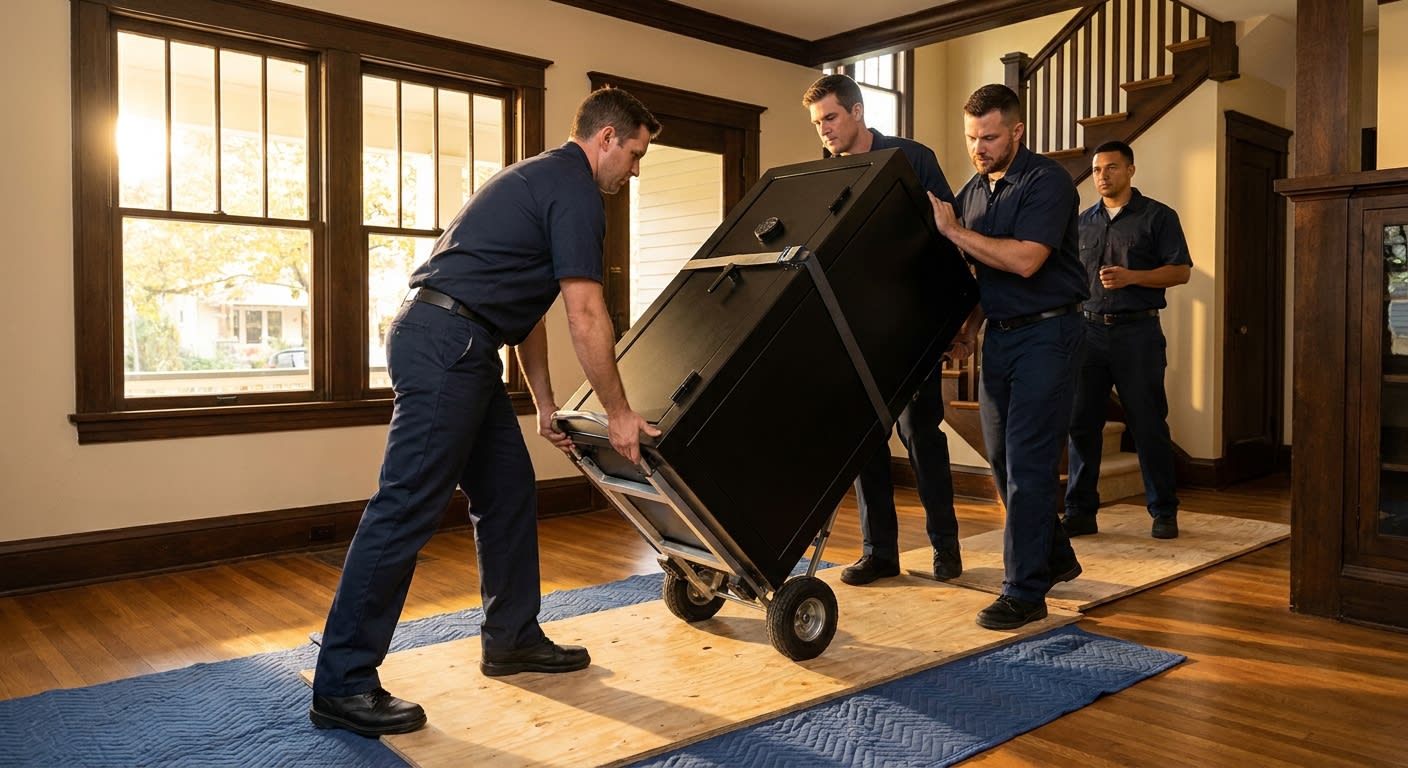
Three weeks ago I got a call from a homeowner in Hancock Park with a 720-pound Liberty Fatboy gun safe sitting in a second-floor office. The house was built in 1927, the original quarter-sawn oak floors had just been refinished, and the staircase had a 90-degree turn at the bottom with a 31-inch clearance at the narrowest point. The client had already gotten two quotes from movers who wanted to "tip and walk it" down the stairs on a regular furniture dolly. That's how you crack a tread, gouge a stringer, and end up with a $14,000 insurance claim. My crew did the job in 90 minutes with zero marks on the wood and zero damage to the walls.
I'm Amir Tabrizi, a Senior Move Foreman at SOS Moving, and I've personally moved more than 400 safes across Los Angeles, Orange County, and the Bay Area since 2020 — everything from 200-pound home safes to a 1,900-pound commercial floor model out of a Beverly Hills jeweler. In this guide I'll walk you through exactly how to move a heavy safe safely, what gear actually matters, where most DIY moves go sideways, and when you should stop and call a rigger instead.
Know Your Safe Before You Touch It
Before I quote a safe job, I need three numbers: weight, height, and base footprint. Most residential gun safes run 400 to 800 pounds. Mid-range commercial safes — the squat black ones you see in restaurant offices — usually hit 1,000 to 1,500 pounds. Anything labeled "TL-15" or "TL-30" rated jumps to 1,800 pounds and up because of the concrete amalgam composite inside the walls.
Weight matters because every dolly, strap, and ramp has a rated capacity. I run a Mavriks 1,200-pound appliance dolly for most home jobs and a 2,000-pound stair-climbing dolly with battery-assist for anything over 1,000 pounds. Height matters because doorways in older LA homes — Spanish Revival in Los Feliz, Craftsmans in Pasadena — often top out at 78 inches. If the safe is 72 inches tall and you have to tilt it 15 degrees to clear a doorframe, you've just added serious dynamic load to your dolly wheels. Footprint matters because a narrow tall safe wants to tip; a wide squat one wants to slide. Measure everything before the truck arrives.
Crew Size and Equipment for a Safe Move
To move a heavy safe safely, you need the right number of bodies on the job. Here's my rule of thumb after thousands of these moves: under 500 pounds, two strong movers plus me supervising. 500 to 1,000 pounds, three movers minimum with one dedicated to spotting and clearing the path. Over 1,000 pounds, four movers and a project-rated dolly. Over 1,500 pounds, I'm bringing a rigger and a Johnson bar, period.
Equipment list I bring to every safe job in 2026:
- Heavy-duty appliance dolly with 1,200-pound or 2,000-pound rating
- Stair-climbing dolly (electric assist for anything over 800 pounds)
- Four 2-inch ratchet straps rated to 3,300 pounds working load
- Eight thick moving blankets (the heavy 7.5-pound kind, not the cheap promo ones)
- Two 4x8 sheets of 3/4-inch plywood for floor protection
- One sheet of Masonite hardboard for the final smooth surface layer
- Two J-bars (also called pry bars) for tipping under the safe to slide the dolly plate
- Corner protectors and door-jamb guards
- A second furniture dolly as a "transfer cart" for flat sections
You don't grab any of this at a hardware store the morning of the move. If you don't already own it, rent the dolly and buy the blankets — or honestly, just call professionals at this weight class.
Protecting Floors: The Layered System
This is where I see the most DIY damage. A 700-pound safe on a dolly with two contact wheels puts about 350 pounds per wheel on a half-inch contact patch. That will dent hardwood, crack ceramic tile, and leave permanent compressions in luxury vinyl plank. My floor protection system has three layers from the ground up.
Layer one is the moving blanket directly on the floor — it absorbs grit and prevents micro-scratches. Layer two is the 3/4-inch plywood sheet — it spreads the dolly load across roughly 32 square feet instead of two wheel contact points. Layer three, only on slick floors like polished concrete or marble, is a Masonite sheet on top of the plywood so the dolly rolls smoothly without the wheels catching the plywood edge.
I lay the plywood in a continuous path from the safe's starting position to the truck. On a long run, my crew leapfrogs the sheets — as the safe passes the rear sheet, two guys pick it up and run it to the front of the line. Don't ever roll a loaded safe dolly directly on finished wood floors, even for "just a few feet." A few feet is all it takes to ruin a $20,000 refinishing job.
Protecting Walls and Door Frames
Walls take damage when a tall safe pivots through a doorway. The top corner of the safe traces an arc as the dolly tips, and that arc almost always intersects the door jamb at about 65 inches off the floor — right where the casing trim sticks out. I've patched a lot of holes in my career, and every single one was preventable with $20 of corner guards.
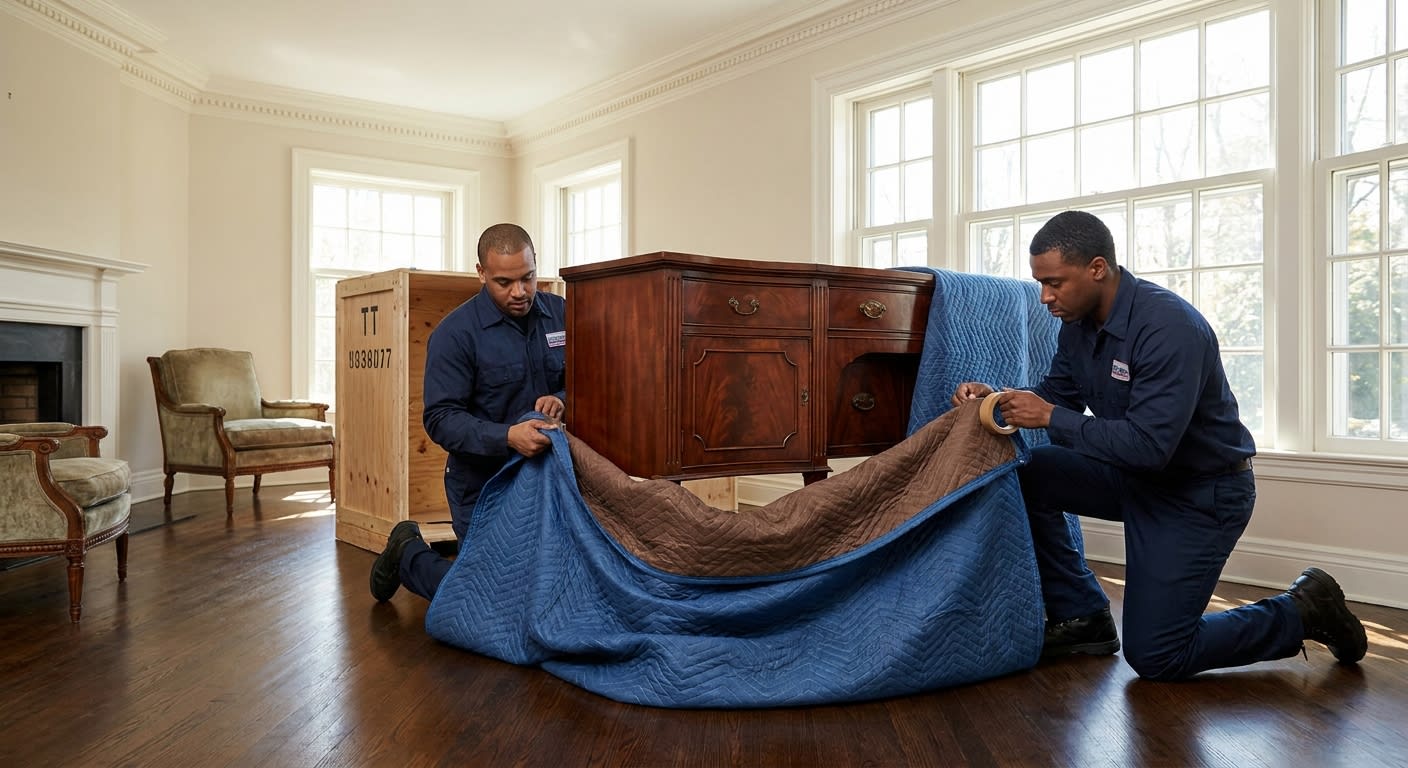
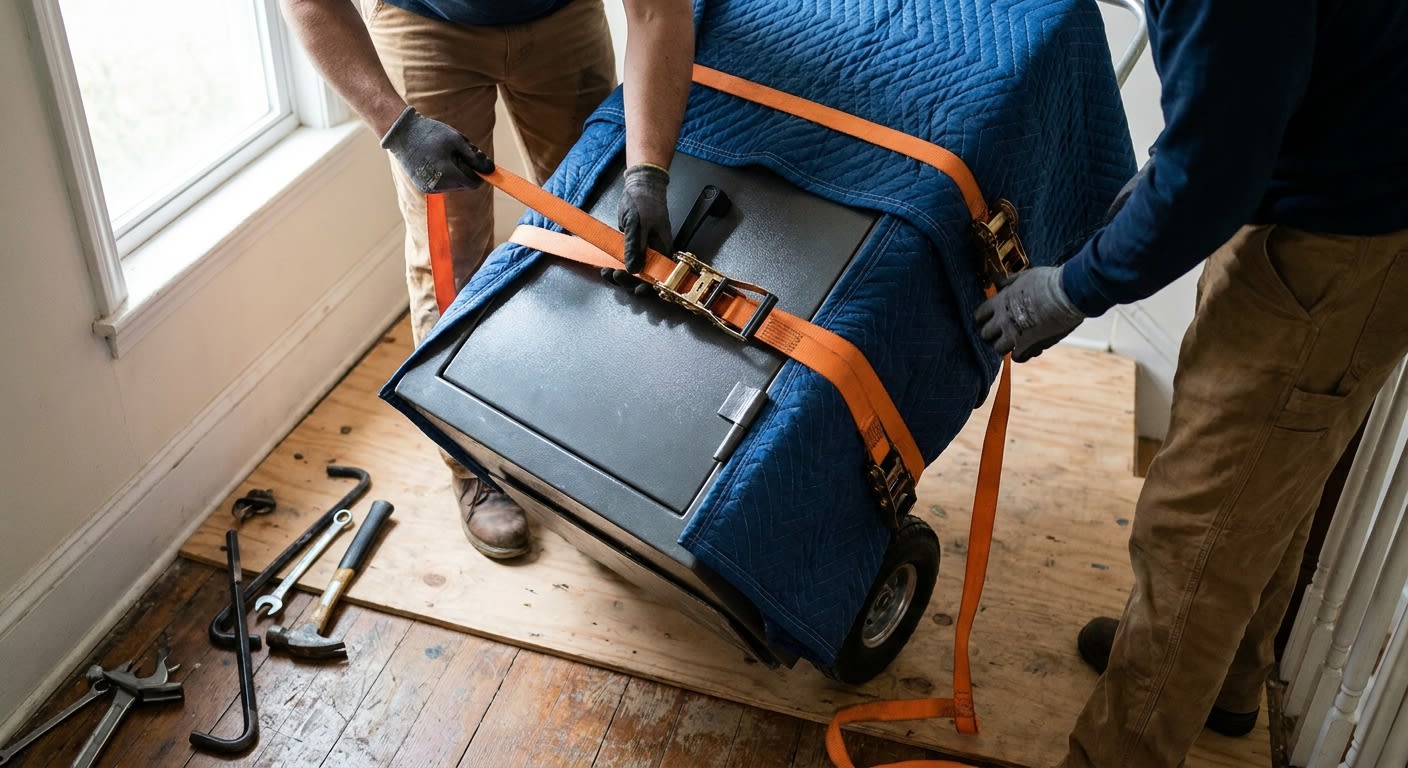
My crew wraps the safe with two moving blankets secured by stretch wrap before it ever leaves the room. We add foam corner protectors on all four top corners. On the doorframes, we tape on cardboard sleeves or use clip-on jamb guards. For the staircase walls — especially in older LA homes with original plaster — I run blanket padding along any wall section within 18 inches of the safe's path and pin it with painters tape, not masking tape, which lifts paint when you remove it.
🛡️ Got a 600+ pound safe, antiques, or anything irreplaceable? My white glove moving crew handles every safe job in LA with full floor and wall protection. Call (909) 443-0004 for a free estimate.
Stairs: Where Most Safe Moves Go Wrong
Stairs are the single most dangerous part of any safe move. The geometry is unforgiving — a typical residential staircase has a 7-inch rise and 11-inch tread, which puts the safe at roughly a 32-degree angle when transitioning between steps. At that angle, on an 800-pound safe, gravity is pulling more than 400 pounds down the slope. If the dolly slips, the safe doesn't stop until it hits something — usually a wall, a banister, or a person.
My approach: one operator on the stair-climbing dolly handles steering, one mover above the safe controls the descent rope (yes, an actual climbing-rated rope tied through the safe's bolt-down holes), and two movers below act as spotters with no weight responsibility — their only job is to clear obstacles and call out the step count. We descend one step at a time, never freewheeling. On any staircase with a turn, I stop the safe on the landing, reposition the dolly, and restart. Don't try to pivot mid-flight. My colleague Amir — well, that's me — and the technique I use overlaps with what's covered in my guide on moving a piano up stairs safely in Los Angeles, because the physics of heavy rectangular objects on stairs is fundamentally the same.
Loading the Truck and Securing the Safe
Getting the safe to the truck is half the job. Getting it into the truck and securing it for transit is the other half. I use a 1,500-pound rated walk ramp, not a regular truck ramp, for any safe over 600 pounds. The walk ramp has a flatter angle and a textured surface that prevents the dolly wheels from slipping when the safe's weight transfers from ground to ramp.
Inside the truck, the safe rides against the front wall or the wheel well — never in the middle of the box where it can shift. I secure it with four ratchet straps in an X pattern: two pulling forward into the front wall E-track, two pulling sideways into the wall E-track. I check the strap tension after the first five miles of driving because heavy loads tend to compress the blankets and create slack.
For LA jobs, I also plan the truck parking carefully. Curb-side loading in front of older homes in neighborhoods like West Adams or Silver Lake often requires a temporary no-parking permit so my truck can sit at the door. My colleague William covers the permit side in our guide to LA moving truck parking regulations, and I always check his article before a safe job in a tight-street neighborhood.
When to Call a Professional Rigger Instead
I'm a believer in DIY for the right jobs — moving a 250-pound home safe across a single-story ranch with a wheelchair ramp out front? Sure, rent a dolly and do it. But there's a clear threshold where I tell clients to stop. If your safe is over 1,000 pounds, if the path involves more than one staircase, if there's a 180-degree stair turn, if the destination is above the second floor, or if the safe is irreplaceable (heirloom, custom commercial-rated, or jewelry-store-grade) — call a rigger or a full-service moving crew.
A rigger uses specialized gear: skates, hydraulic toe jacks, gantries, and sometimes a small electric stair-climber that costs more than a used Honda. Riggers also carry $1 million-plus cargo insurance specific to safes and equipment moves. The cost difference is real — a professional safe move in LA in 2026 runs anywhere from $450 for a simple ground-floor relocation to $2,800 for a multi-story commercial safe — but compared to refinishing oak floors, replacing a banister, or paying an ER bill, it's the cheapest part of the project. This is exactly why SOS Moving offers licensed and insured full-service moving and storage, from $119/hour, thousands of local and long-distance relocations handled stress-free — we'd rather show up with the right crew and gear than try to retroactively fix damage.
FAQ
How much does it cost to move a safe in Los Angeles in 2026?
For a standard 400 to 800-pound home safe with ground-floor access at both locations, expect $350 to $650 in the current 2026 LA market. Add roughly $150 per flight of stairs, $200 to $400 for tight access situations, and $300 to $800 more for commercial safes over 1,200 pounds. Always get a flat-rate quote in writing for safe moves — hourly billing on a tricky safe job can balloon fast.
Can two strong friends and I move a 600-pound safe ourselves?
Physically, three people can roll a 600-pound safe on a properly rated dolly across a flat surface. The problem isn't the weight — it's the stairs, the doorframe pivots, the floor protection, and the truck loading. I'd say 90% of the DIY safe moves I've been called in to rescue went wrong in one of those four spots. If your path involves any stairs at all, hire pros.
Will a regular furniture dolly work for a heavy safe?
No. Standard four-wheel furniture dollies are rated for 700 to 1,000 pounds of evenly distributed weight, but a tall safe concentrates load on a small footprint and the wheels splay outward under that pressure. Use a heavy-duty appliance dolly with a strap and stair-climbing capability instead. The rental cost is about $35 to $55 per day in LA.
Do I need to empty the safe before moving it?
Yes, always. Empty the safe completely — guns, ammo, documents, cash, jewelry, hard drives, everything. A loaded safe is heavier, the contents shift during the move and can damage interior shelving or the lock mechanism, and most movers' cargo insurance specifically excludes contents inside safes. Transport valuables separately in your own vehicle.
How do I protect hardwood floors during a safe move?
Use a three-layer system: moving blanket on the floor, 3/4-inch plywood on top of the blanket, and on slick floors add a Masonite sheet on top of the plywood. Never roll a loaded safe dolly directly on finished wood, even briefly. Lay a continuous plywood path from the safe's starting position to the truck and have a crew member leapfrog sheets as the safe advances.
What's the difference between a mover and a safe rigger?
A general mover handles furniture, boxes, and standard household items up to typical residential weights. A rigger specializes in heavy equipment over 1,000 pounds — safes, industrial machinery, large statuary — and uses gantries, skates, toe jacks, and hydraulic lifts. At SOS Moving my crews handle most residential safe moves up to about 1,500 pounds; above that or for complex commercial jobs, I bring in a specialty rigger partner.
Ready to move a heavy safe safely without scarring your floors or cracking a doorframe? SOS Moving serves Los Angeles, Orange County, and the San Francisco Bay Area with licensed and insured crews trained on safes from 200 to 2,000 pounds. Call (909) 443-0004, email info@sosmovingla.net, or get a free quote. Licensed and insured — backed by a 4.9/5 Google rating across thousands of completed moves.