



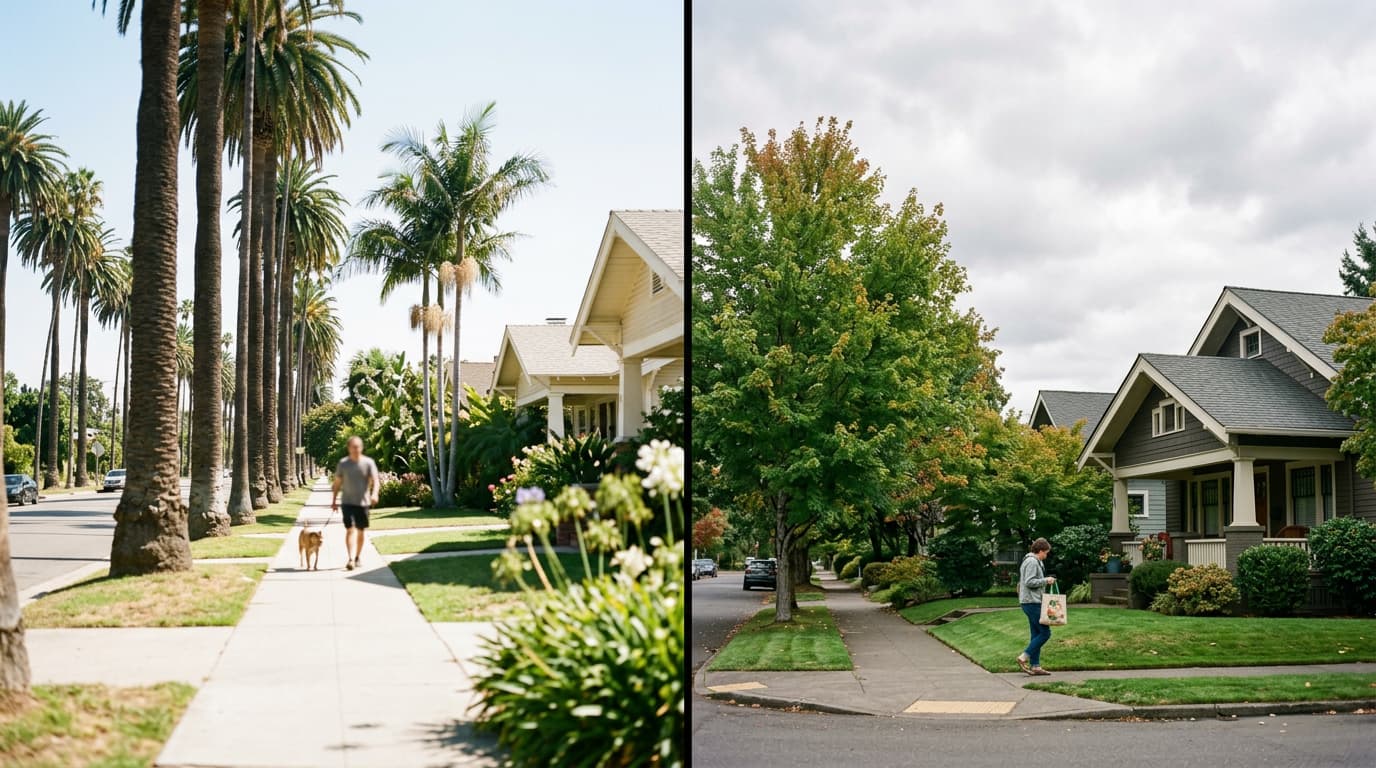
Portland has been pulling Angelenos north for years with a pitch that sounds almost too good: lower housing costs, no sales tax, a walkable downtown, world-class food and coffee, and enough trees to make you forget that concrete exists. The 960-mile drive up I-5 takes you from palm trees to evergreens in roughly fourteen hours, and the lifestyle shift is just as dramatic. But the financial picture of an LA-to-Portland move is more nuanced than the "everything is cheaper" narrative suggests — particularly when it comes to taxes, which is where most California transplants get surprised.
At SOS Moving, the Portland route is one of our regular Pacific Coast interstate corridors. Our Portland movers handle the Oregon end of the drive. The logistics are straightforward — a single highway connects the two cities with no mountain passes or desert crossings to complicate the transit. The decisions that matter happen before and after the drive, not during it. This guide covers the real costs, the tax implications that catch people off guard, and what daily life looks like when you trade year-round sunshine for 144 days of annual rainfall.
What the LA to Portland Move Costs
The 960-mile distance puts Portland moves in the mid-range of interstate pricing — shorter than a cross-country haul to the East Coast but long enough that flat-rate quotes make more sense than hourly billing.
A one-bedroom apartment runs $2,200 to $4,000 for full-service professional movers. A two-bedroom home costs $3,500 to $6,500. A three-bedroom house with a full garage pushes $6,000 to $10,000. These ranges include loading in Los Angeles, interstate transport up I-5, and unloading at your Portland address. Full packing services add $400 to $1,000 depending on household size.
The DIY option is tempting at this distance. A one-way U-Haul from LA to Portland runs $1,200 to $2,800 depending on truck size and season. Add fuel — roughly $200 to $250 for the 960-mile drive in a loaded truck — plus one to two nights of hotels, meals, and the physical exhaustion of loading and unloading without professional help. Total DIY cost lands between $1,500 and $3,500, which saves money over professional movers if you have help on both ends and don't mind spending two days behind the wheel of a vehicle that handles nothing like your car.
At SOS Moving, LA-to-Portland moves are quoted as flat-rate interstate jobs based on inventory weight and service level. The quote includes all protective materials — moving blankets, unlimited shrink wrap, heavy-duty tape, and wardrobe boxes — at no extra cost. Transit time is typically five to seven business days for standard delivery, with expedited options available for time-sensitive moves.
The I-5 Route: 960 Miles of Pacific Coast
The LA-to-Portland route follows Interstate 5 almost exclusively — a straight shot north through the Central Valley, over the Siskiyou Mountains at the Oregon border, and down into the Willamette Valley where Portland sits.
The drive breaks naturally into two days. Day one covers Los Angeles through the Central Valley to roughly Redding or the Oregon border — about 600 to 700 miles. Day two covers the remaining 250 to 350 miles through southern and central Oregon into Portland. Professional drivers running this route regularly can make it in a single push, but the fourteen-hour drive with a loaded truck is fatiguing and most carriers split it across two days for safety.
The Siskiyou Pass at the California-Oregon border sits at roughly 4,300 feet and is the only significant elevation change on the entire route. In winter — November through March — the pass can see snow and ice conditions that close the highway or require chains. Professional moving trucks running this route in winter carry chain sets and experienced drivers know the pass conditions. If you're driving a rental truck yourself in winter, check Caltrans and ODOT road condition reports before attempting the pass — a loaded 26-foot truck on an icy mountain road is a serious safety risk.
Summer driving is straightforward but hot through the Central Valley. Temperatures between Bakersfield and Redding regularly exceed 100 degrees from June through September. The same heat protection protocols that apply to desert moves apply here — keep heat-sensitive items in your air-conditioned car rather than the truck's cargo area.
The final stretch into Portland from the south passes through Salem and the Willamette Valley — green, flat, and mild. After fourteen hours of California highway, the sudden shift to forested hills and overcast skies feels like arriving in a different country, not just a different state.
Tax Implications: The Real Story
The tax comparison between California and Oregon is where most people get the headline right and the details wrong. Oregon's tax structure is different, not categorically better, and the net impact depends entirely on your income level and spending patterns.
Oregon has no sales tax. This is the headline everyone knows, and it's significant. California's combined state and local sales tax ranges from 7.25 to 10.25 percent depending on the city. For a household that spends $40,000 annually on taxable goods and services, the sales tax savings in Oregon amounts to $3,000 to $4,000 per year. That's real money that shows up in every shopping trip, restaurant meal, and large purchase.
Oregon's income tax, however, is higher than California's for most income brackets. Oregon's top marginal rate is 9.9 percent, which kicks in at relatively modest income levels — $125,000 for single filers. California's top rate of 13.3 percent is higher, but it doesn't apply until income exceeds $1 million. For earners between $60,000 and $250,000 — the range where most LA-to-Portland transplants fall — Oregon's effective income tax rate is often comparable to or slightly higher than California's.
The net tax impact for a household earning $120,000 works out roughly like this: California income tax of approximately $5,800 versus Oregon income tax of approximately $8,500, a difference of $2,700 more in Oregon. But the sales tax savings of $3,000 to $4,000 annually more than offset the income tax increase, putting the Portland household slightly ahead on a net tax basis. As income rises above $250,000, the California income tax rate climbs faster than Oregon's, making the move increasingly tax-favorable for higher earners.
Property taxes in Oregon are roughly comparable to California — both states have effective rates around 0.8 to 1.0 percent of assessed value. Oregon assesses at a percentage of real market value with annual growth limits, similar in spirit to California's Proposition 13 framework, though the specifics differ. The property tax difference between the two states is rarely the deciding financial factor.
The critical tax planning step for your move year is determining your residency date. California taxes your income through your last day of residency. Oregon taxes your income from your first day of residency. Both states require part-year resident returns. Your moving company invoice with dates serves as documentation of when the physical transition occurred — keep it with your tax records.
Planning your move to Portland? SOS Moving handles the LA departure logistics with flat-rate pricing, all materials included, and a crew that knows how to prep your belongings for a Pacific Coast transit. Call 909-443-0004 or get your free estimate.
Housing: Where the Real Savings Land
The housing cost difference between LA and Portland is where most transplants feel the financial shift most immediately, and the savings are substantial.
Portland's median home price sits around $475,000 compared to Los Angeles at over $900,000. That gap buys a fundamentally different living situation — a three-bedroom house with a yard in a Portland neighborhood like Sellwood, Hawthorne, or Alberta for the price of a small two-bedroom condo in most desirable LA areas.
Rental markets show a similar gap. A two-bedroom apartment in Portland averages $1,600 to $2,000 in desirable neighborhoods like the Pearl District, Division, or Mississippi. The same apartment in comparable LA neighborhoods — Silver Lake, Echo Park, Culver City — runs $2,800 to $3,500. Monthly savings of $1,000 to $1,500 on rent alone amount to $12,000 to $18,000 annually.
The combination of housing savings and sales tax elimination creates meaningful financial breathing room that most LA transplants describe as life-changing. The money you were spending to afford a one-bedroom in LA funds a two-bedroom in Portland with money left for savings, travel, or the other lifestyle upgrades that motivated the move.
One important caveat: Portland's housing market has tightened significantly over the past five years as California transplants have driven up demand. The bargain Portland of 2015 no longer exists. Prices remain well below LA, but the gap is narrowing in the most popular neighborhoods. East Portland and outer suburbs like Beaverton, Tigard, and Milwaukie offer the most value for families willing to commute.
The Lifestyle Shift
The daily experience of living in Portland differs from LA in ways that go beyond weather, and understanding these differences before you arrive prevents the disillusionment that sends some transplants back to California within a year.
Rain is the defining climate reality. Portland receives approximately 37 inches of rain annually spread across 144 days — compared to LA's 15 inches across 36 days. The rain isn't typically heavy — Portland's daily rainfall is often a light drizzle rather than a downpour — but the persistent gray overcast from October through June affects mood, energy, and outdoor plans in ways that first-year transplants consistently underestimate.
The compact geography is Portland's biggest lifestyle upgrade for most LA transplants. Portland's metro area spans roughly 25 miles across. LA's spans 70 miles. A cross-town commute in Portland takes 25 minutes. The same commute in LA takes 75 minutes. The difference in daily time recaptured — an hour or more every day — compounds into hundreds of extra hours per year for family, hobbies, rest, or anything other than sitting in traffic.
Portland's food and coffee scene is among the best in the country for a city its size. The concentration of independent restaurants, breweries, and coffee roasters per capita exceeds any city on the West Coast, including LA and San Francisco. What Portland lacks in the cultural breadth of LA's dining scene — the Korean, Japanese, Thai, and Mexican variety that reflects LA's immigrant communities — it compensates for with depth and craft in Pacific Northwest cuisine.
Public transit actually works in Portland. The MAX light rail, bus system, and streetcar network connect most of the urban core reliably enough that many residents go car-free — something that's functionally impossible in LA outside a few dense neighborhoods. If you're used to spending $300 to $500 per month on car payments, insurance, gas, and parking in LA, Portland's transit infrastructure can eliminate or significantly reduce that expense.
Vehicle and Administrative Transitions
Oregon gives you thirty days after establishing residency to register your vehicle and get an Oregon driver's license. The timeline is more generous than California's ten-day vehicle registration requirement.
Oregon does not require a smog or emissions test for vehicles registered outside the Portland metro area. Within the Portland metro — Multnomah, Washington, and Clackamas counties — vehicles require a DEQ (Department of Environmental Quality) emissions test. The test costs $25 and most California vehicles pass without issue.
Oregon driver's licenses are standard-issue at the DMV, with no appointment necessary at most locations. Wait times in Portland are shorter than LA DMV offices but still benefit from early-morning visits. The license is valid for eight years — more generous than California's five-year renewal cycle.
Car insurance rates in Oregon are generally lower than LA, though the specific savings depend on your zip code and driving history. Portland's theft rate is higher than the LA average in certain neighborhoods, which can offset some of the base-rate savings. Shop rates before your move to optimize coverage and pricing.
Frequently Asked Questions
How long does the LA to Portland move take? Drive time is approximately fourteen hours on I-5. Professional movers deliver within five to seven business days for standard service. Expedited options reduce transit to three to four days.
Is Oregon really cheaper than California? For most households, yes. The combination of lower housing costs and zero sales tax more than offsets Oregon's slightly higher income tax rates for earners below $250,000. Above that income level, the tax advantage grows as California's higher income tax brackets kick in.
What is the best time of year to move from LA to Portland? Late spring through early fall — May through September — offers the best weather on both ends and avoids winter conditions on the Siskiyou Pass. September is ideal: summer prices are fading, Portland weather is still pleasant, and the pass is clear.
Do I need to change my car insurance for Oregon? Yes. Oregon requires Oregon-registered insurance within thirty days of establishing residency. Rates are generally lower than LA, but shop multiple providers because Portland-specific factors like vehicle theft rates affect pricing.
Will I miss the sunshine? Honestly, most transplants underestimate the impact of Portland's gray season. The first winter is the hardest. Investing in a light therapy lamp, staying physically active, and embracing outdoor activities in the rain — rather than avoiding them — are the strategies that long-term transplants recommend.
Get Started with Your Pacific Coast Move
SOS Moving handles the Los Angeles departure for your Portland relocation — flat-rate pricing, all materials included, and transit coordination up the I-5 corridor. Call 909-443-0004 or request your free estimate to start planning your move from sunshine to evergreens.