



%201.svg)














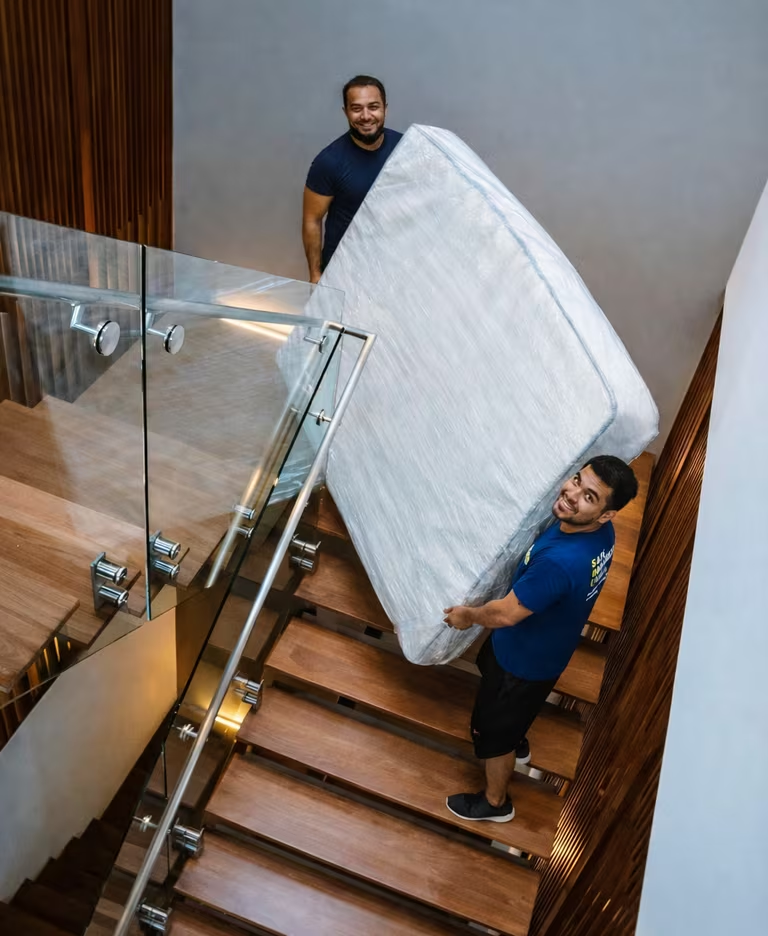
A single booking covers everything between your old door and your new one. The crew wraps furniture in moving blankets and stretch wrap, takes apart bed frames and tables that will not clear a tight hallway turn, carries the load down, drives it over and rebuilds each piece in the room you point to. Floors, walls and door frames along the route are covered first, since in a rental a scuffed corridor tends to come out of the tenant's deposit.
Here is how a job at a Newport Beach apartment runs with us:








Apartment moves within the region are billed per hour. Two things set the rate: how many movers you book, and whether the job falls Monday to Thursday or Friday to Sunday. Cash comes out lower than card at every crew size.
On top of the hours come a $30 gas fee, $50 for a certificate of insurance if the building needs one, and $200 if the load calls for a second truck. The $50 deposit taken at booking is credited toward the final bill. Every job carries a 3-hour minimum, and hours after the eighth count as overtime.
Newport Beach sits in Orange County, away from our Los Angeles base, so two distance rules from the rate sheet can come into play: a 4-hour minimum once a job is 30 or more miles from the base, and drive time counted double past 10 miles. We do not guess the mileage here; the coordinator checks your two addresses and tells you on the call which rules apply. A move out of California is priced another way, as a flat rate rather than by the hour.
If your building's service door opens onto an alley, the municipal code sets a firm limit: a vehicle may stop there only to load or unload people or materials, unless the City Council has designated that alley for parking. We plan around it by treating the alley as a working bay.
The truck pulls in when the crew is ready to carry, one mover stays with it, and if the work stalls, say for a shared elevator or a delivery van behind us, the truck moves off to a legal curb space and returns when loading resumes. Before the date, send us a photo of the door we will use and tell us where the elevator opens. That shows us whether the alley or the street is the better side to load from, and how many trips the crew should expect.
Several rental communities in the city are Irvine Company properties, among them Villas Fashion Island, Colony at Fashion Island, Promontory Point, Newport Ridge and Baypointe. We have not found their move-in and move-out rules published anywhere, so we do not guess at elevator hours, deposits or truck limits. Ask the leasing office for its move packet the week you give notice and forward it to us.
We read it for three things: the allowed window, how the elevator or loading area is reserved, and the insurance wording. If the office asks for a certificate of insurance naming the owner, we issue one for $50 and send it ahead of the move. Condo associations anywhere in Newport Beach get the same treatment: their written rules, our paperwork, and one agreed plan before a crew is assigned.
The Balboa Peninsula has water on three sides, and cars reach it only by Newport Boulevard and Balboa Boulevard. A City pedestrian study describes both as often crowded with cars, bikes and people on foot in summer, and on weekends and holidays all year. On an hourly move that congestion is paid time, so for peninsula apartments we suggest a weekday start at 8AM, and the crew lays floor and door protection before the first carry.
Uptown Newport is a different setting: a 25-acre planned neighborhood in the Airport Area along Jamboree Road, entered from Birch Street and surrounded by Koll Center office buildings. The land once held telecom and chip-making plants, and the plan allows 1,244 homes. Residents there share driveways with office traffic, so we confirm with management which entrance the truck should use.
The traffic study behind the City's General Plan counted a set of road segments, most of them near the coast, and every one carried more cars in summer: at least 5 percent more, and up to 74 percent more. The same study calls parking in the coastal parts of the city limited, above all in the peak summer months. That stretches both the drive down from our Los Angeles base and the final approach to your door.
We work every day from 8AM to 6PM; for a coastal apartment in summer we recommend the first weekday slot. Distance rules still shape the bill: the minimum rises to 4 hours for jobs 30 or more miles from the base, and drive time past 10 miles is doubled. A move booked the same morning is still on the table when a crew has an open slot.






Only while it is being loaded or unloaded. City code bans stopping or parking in an alley for any other purpose unless the City Council has designated it for parking. We load from the alley when it is the shortest route and move the truck to a legal curb space whenever the crew has to pause.
You pay an hourly rate set by crew size and day of the week, starting at $119 an hour in cash for two movers and a truck from Monday to Thursday. Because Newport Beach lies outside our home area, the 4-hour minimum for jobs 30+ miles from the base and double drive time beyond 10 miles may apply. The coordinator checks both addresses and tells you which rules apply before you book.
Yes. Send us the holder name and any wording the office requires, and we issue the certificate for $50 and send it before the move. Irvine Company communities and condo associations set their own requirements, so we work from the document they hand you.
It is the hardest slot of the week. Only Newport Boulevard and Balboa Boulevard reach the peninsula, and the City describes both as often congested in summer and on weekends and holidays. Since the clock runs by the hour, a weekday morning usually costs less, and Monday to Thursday rates are lower as well.
Yes, if a crew is free. We work every day between 8AM and 6PM, so a same-day job has to fit inside that window, and we do not run evening moves. Call 909-443-0004 early in the day to leave the crew enough hours.
Ask each mover for three things before you book: a state license number, a certificate of insurance your building will accept, and a rate that shows crew size, day of the week and travel rules. Our numbers are CAL-T0192140, USDOT 3398018 and MC 1153871. Our reviews stand at 4.9 on Google and 4.8 on Yelp.
Most apartment moves start from a date someone else picked: a lease that ends, another that begins, a move-out deadline set by the building. Plan backward from it. Call a mover in the same week you give notice, since the building's paperwork usually takes longer to line up than the move itself.
In the first days after notice, ask the leasing office for three documents: the move packet, the form for reserving an elevator or loading area if the building has one, and its insurance requirements for vendors. Pass all three to your coordinator. We compare them with our calendar, choose the crew size and propose a start time that fits both the building's window and our working day.
A week out, reserve the elevator for the full slot instead of a single hour, and confirm where the truck will stand at each address. The evening before, empty dressers and nightstands. The foreman on site may let a light piece travel with its contents, but the default is empty drawers, because a loaded dresser is heavier and its joints take the strain.
On the day, the crew walks the route, protects it and loads the largest pieces first so the truck packs tight from the front wall. Boxes go next, and the last things on are the ones you want first at the new place: mattresses, bedding, a lamp and the coffee maker.
Once the truck is loaded, give the empty unit ten minutes before you hand back the keys. Open every closet and cabinet, check the balcony and any storage cage, and photograph the walls and floors. Leasing offices compare the unit with its move-in condition, and dated photos help settle any argument about the deposit.
Short notice happens too: a lease falls through, or a unit opens up early. We take same-day jobs when a crew is free, but a building that needs a certificate or an elevator booking may not turn its paperwork around that fast, so call the management office before you call us.
On a local apartment job, the distance between the truck and your front door drives the hours more than the road does. Every extra minute of carrying repeats on each trip the crew makes, and even a one-bedroom unit means dozens of trips.
When you book, describe both ends: street or alley, how far it is from the truck to the lobby, whether there is a garage and how low its entrance is. A moving truck rarely fits under a residential garage entrance, so a garage elevator helps only if the crew can reach it on foot from the street.
If the building has a marked loading area, ask management to hold it for your slot. If it has none, tell us, and we plan the carry from the nearest legal curb space. The new address deserves the same questions, and they matter even more there, because the crew arrives with a full truck and every piece has to travel the route once.
Inside the building, the question is the route. A third-floor walk-up with a straight stairwell can go faster than a high floor served by one elevator that the whole building shares. Tell us which you have, how many flights or floors, and how far the elevator is from the loading door; those three answers shape the crew size we suggest.
Long corridors in large complexes add time of their own, since a unit at the far end of a hallway can mean a longer carry than the elevator ride. Where the building allows it, the crew stages furniture near the elevator so the car goes down full on every trip.
Pieces that will not make a stairwell turn come apart: bed frames, dining tables, desks with removable tops, sectionals that unclip. The crew brings its own tools, bags and labels the hardware, and rebuilds each piece in the room you name. A wall-mounted TV comes down and gets packed, but for insurance reasons we leave remounting it to you or an installer.
Protection goes down before the first piece moves: floors on the route are covered, door frames are padded, and furniture travels in blankets and stretch wrap. For towers with booked elevators and docks, our guide to high-rise move-in rules lists what building managers typically ask of tenants.
An hourly rate says little by itself. Before comparing quotes, check that each one names the crew size, the weekday or weekend rate, the minimum hours and the way travel time is billed. With a drive from Los Angeles involved, those last two lines can move the total as much as the rate does.
Our full rate list sits in the pricing section above. What changes the final bill is the number of hours, and that depends on four things:
Two small choices also shift the number: Monday to Thursday dates cost less than Friday to Sunday, and cash costs less than card at every crew size. Put the same questions to every mover you call. If a company cannot give you its license number, produce a certificate your building will accept or explain how it bills travel, it is a poor match for a managed apartment building at any hourly rate.
Reviews are worth reading for detail rather than stars alone. Look for mentions of stairs, elevators, parking and how the crew dealt with building staff, because those are the parts of an apartment move that tend to go wrong. A long review history shows how a mover handles the awkward jobs, not only the easy ones.
Packing on your own saves paid hours only when the boxes are finished before the crew shows up: taped, marked with the room, stacked near the door. A kitchen still half in the cupboards at 8AM can cost more time than a staircase.
Tape and stretch wrap come free and without a limit on every estimate. Boxes in small, medium and large sizes start at $4, and you pay only for the ones used. Wardrobe boxes are on the truck, so hanging clothes can travel on their hangers. If you would rather hand the whole job over, the crew can pack by the hour as well; our packing service explains how that day runs.
Write the room name on the side of each box as well as the top, so it stays readable when cartons are stacked. For a studio or a one-bedroom, one room name per box is enough; in larger units, number the first-night boxes and keep a short list of what each one holds.
Keep one bag out of the boxes for documents, IDs, keys, chargers, medication and valuables, and carry it yourself. Anything you are not taking should be gone before moving day, since the crew bills the same for carrying a chair you meant to leave behind.
Not every apartment move ends across town. When the new address is in another state, billing switches from hourly to a flat rate for the whole trip, and our federal registrations, USDOT 3398018 and MC 1153871, cover the interstate part. How that works from here is set out on our page on long-distance moves from Newport Beach.
A piano in the living room changes the crew, not the model. The move stays hourly, with four movers, a $200 add-on for the instrument and a 3-hour minimum, and the distance rules apply as usual. The details are on the Newport Beach piano moving page.
For a move between two apartments in the same city, our main page on apartment moves sets out the full service: hourly billing and one rate sheet, from the first carry to the last. Moving a house rather than a unit? Our movers in Newport Beach cover that too.














.jpg)