




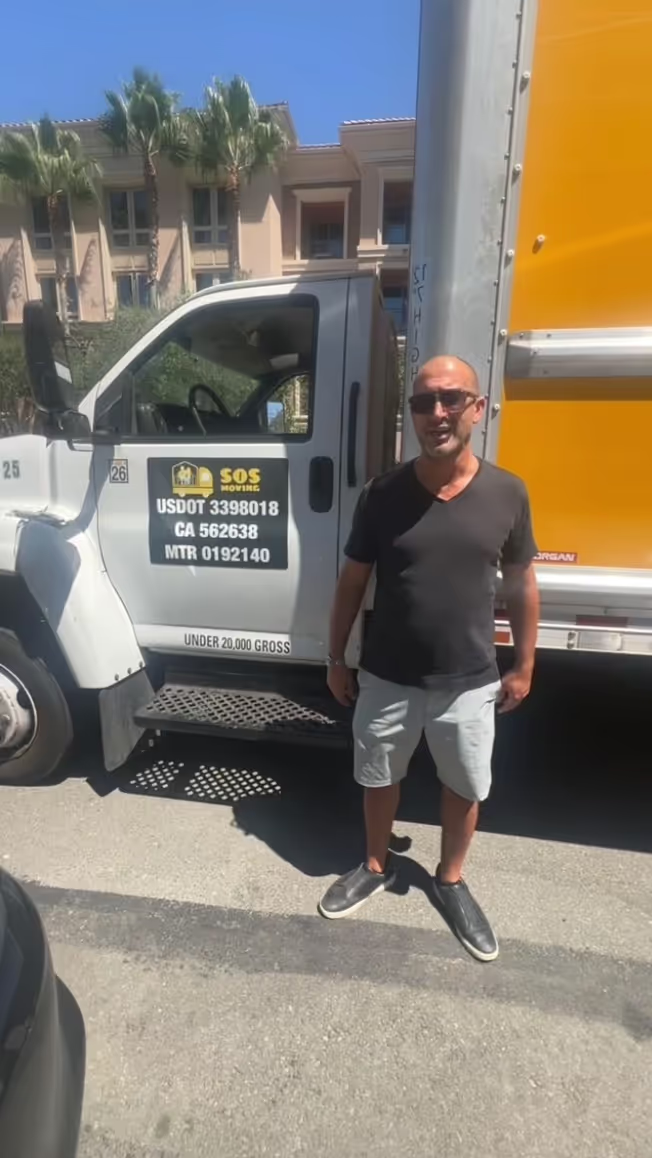
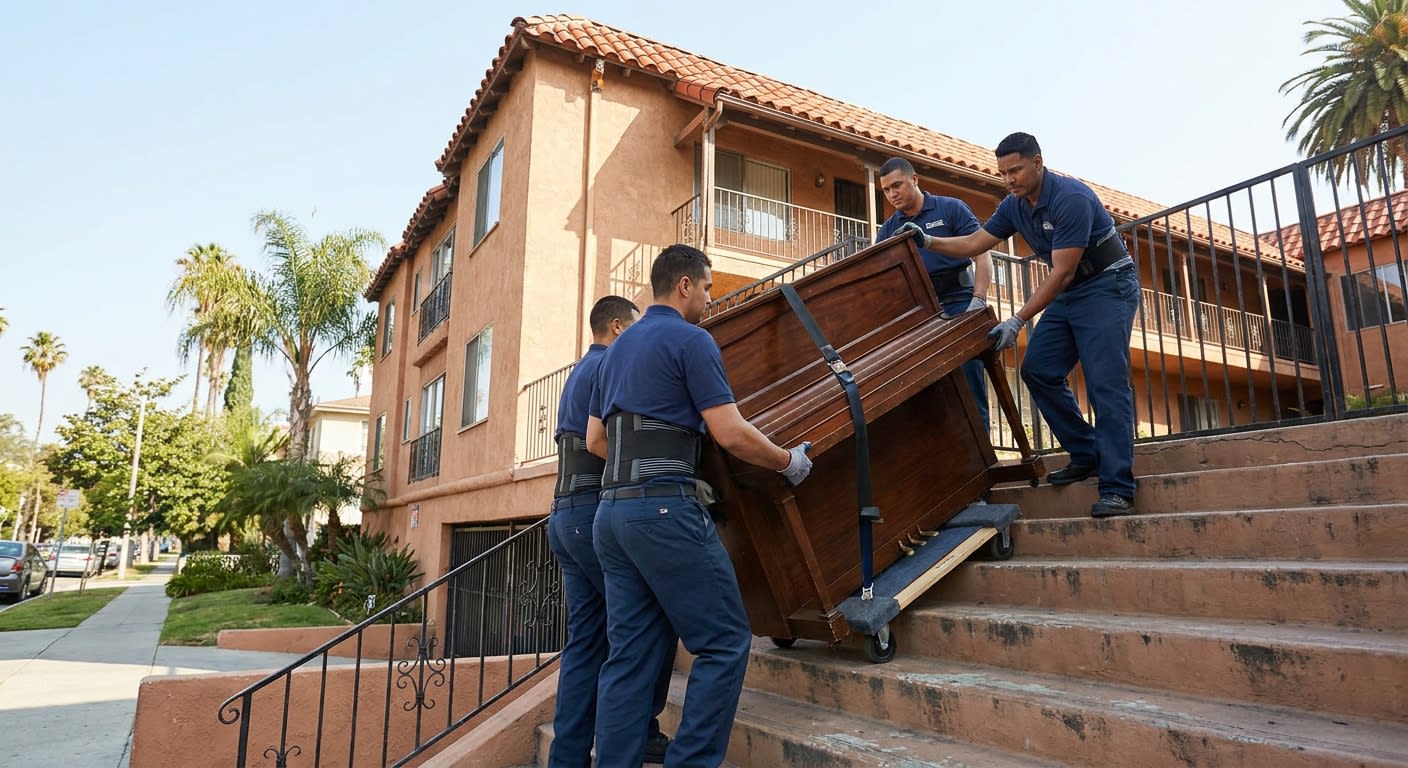



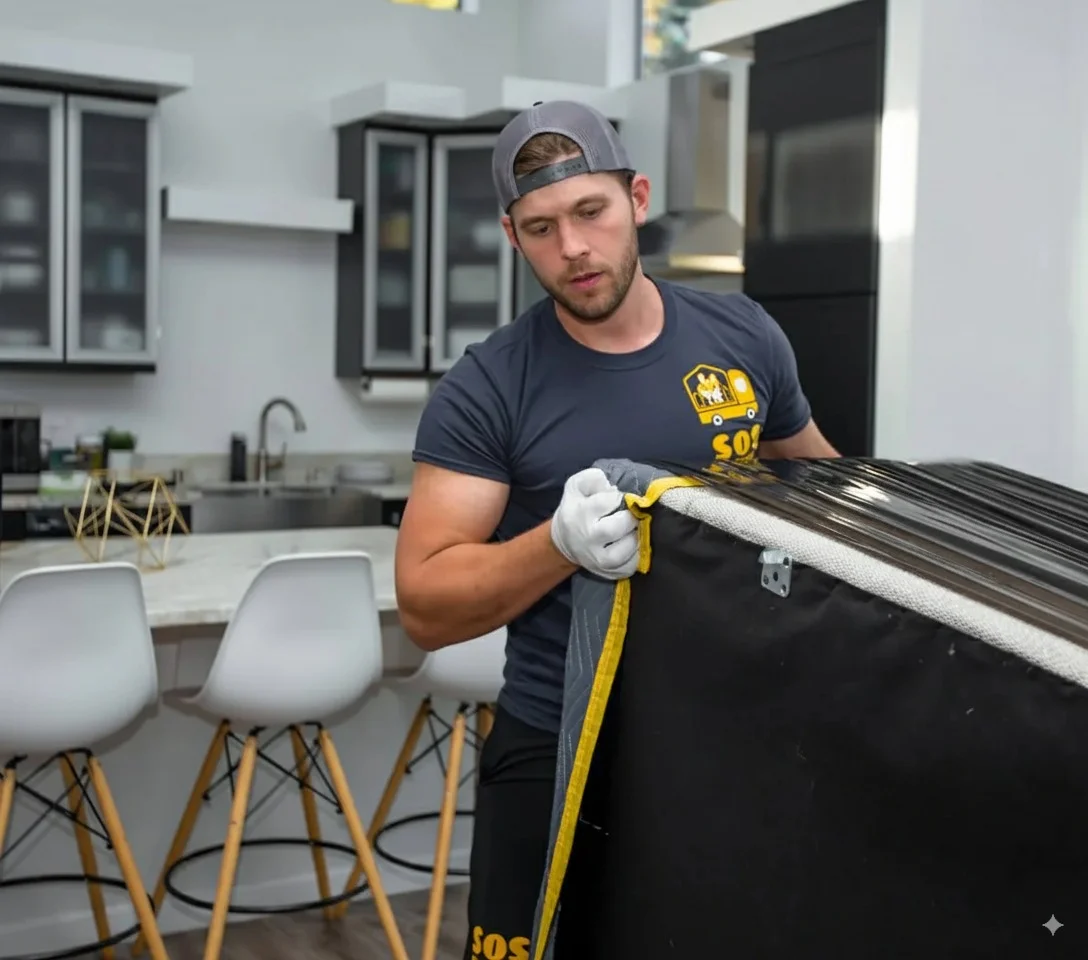
SOS Moving provides piano moving services in Newport Beach, CA the same way it handles any heavy household piece: inside an hourly move, with one truck and a crew of four around the instrument. The method, the gear and the $200 add-on are spelled out on our piano movers page for Los Angeles and Southern California, and the rest of a local household relocation is covered on our Newport Beach movers page. What follows is the local part: bridges, guard gates, narrow island streets and a bay that splits the city in two.
What a piano job here includes:
Uprights ride standing up. A grand is taken apart first: the legs, the pedal lyre and the lid come off, the body goes onto the board on its straight side, and at the new house the crew puts it back together in the room you choose.


The base minimum is 3 hours for the whole job, not for the piano alone. Every crew leaves from 5530 Jillson Street in Los Angeles, and two distance rules apply on the way to Orange County: an address 30 or more miles from that base carries a 4-hour minimum, and drive time beyond 10 miles is counted double. We do not print a mileage figure for your street here; the office runs both rules against your real pickup and delivery addresses when it prepares the quote.
Overtime starts after 8 hours, which usually comes into play only when the piano travels with a large house.
The City of Newport Beach itself warns that some of its tight residential areas cannot take larger moving vans, and it names Balboa Island among them. For a piano that is more than a parking nuisance. Every yard between the truck and the front door is walked by four people holding a loaded board, so the spot where the truck stops sets part of the bill.
When you book, send the exact address with photos of the street in front and of the side or rear access. The office uses them to decide where the truck will wait and how far the crew will carry, and that carry goes into the estimate before move day instead of surprising anyone on it. If your household has cars, keep the curb at your door free on the morning of the move.
Some of the best-known neighborhoods in the city sit behind staffed guard gates. Big Canyon, a gated community built around a golf course, and Linda Isle, a gated island where every home is on the water, are two familiar examples. Up in Newport Coast, most of the top-tier enclaves keep staffed gates and patrols; their associations issue vendor passes and set policies for move-ins, and some entry lanes now read license plates.
A crew waiting at a gate is still on the hourly clock, so we ask for two things a few days ahead: SOS Moving on the gate list for your date, and the association's move-in rules in writing. We reply with the crew leader's name, the arrival time and the truck plate. If the association or a building wants insurance paperwork, the certificate costs $50.
Balboa Island is a grid of small lots with narrow streets and alleys. Vehicles reach it over the short two-lane Marine Avenue bridge from the Bayside Drive and Jamboree side; the only other way on is the ferry from the Peninsula, which takes about three cars a trip, so our truck always uses the bridge.
Spyglass Hill is an Irvine Company village from the late 1960s and early 1970s on the mesa ridge across from Newport Center, bounded by San Joaquin Hills Road to the west and MacArthur Boulevard to the north; there we ask for a photo of each step from curb to entry. In the Flower Streets of Corona del Mar, named in alphabetical order from Acacia to Poppy, beach cottages, many since enlarged or replaced, share blocks with contemporary houses built around courtyards and rooftop decks, so the courtyard gate gets measured before the lift.
Upper Newport Bay splits the city, and the General Plan counts only two east-west routes across it: Coast Highway and the Bristol Street/SR-73 corridor. Both carry heavy volumes and congest. A piano going from one side of the bay to the other rides one of them, so the crew leader picks the route by time of day and checks for lane work before rolling.
Caltrans owns and runs Coast Highway everywhere except the stretch between Jamboree Road and Newport Coast Drive, so its notices cover most of that road. We work Monday through Sunday from 8AM to 6PM, and drive time from Los Angeles counts toward the hours, so an early start keeps the carry comfortably inside the window. A same-day piano move is possible whenever a crew of four is free.
Home type in Newport Beach and what the crew of four prepares:
| Home type in Newport Beach | What the crew of four prepares |
|---|---|
| Cottage or rebuilt house on the small-lot grid of Balboa Island | Street and alley photos reviewed before the day; a truck stop planned once it crosses the Marine Avenue bridge; extra pads for a longer walk on the board. |
| Home inside a guard-gated community such as Big Canyon or Linda Isle | Crew added to the gate list for the date; the leader's name, arrival time and truck plate sent to you; the path from the drive to the door walked before the first lift. |
| Newport Coast home under an association that issues vendor passes | Move-in policy read through with you in advance; the vendor pass arranged through you; the plate number supplied where entry lanes read license plates. |
| House on the Spyglass Hill mesa ridge | Photos of each outside step; runners laid from the entry to the piano room; straps rechecked before any step down toward the truck. |
| Flower Streets home with a courtyard or a rooftop deck | Courtyard gate width measured; interior stairs checked when the piano stands on an upper level; grand legs and lid removed ahead of the tightest turn. |













Add SOS Moving to the gate list for the move date and ask your association for its move-in and vendor-pass rules. We send back the crew leader's name, the arrival time and the truck plate for the pass. If the association asks for proof of insurance, we issue the certificate for $50.
Yes, over the Marine Avenue bridge; the small car ferry is no route for a moving truck. The City notes that larger moving vans do not fit some tight residential streets on the island, so send photos of your street and alley when you book. We plan the truck's stop and the length of the carry from them and include that time in the estimate.
The house and the piano share one hourly clock with a crew of four: $199 to $225 an hour depending on the day and how you pay, plus the $200 piano add-on, $30 for gas and a $50 deposit credited to the bill. Addresses 30 or more miles from our Los Angeles base carry a 4-hour minimum, and drive time beyond 10 miles counts double. The office applies both rules to your exact addresses.
Often, yes, if a four-person crew is free. Call 909-443-0004 as early as you can: we work Monday through Sunday, 8AM to 6PM, and the drive from Los Angeles, the carry and the unload all have to fit inside that day.
No. Our crews only move pianos, so tuning, appraising, repairs, storage and haul-away all sit outside the service we sell. Let the instrument settle into its new room for a while, then book a tuner you trust.
Most of a piano move is decided on the phone. When you call, the office asks what kind of piano you own, what lies between it and the street, whether a guard gate or an association has to clear the visit, and on which side of Upper Newport Bay each address sits. The crew size is fixed at four; the answers shape everything else, from the start time to the first estimate of hours.
Photos save more time than any description. Take pictures of the piano, of the door it will leave through, of every outside step and of the street where the truck would stop. On Balboa Island, add the alley behind the house. With those images the crew leader can see before the day where the tightest turn is and where a grand will be taken apart.
After the call, the office sends a quote that lists the crew, the hourly rate for your day, the piano add-on and the minimum that applies to your addresses. The method behind it is the one SOS uses across the region. What changes here is the local layer, the gates, the island streets and the bay, and that layer decides how long the same method takes.
The lid and fallboard are closed, the cabinet is wrapped in moving pads, and all four movers lift it onto a padded board at once. Straps belt it to the board, so the weight rides on the board rather than on the small casters. Those casters were made to nudge a piano a few inches along a wall, not to roll it across a patio or down a ramp.
Uprights travel standing and are tilted only as far as a step or a ramp requires. A grand comes apart before it moves: legs, pedal lyre and lid are removed and padded on their own, and the body lies on the board on its straight side. In the truck the piano is strapped against the wall so turns and braking cannot shift it, and at the new home every step runs in reverse until the piano stands where you want it.
Floors and frames get their own attention. Hardwood, tile and stone on the route are covered before the first lift, door frames along the path are padded, and an elevator car, where the building has one, is lined before the piano goes in.
The type of piano changes the plan in predictable ways: a spinet or console turns easily in a hallway, a tall upright is top-heavy on a stair, and a grand is judged by its tightest corner rather than by the width of the front door. The instrument-by-instrument breakdown lives on our main piano moving page, so we keep it short here.
A clear path is worth more than a fast crew. The evening before, move rugs, plants, side tables and anything hanging low along the route from the piano to the door. If the board will pass through a side yard, clear bikes and outdoor furniture out of it as well.
Empty the piano bench, take photos and ornaments off the lid and close the fallboard. Unplug lamps near the instrument and roll away anything on casters that sits close to it. If the room meant for the piano at the new home will not be empty when we arrive, say so, and we will unload the piano before the furniture that would block its way.
The gate is the step people forget. In a guard-gated community, add the crew to the guest list so the truck is not held at the gatehouse, and expect an association with vendor passes to want paperwork several days earlier. Call the gate and the association as soon as the date is fixed and forward their rules to our office. When a building or an association asks for a certificate of insurance, we provide it for $50.
Pets and small children are safer in a closed room or at a neighbor's house while the board is moving; four people carrying a piano cannot stop short for a dog underfoot.
Think about parking at both ends. The truck needs a stop close to the door, so ask your household and, if you can, your neighbors to leave the curb in front of the house open that morning.
On arrival the crew leader walks the route before the piano moves at all: truck to door, door to room and every turn in between. Three things set the pace, namely the number of steps, the tightest corner and the distance from the parked truck to the entry.
On a narrow island street that distance can grow when the truck cannot stop right at the door. The piano then covers the extra yards on its board with four movers around it. That is slower than a short hop from a driveway, but the time was already in the estimate because the photos showed the street.
In a house built around a courtyard, the courtyard gate is often the narrowest opening on the whole path. A grand without its legs fits through openings an assembled one never could, so the crew chooses where to take it apart based on that gate rather than on the front door.
For an upright headed up an inside stair, two movers take the low side and the pace follows the steps; our guide to carrying a piano up a staircase explains why the lower side matters. In a condo the elevator replaces the stairs as the deciding measurement, so we ask for the inside size of the car and the width of the corridor corner outside your door.
Most piano calls are really calls about a house or an apartment, and SOS books the piano inside that move. That means a single crew of four and a single truck for the day. The piano is wrapped while the room around it still stands and unloaded early at the new address, so it reaches its room before boxes crowd the floor.
Inside the truck the piano gets a place against the wall where the straps can hold it for the whole drive, and nothing heavy is stacked against its case. Boxes and soft furniture fill the space around it afterwards.
If you are leaving a condo or a rented unit, the building rules on elevators and loading times cover the piano as much as the sofa; our page on apartment moves in Newport Beach deals with that side of the day. For the rest of a household relocation in town, see the SOS moving crews for Newport Beach homes.
If only the piano is moving, say from a living room to a new home a few streets away, the same crew of four and the same hourly rules apply. The 3-hour minimum, or the 4-hour one for addresses 30 or more miles from our base, covers the job even when the carry itself is short.
Firms that carry nothing but pianos make sense when a single instrument goes across town. When the whole home moves the same day, one crew is simpler: nobody waits for a second company, and the piano does not stand in a hallway while the rooms are loaded around it.
The bill follows the clock, and access sets the clock. These factors change the hours the most:
None of these is a surcharge. Each one simply adds minutes to an hourly clock, which is why the photos and the call to the gate matter as much as the rate.
Two rules turn distance into time. An address 30 or more miles from our base carries a 4-hour minimum instead of 3, and drive time beyond 10 miles counts double. This page does not guess the mileage to your street; the office runs both rules against the addresses you give and shows the result in the quote.
Long days have a rule too: overtime applies after 8 hours. A piano added to a large house can push the job toward that line, so for a big household we suggest the earliest start in the 8AM – 6PM window. For the background, our piece on why a piano costs more to move than other furniture walks through where the money goes.
Quotes for the same piano can look far apart, and the lowest one rarely covers the same work. Ask every company three questions: how many movers arrive, what equipment comes on the truck, and whether the piano is priced alone or as part of the hourly move.
Then ask where the crew starts its day. On an hourly job, drive time is part of the bill, so a company's base matters. Every SOS crew starts at one headquarters, 5530 Jillson Street in Los Angeles; we keep no office in Orange County, and we would rather say so now than let the distance rules above come as a surprise.
Read past the star counts as well. SOS holds 4.9 on Google from 1,007 reviews and 4.8 on Yelp from 1,585, yet the reviews worth your time are the ones that mention stairs, gates and heavy pieces, because they describe the kind of day a piano brings.
A good piano moving company in Newport Beach, CA also tells you what it does not do. SOS does not tune, appraise, repair, refinish, store or dispose of pianos. Give the instrument time to settle into its new room, then call a tuner you trust.
Our crews work Monday through Sunday from 8AM to 6PM. There are no overnight jobs, so the whole piano move, the drive included, has to fit inside that window, and a morning start leaves the most room.
Same-day moves happen. If you call 909-443-0004 early and a crew of four is open, the piano can move that day; the later the call, the less of the day is left for the drive, the carry and the unload.
A search for piano movers near Newport Beach often starts with a closing date or a lease that ends sooner than planned. Whatever the reason, give the office the gate details, the truck access and photos of the path on the first call. A crew can only work as fast as the gate and the curb allow, and those are the two things you can settle before we arrive.
When you call, keep both addresses, the piano type and the gate or association contact at hand. With those in front of the office, a crew and an arrival time can be confirmed in one conversation instead of three.