





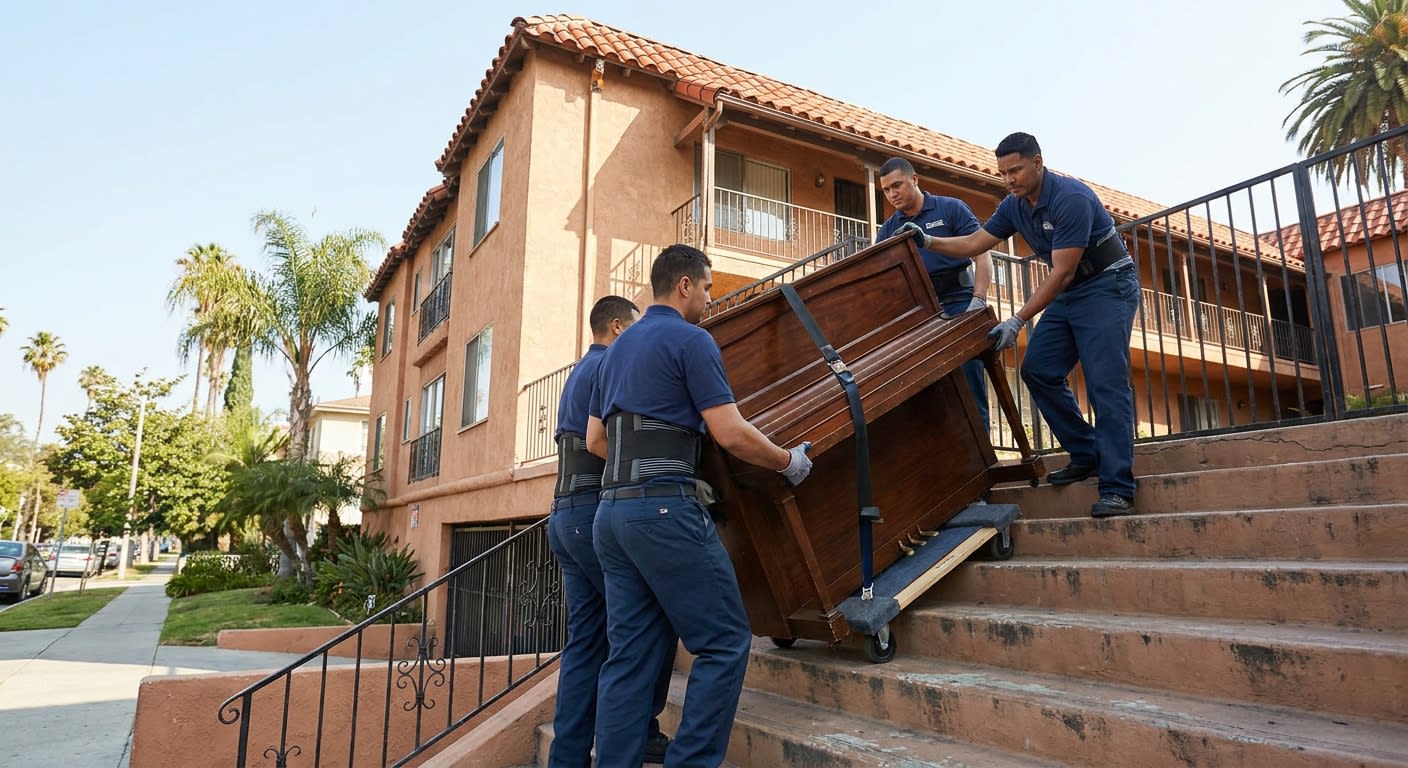




Households weighing up piano moving companies in Aliso Viejo, CA usually want one question settled first: is the instrument a separate job, or part of the move? With SOS it is part of the move — four movers, one truck, an hourly rate and a flat $200 for the piano, run the way our piano moving service works across the county. Crew and truck are booked through SOS Moving in Aliso Viejo.
What the four-person crew brings to the curb:

There is no standalone tariff for an instrument here. The piano adds a flat $200 to an hourly booking with four movers and a truck, and the three-hour minimum is measured across the whole job rather than against the cabinet alone.
Clock rules are written down and do not bend. An address 30 or more miles from our Los Angeles base carries a four-hour minimum instead of three, drive time past 10 miles is billed at double, and anything beyond the eighth hour counts as overtime.
Tuning, valuation, disposal and instrument storage sit outside what we sell. A technician for the new room is booked separately, after move day.
The city code treats a vehicle longer than 24 feet, or heavier than 10,000 pounds, as oversized, so a 26-foot box truck counts as one. Such a vehicle may not stand on a city street between 2:00 and 6:00 a.m., or for more than 12 hours in a row during the day, on two consecutive days.
The exception is what matters on move day: the rule does not apply while the truck is actively loading or unloading, or while it is parked to serve a job on a property in the same block. The city describes no temporary permit for this case, so our truck stays worked rather than left standing.
The Aliso Viejo Community Association oversees 19,674 units, 21 parks, more than 600 acres of greenbelt and 106 sub-associations, so the rules for one building usually sit a level below the master association. The city sets out the division of labour plainly: it runs Building and Safety, Fire Safety, Planning, Police Protection and Public Works.
AVCA, for its part, maintains the common areas — parks, greenbelts, parkways and slopes — and enforces the CC&Rs on matters such as paint colors and property maintenance. Where a neighborhood sits behind a gate on private streets, the association’s rules govern rather than the city parking code.
Hillsides, ridgelines, canyons and view corridors are how the General Plan paints the city, with the ground running from roughly 120 feet above sea level at the southern end to more than 890 feet at Moulton Peak in the north. The city profile calls the terrain rolling hillside and valley.
Higher ground above Town Center is built up rather than open. The wrap apartments there rise four and five stories over 435 units on an eight-acre site with their own parking garage, and neighboring City Walk holds 41 units completed in 2007; in a building of that shape the long leg of the carry is the corridor, so the lead measures the lift car first.
Regional access is the San Joaquin Hills Transportation Corridor, SR-73, which the General Plan says roughly bisects the city from northwest to southeast; it reaches I-405 about twelve miles northwest near Irvine and I-5 about five miles southeast near San Juan Capistrano. Cash left The Toll Roads on 14 May 2014, and a driver without an account settles online against the plate number, five days either side of the trip.
The city manages traffic around schools in the morning and afternoon peaks and coordinates the shared intersections along Moulton Parkway, Alicia Parkway and El Toro Road with its neighbors. Instrument slots are booked away from those peaks whenever the calendar allows.
Type of home in Aliso Viejo and what the crew of four prepares:
| Type of home in Aliso Viejo | What the crew of four prepares |
|---|---|
| Detached home on a quiet two-lane street where curbside parking is allowed | Truck at the curb close to the door; board run straight to the entry; runners from door to instrument. |
| Townhome on a two-lane collector street | Set-up away from any intersection approach carrying a separate right-turn lane, where parking is restricted; one mover on route watch while the board crosses the parkway strip. |
| Condo fronting a primary arterial — Aliso Creek Road between SR-73 and Glenwood Drive, Glenwood Drive, Pacific Park Drive north of Wood Canyon Drive; four lanes divided | Curbside parking may not be suitable there, especially where a bike lane shares the road, so the load runs from the garage or a side street and corridor time is added to the estimate. |
| Address on a secondary roadway — Aliso Creek Road north of Glenwood Drive, Aliso Viejo Parkway south of Pacific Park Drive, Wood Canyon Drive from Pacific Park Drive to Aliso Creek Road | Curbside parking is provided, but not near intersections with left-turn striping; the truck stops past the striping and the board covers the extra distance. |
| Address off Wood Canyon Drive south of Aliso Creek Road, where the road stays two lanes undivided | Cones and a spotter behind the tailgate, a tighter arrival window, and the ramp set before the cabinet comes off the deck. |
| Gated neighborhood on private streets | Gate procedure and vendor details confirmed at booking; on a private street the association's rules govern rather than the city parking code; $50 certificate of insurance if the building asks. |
| Wrap building above Town Center — 435 units over four and five stories on an eight-acre site with a parking garage; neighboring City Walk holds 41 units completed in 2007 | Lift car measured before the piano leaves the truck, garage ramp clearance checked, corridor padded end to end, and the destination room kept clear. |














No. It is one hourly job with four movers and a truck, plus a flat $200 for the instrument. The three-hour minimum covers the whole booking, and an address 30 or more miles from our Los Angeles base lifts that minimum to four hours.
The $200 instrument charge is only written onto a four-person booking. Two movers take the low end of the board, one steadies the high end and one goes ahead clearing the route, which is what keeps a board level on an entry that steps down.
Street type decides that. Local streets allow curbside parking; on the busy four-lane roads such as Glenwood Drive the city warns that curbside parking may not be suitable, especially where a bike lane shares the road, so we load from a garage or a side street and allow more carry time.
The gate procedure, the name of the sub-association and any certificate of insurance requirement. On a private street the association's rules govern rather than the city parking code, while enforcement on public streets runs through the Orange County Sheriff's Department, which the city contracts for police services.
Often, yes, because same-day work happens whenever a four-person crew has a gap. Our hours run Monday to Sunday, 8AM to 6PM, so the instrument, the rest of the load and the drive all have to fit inside that window.
No. SOS carries pianos; tuning, valuation, disposal and instrument storage sit outside the service. Book a technician separately for a date after the move, once the piano is standing where it belongs.
An instrument is not sold here as a product with its own price list. It is a line inside an hourly household move: four movers, one truck, a flat $200 for the piano and a three-hour minimum that belongs to the booking as a whole. That framing decides almost everything else about the day.
Rates follow the day of the week and the way you pay. Monday to Thursday, a four-person crew with a truck runs at $199 an hour in cash or $209 by card; Friday to Sunday the same crew is $215 and $225. A $30 gas line and a $50 deposit, credited back against the bill, complete the fixed part.
Distance carries rules of its own. Thirty or more miles between our Los Angeles base and your address lifts the minimum from three hours to four, driving beyond ten miles is billed at double time, and the hours after the eighth count as overtime.
None of that is specific to pianos, which is exactly the point: the instrument sits inside the same clock as the sofa. Where a building asks for a certificate of insurance, that is $50 and is arranged before the crew rolls.
People sometimes expect a piano-only call to be cheaper than a household day, and on paper the difference is small. The same four movers, the same truck and the same minimum apply either way, which is why an instrument travelling alongside beds and boxes uses time that was already booked.
A deposit of $50 holds the slot and comes straight off the closing figure. Everything else is read off the clock: arrival, walk-through, protection, the carry, the drive and the set-down at the far end.
A crew of four is not a preference, it is the condition on which the $200 charge is written. Four people mean a cabinet can be lifted, held and steered at the same moment instead of being walked and rested, and one of the four is deliberately not carrying.
This city gives that fourth pair of hands plenty to do. The General Plan describes hillsides, ridgelines, canyons and view corridors, with ground rising from about 120 feet above sea level in the south to more than 890 feet at Moulton Peak in the north.
Across terrain shaped like that, the low end of the board is often a step or two below the high end for the whole carry. Two movers take the low end, one steadies the top, and the fourth goes ahead opening doors, shifting planters and calling the turns.
The same arithmetic applies in a lift lobby. A board cannot be tipped inside a car with a low ceiling, so somebody has to hold the angle while the doors are blocked and the instrument is walked in.
Gates change the arithmetic again. Where a private street or a guard controls the entrance, one mover deals with access and the spotting while the other three stay with the cabinet, and the crew does not shrink to cover the errand.
It is not a handling fee in the abstract. The money pays for the specialist part of the job: the padded piano board, the belts that hold the cabinet to it, the rub rails and ratchet straps that give the piano its own anchor in the truck, and the extra person on the crew.
Before any of that touches the instrument, the case is closed and padded. Lid and fallboard go down, blankets cover the cabinet, and shrink holds the blankets where they belong so nothing slides during a turn or a set-down.
Floor protection follows, and it is not an afterthought. Runners go over tile, hardwood and any shared corridor, because a loaded board and four pairs of work boots do more to a floor than the piano ever does to itself.
A grand is partly dismantled for the trip. Lid, lyre and legs come off, the body travels on its straight side, and the parts go back on in the room you have chosen rather than wherever the truck was unloaded.
What the charge does not buy is worth stating. Tuning, valuation, disposal and instrument storage are not services we sell, and we do not take pianos on long-haul runs; the $200 buys the board, the hardware and the fourth mover, nothing more and nothing less.
Preparation is mostly measurement and photographs. A side-on shot of the instrument, one of the doorway it must leave through, one of every flight of steps and one taken from the street towards the entrance tell a crew leader more than a paragraph of description.
Clear the route the day before if you can. Rugs rolled, planters off the path, the spot where the piano will stand left empty: a cabinet set down twice takes twice as long, and the clock does not pause while furniture is shuffled.
Tell us about the gate before the day, not at the gate. Where a sub-association controls entry the crew and truck need to be expected, and where the building wants a certificate of insurance that $50 document has to exist in advance.
Last, decide about the rest of the load. If the household is moving too, the same four movers handle both, and the piano takes its place in the loading order instead of requiring a second visit.
Small things save real minutes on the invoice. Pets behind a closed door, children out of the carry path, a space kept free at the curb where the truck can stop, and somebody at the destination who can say where the instrument finally stands.
Street type quietly sets the difficulty of a carry. Local streets here are quiet two-lane roads with curbside parking allowed.
That is the easy case, where the truck stands close and the board runs straight in. Collector streets are also two lanes, but parking is restricted near intersections that have a separate right-turn lane.
Addresses on the main four-lane roads are different again. Aliso Creek Road between SR-73 and Glenwood Drive, Glenwood Drive itself and Pacific Park Drive north of Wood Canyon Drive are divided roads, and the city warns that curbside parking may not be suitable on the busier segments, especially where a bike lane shares the road.
Secondary roadways do provide curbside parking, except near intersections with left-turn striping: Aliso Creek Road north of Glenwood Drive, Aliso Viejo Parkway south of Pacific Park Drive, and Wood Canyon Drive from Pacific Park Drive to Aliso Creek Road.
One stretch is the exception the plan names itself. Wood Canyon Drive south of Aliso Creek Road is still striped as a two-lane undivided road, to be brought up to the County four-lane secondary classification when needed, so a crew working an address off it puts a spotter behind the tailgate.
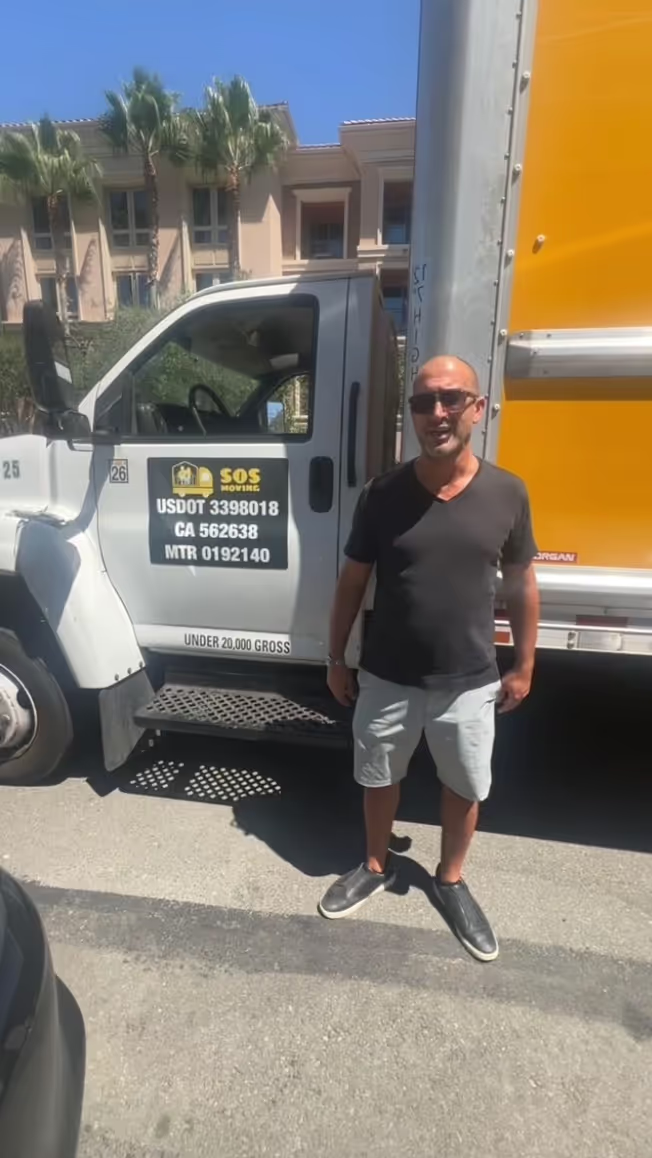
There is a parking rule behind all of this. A truck longer than 24 feet or heavier than 10,000 pounds counts as oversized under the city code, and a 26-foot box truck is over that length, so where it stands and for how long is not a matter of taste.
The limits are plain: no oversized vehicle left on a city street between 2:00 and 6:00 a.m., and no more than 12 hours in a row during the day, on two consecutive days. A vehicle that is actively loading or unloading is exempt.
Most pianos we carry in this city are not travelling alone. The hourly model means the instrument and the household share one crew, one truck and one invoice, and the only piano-specific line on that invoice is the $200.
Loading order does much of the work. The cabinet usually goes on last at the origin and comes off first at the destination, so it spends the least time aboard and the room it is destined for is still empty when it arrives.
That settles a question people often ask about time. There is no separate piano hour to count: the clock runs on the job, and whether the crew is carrying a cabinet or a wardrobe makes no difference to how it is billed.
Same-day work is possible when a four-person crew has a gap. Dispatch answers on 909-443-0004 between 8AM and 6PM every day of the week, and load, drive and unload all have to fit inside those hours.
Booking earlier widens the choice of window. A four-person crew is the largest we send on a standard hourly job, so the days with a free one fill first, and a slot chosen away from the school peaks is easier to hold at the start of the week.
Four things move the number more than anything else: how many steps stand between the instrument and the truck, how far the door is from the curb, how tight the narrowest turn is, and how ready the house is when the crew walks in.
Traffic is the fifth. The city manages traffic around schools in the morning and afternoon peaks and coordinates the shared intersections along Moulton Parkway, Alicia Parkway and El Toro Road with neighboring cities.
The toll corridor is a choice rather than a rule. SR-73 roughly bisects the city from northwest to southeast, cash collection ended on 14 May 2014, and a driver without an account pays online against the plate number within five days either side of the trip.
Professional piano movers in Aliso Viejo do not guess any of this on the morning itself. Answer the walk-through questions honestly when you book, and the estimate stops being a guess.
Two documents can hold a day up if they are left late. A certificate of insurance, where the building wants one, costs $50 and has to be issued before the crew arrives, and the gate list at a private community needs the truck and the crew on it in advance.
Everything else is arithmetic you can do yourself. Count the steps, measure the narrowest door, note the distance from curb to entrance, then add the drive, remembering that the leg past ten miles is billed at double time.
The four common types behave differently on a board: a spinet with its short strings and light case, an upright with its height, a baby grand with its weight once the legs are off, a grand with its length through a turn.
Our piano movers page takes each of them in turn, including what comes off and in what order. On a booking here the type changes the route plan rather than the price: the instrument line stays at $200 and the crew stays at four.