





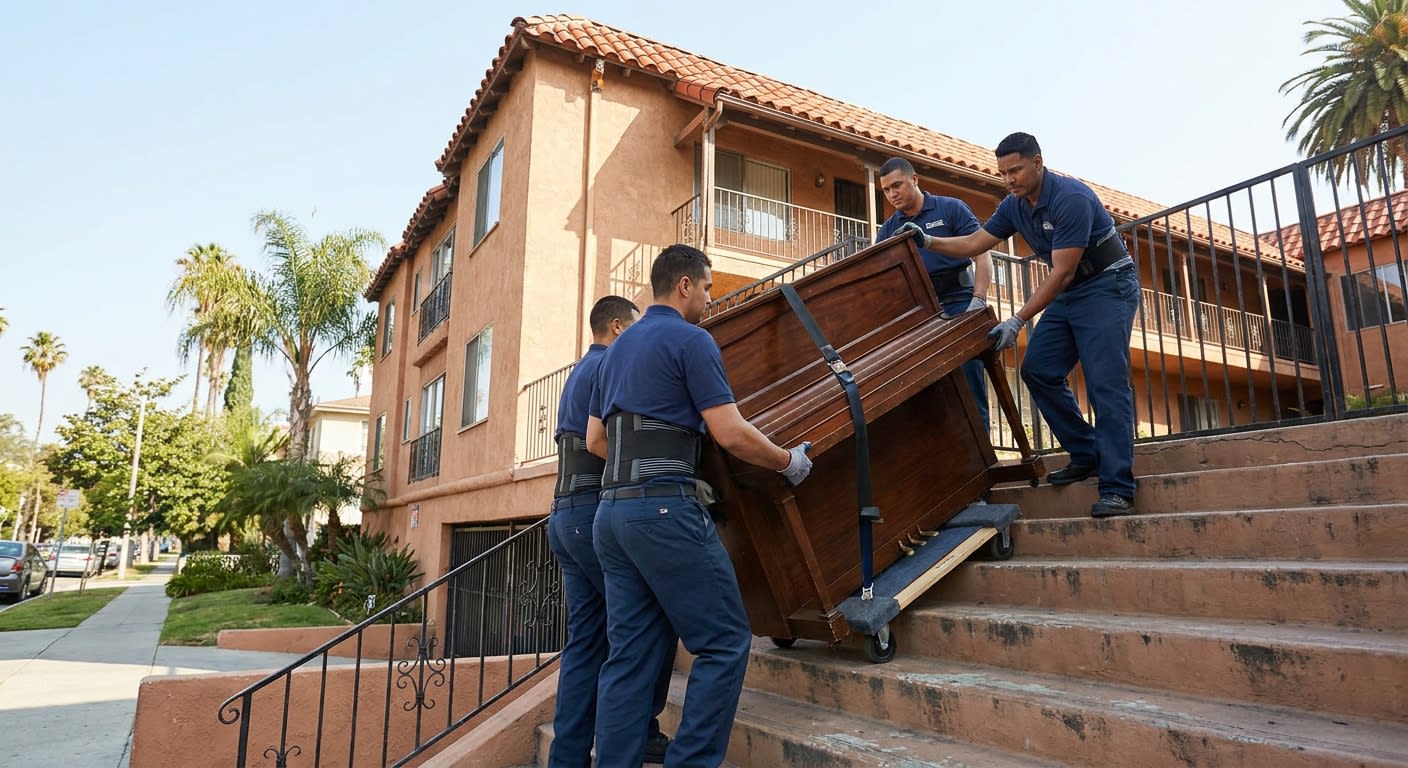



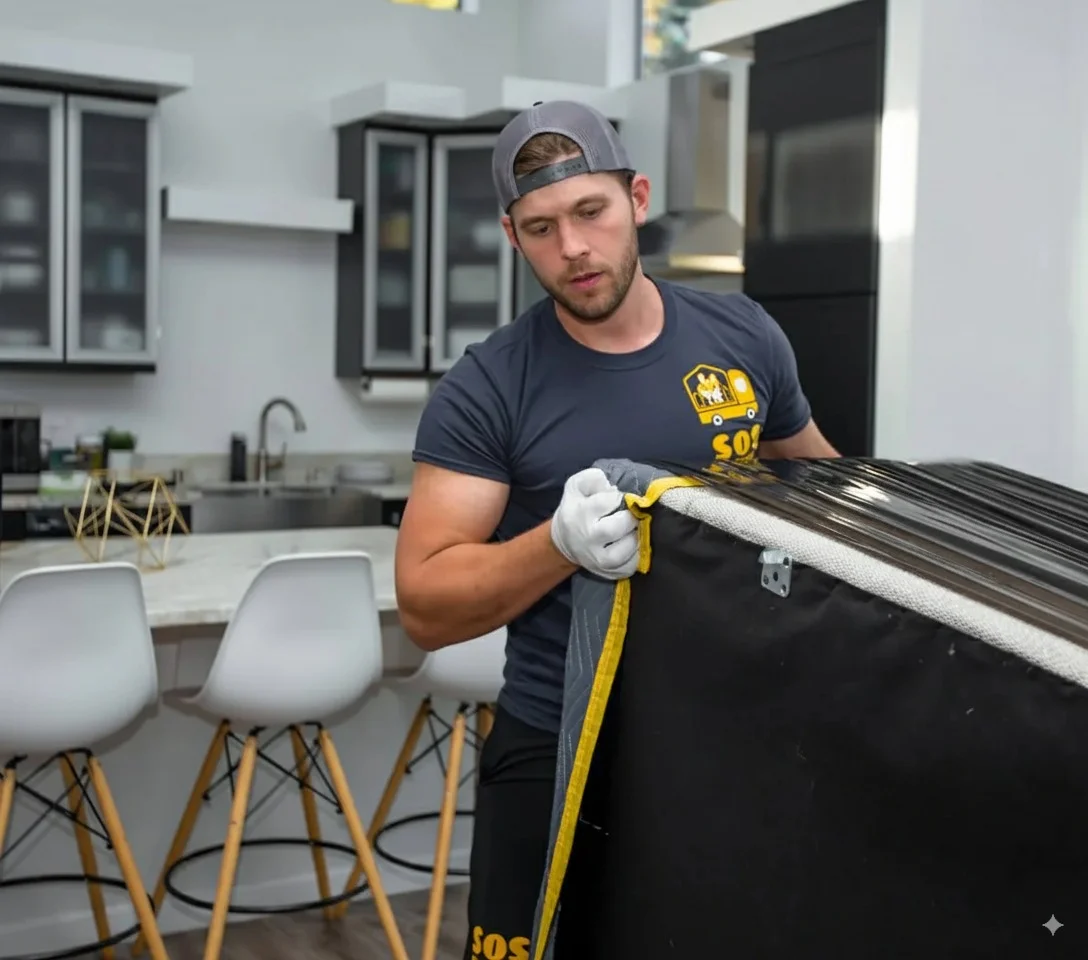
What a four-mover crew brings to an Anaheim address:
Booking is one call to 909-443-0004, Monday through Sunday between 8AM and 6PM. Same-day pickup is possible whenever a truck and a full crew are free, and a $50 deposit holds the date and comes off the final bill.


Planning starts with the questions that actually change the schedule: what the instrument is, which floor it sits on, how many steps stand between it and the curb, and whether a gate or a shared driveway limits where a full-size truck can wait.
On the day four movers arrive together, because a four-person crew is exactly what the piano charge pays for. They lay runners, pad the door jambs and agree on a stopping point at every turn while the clock runs from the three-hour minimum.
Loading is the part that rewards patience. The instrument is boarded, strapped, walked out along the protected path and tied to the truck wall first, so the rest of the load is built beside it rather than stacked over it.
At the far end the order reverses: the piano comes off before the furniture and goes straight to its room, then the crew keeps working through the rest of the truck on the same hourly clock. We lift, protect, carry and place — tuning, appraisal and instrument storage are trades we leave to other people.
Piano movers in Anaheim, CA are billed off the same rate card as any other hourly crew we send out; the instrument adds one line to it and nothing else. Here is that card as it applies to a team of four:
Two things move the total more than the rate does: how long the protected walk between the instrument and the curb turns out to be, and how far apart the two addresses sit. Tell us both when you call and the estimate stops being a guess.
A loaded moving truck is longer than 22 feet, and Anaheim Municipal Code 14.32.206 treats any vehicle over 22 feet in length — or over seven feet wide and seven feet tall — as an oversized vehicle that may not stand on a public street. The code’s own exemption is what keeps a move legal.
An oversized vehicle engaged in loading and unloading parks at the street curb immediately adjacent to the residence or building, or within 400 feet of it when that curb is unavailable because of curb configuration or codified parking restrictions. The same section also recognises a temporary placard issued by the City for oversized vehicles engaged in loading, unloading or preparation for travel.
Our dispatcher therefore asks for a photo of your curb before the date is confirmed, and the driver takes the closest legal spot so the instrument’s walk stays short.
Private property has its own rule. AMC 18.42.030.010.0108 prohibits the parking and storage of box trucks and tractors on residential property, then states that the prohibition does not apply to temporary loading and unloading activities associated with residential moving operations — so a driveway is fair ground while the crew is actively working it.
Gated pockets add a checkpoint rather than an obstacle: Anaheim Hills has three guard-gated communities, Summit Pointe, Belsomet and Hidden Canyon, and Summit Pointe has a single point of access, one way in and one way out, with a staffed guard gate. We send the truck description and the names of the four movers ahead of the date, and a certificate of insurance costs $50 when a building asks for one.
Housing stock changes the problem block by block. The Anaheim Colony Historic District, adopted by the City Council in October 1997, is the city’s first and largest; its boundaries match the original German colony founded in 1857 — North, South, East and West Streets — and over 1,000 qualified structures stand inside that 1.8-square-mile area.
Those blocks come with period doorways, porch runs and tight interior turns, which is exactly why the narrowest point gets measured before the board goes under the instrument. East of downtown the emergency material the city publishes is blunt about the other half of town: living in the hills of east Anaheim brings year-round risk from wildfires, earthquakes and hillside runoff, and on a working day that same terrain shows up as a driveway pitching away from the street.
Anaheim describes its own road shape honestly, even though the description was written for fire evacuation rather than truck routing. Hillside residents reach major streets over smaller roads and the freeway over major streets, with Weir Canyon, Fairmont and Santa Ana Canyon named among those majors and the westbound 91 as the primary way out.
That same plan directs the Nohl Ranch and Canyon Rim side west at the earliest opportunity to avoid going into the city of Orange, and notes that the city will not use Imperial to access the 91 unless conditions dictate.
We read that as a warning about approach angles and keep hillside pickups away from the commute peaks. The truck also leaves our Los Angeles yard, so double drive time past ten miles is a real line on the bill.
Type of home in Anaheim and what the crew of four preps. Preparation is decided by the shape of the property far more than by the instrument, so here is how the common local cases translate into crew work:
| Type of home in Anaheim | What the crew of four preps |
|---|---|
| Detached house with five bedrooms or fewer | The code asks for four parking spaces, two of them in a garage, so the tandem space in front usually becomes the staging area — 8 by 25 feet with a tilt-up door, 8 by 20 with a roll-up, measured from the garage door to the nearest property line, walkway, street or vehicle accessway. Board, ramp and runners are laid out there. |
| Attached home on an auto court | City street standards cap an auto court at 150 feet, let it serve no more than eight residences, and give it no through street access, with no front doors or primary pedestrian entrances opening onto it. The truck stages at the street and the walk is planned long and flat. |
| Home inside a guard-gated community | Summit Pointe, Belsomet and Hidden Canyon are the three guard-gated addresses in Anaheim Hills, and a single point of access means there is no second route if the first one is blocked. Truck details and crew names go to the gate before the date. |
| House on a Colony historic block | Period doorways and porch steps inside the 1.8 square miles of the 1857 street grid get measured first; jamb padding and a shallow ramp angle matter more here than raw crew speed. |
| Hillside lot in east Anaheim | Grade decides the carry. The driver looks for the flattest legal curb, the board is worked across the slope instead of down it, and the fourth mover holds the low side. |
| Condo or apartment with a lift | The instrument rides up alone with two movers while the other two receive it on the floor; a building certificate of insurance is arranged in advance when the manager requires one. |













Either works, and the structure is the same both ways. A piano goes with a crew of four, a flat $200 piano charge and a three-hour minimum, whether it travels alone or leaves with the rest of the furniture. Nothing about the instrument creates a second booking with its own minimum.
Four movers with a truck run $199 an hour in cash or $209 by card Monday through Thursday, and $215 or $225 Friday through Sunday. Add the $200 piano charge, a $30 fuel fee, and a $50 deposit that comes straight off the bill. Drive time doubles past ten miles, and the minimum becomes four hours at thirty miles or more from our base.
Anaheim treats a vehicle over 22 feet long as oversized and keeps it off public streets, with an exemption for active loading and unloading at the curb immediately adjacent to the building, or within 400 feet when that curb cannot be used. Send a photo of your block when you book and the driver plans the closest legal spot.
The names of the four movers and a description of the truck, passed to the association or front desk before the date. In the guard-gated pockets of Anaheim Hills that gate is the only way in, so an approval that lands the morning of the move costs you clock time. If the building wants a certificate of insurance, that is $50.
No. We lift, protect, carry, place and level the instrument on its castor cups, and that is where our work ends. Tuning and appraisal are separate trades, and we do not keep instruments in storage, so book a technician directly once the piano is standing in its new room.
The plan changes, not the rate card. Steps and grade are worked with the board across the slope rather than down it, and in a building with a lift the piano rides up alone with two movers while the other two receive it. All of it is billed as the same hourly time, which is why the walk length matters more than the mileage on most jobs.
SOS Moving does not sell a piano package. The instrument rides inside a normal hourly move: four movers with a truck, a flat $200 added for the piano, and the usual three-hour minimum. That is the entire commercial structure, and it holds whether the piano is the only thing going or the last thing loaded.
The rate follows the calendar rather than the cargo. A four-mover crew costs $199 an hour paid in cash or $209 by card from Monday through Thursday, and $215 or $225 on Friday, Saturday and Sunday. Fuel is a flat $30, and a $50 deposit holds the date and comes off the final total.
Two travel rules matter before anyone quotes a number. Drive time counts double once the run passes ten miles, and the minimum rises from three hours to four when the job sits thirty miles or more from our base. Work that runs past eight hours on site moves into overtime.
What we do not do is worth stating plainly. Tuning, appraisal, disposal and instrument storage are not on our list; the hours you pay for are lifting, protecting, carrying and placing, and nothing is dressed up as anything else.
Crew size here is not a preference. A piano leaves its room with four people on it, and the $200 charge exists because that is the team the instrument needs — two carrying weight, two managing balance and the path ahead.
Equipment arrives with the crew instead of being improvised on site. The board and its straps take the load off the castors, blankets and stretch wrap cover the case and the lid, and corner protection goes on before anything is tipped.
The route gets the same treatment as the instrument. Runners go down over hardwood and tile, jambs get padding wherever the clearance is tight, and the crew settles on a stopping point at each turn before the lift begins.
Inside the truck the piano is first and separate. It stands against a wall, strapped to the tie-down rail, and the rest of the load is built alongside it — never leaning on the case, never stacked above it.
Uprights, spinets, baby grands and full grands all behave differently on the board: an upright is dense and top-heavy, a spinet is short but awkward to grip, a baby grand comes off its legs and lyre to ride on its side, and a full grand is the one that turns into a crating conversation. That comparison belongs on our piano movers page, which walks through each instrument in detail.
Preparation is the cheapest hour of any move, because it is the one you do yourself. Clear the route from the instrument to the front door the night before: rugs rolled up, side tables out of the way, cords off the floor, breakables out of the swing radius.
The bench, the lamp, the sheet music and the photographs on the lid count as separate cargo. Pack them into a labelled box, because the crew needs the top of the instrument bare before blankets and wrap can go around it.
Doorways decide more than floor area does. Measure the narrowest point on the route — the front door, a hallway turn, the gap between a stair rail and the wall — and send those numbers with your booking, along with a photo of the curb outside.
Two logistics answers save the crew a phone call at eight in the morning. Tell us where a full-size truck can legally stand on your block, and if the property sits behind a gate, get the vehicle and the crew names approved before the date arrives.
Pets and small children need a room with a door that closes. A piano walk has no pause button once the board is under the instrument, and a crew forced to stop mid-carry is a crew working around an obstacle it cannot see.
In the Colony the constraint is age. The historic district adopted by the City Council in October 1997 follows the boundaries of the original 1857 colony — North, South, East and West Streets — and more than a thousand qualified structures stand inside its 1.8 square miles, with all the period doorways and porch runs that era built.
East of downtown the constraint is grade instead. The city says plainly that life in the hills of east Anaheim carries year-round risk from wildfires, earthquakes and hillside runoff, and on a working day that terrain simply shows up as a driveway pitching away from the street.
A sloped approach changes the carry rather than the price. The board is worked across the grade instead of down it, the driver parks as close to level as the curb allows so the ramp angle stays shallow, and the fourth pair of hands takes the low side of the instrument.
Attached housing brings a different shape again. City street standards define an auto court as a common driveway fronted with garages — no longer than 150 feet, serving no more than eight residences, with no through street access and no front doors or primary pedestrian entrances opening onto it.
That geometry has a practical consequence: a truck that enters an auto court cannot drive out the far end, so the crew stages at the street and plans a longer flat carry. Where there is a lift, the instrument rides up on its own with two movers and is received on the floor by the other two.
Guard-gated pockets add a checkpoint rather than a problem. Anaheim Hills has three of them — Summit Pointe, Belsomet and Hidden Canyon — and Summit Pointe has a single point of access, one way in and one way out, with a staffed guard gate at the entrance.
Most of the piano work we do here is not piano-only work. A family moves a three-bedroom house and the upright in the living room is simply the heaviest item on the inventory, which is why it shares a clock with the sofa and the boxes.
Sequence is what keeps that efficient. The crew loads the instrument first, while everyone is fresh and the truck is still empty, then builds the rest of the load around it, so the piano is never handled twice on the same job.
Billing stays a single line as a result. You pay the four-mover hourly rate for the day plus one $200 piano charge, not a separate call-out with its own minimum layered on top of a household move.
Delivery runs the same logic in reverse. The instrument comes off before the furniture and goes straight to its room, because setting a piano into a space that is already full is how floors, door casings and case corners get damaged.
Distance to the curb beats distance between cities on nearly every job. Forty feet of protected floor and three porch steps is a different hour from a second-floor unit at the end of a long shared driveway, and that gap is visible in the estimate before you book anything.
Timing matters because drive time is billable and doubles past ten miles. Hillside pickups get scheduled away from the commute peaks, and we are straight with you that the truck leaves our Los Angeles yard rather than a depot around the corner.
The city describes its own road shape well, even though the description was written for fire evacuation rather than moving trucks. Residents reach major streets over smaller roads and the freeway over major streets, with Weir Canyon, Fairmont and Santa Ana Canyon named among the majors and the westbound 91 as the way out.
That plan also moves the Nohl Ranch and Canyon Rim side west at the earliest opportunity to avoid going into the city of Orange, and notes that Imperial will not be used to reach the 91 unless conditions dictate. For a crew with a board and a piano, it reads as a reminder to check the approach twice.
When you are ready, call 909-443-0004 any day between 8AM and 6PM, or send the address, the floor and a photo of the curb and we will come back with the hours we expect to bill. Same-day pickup happens whenever a truck and four movers are free.