






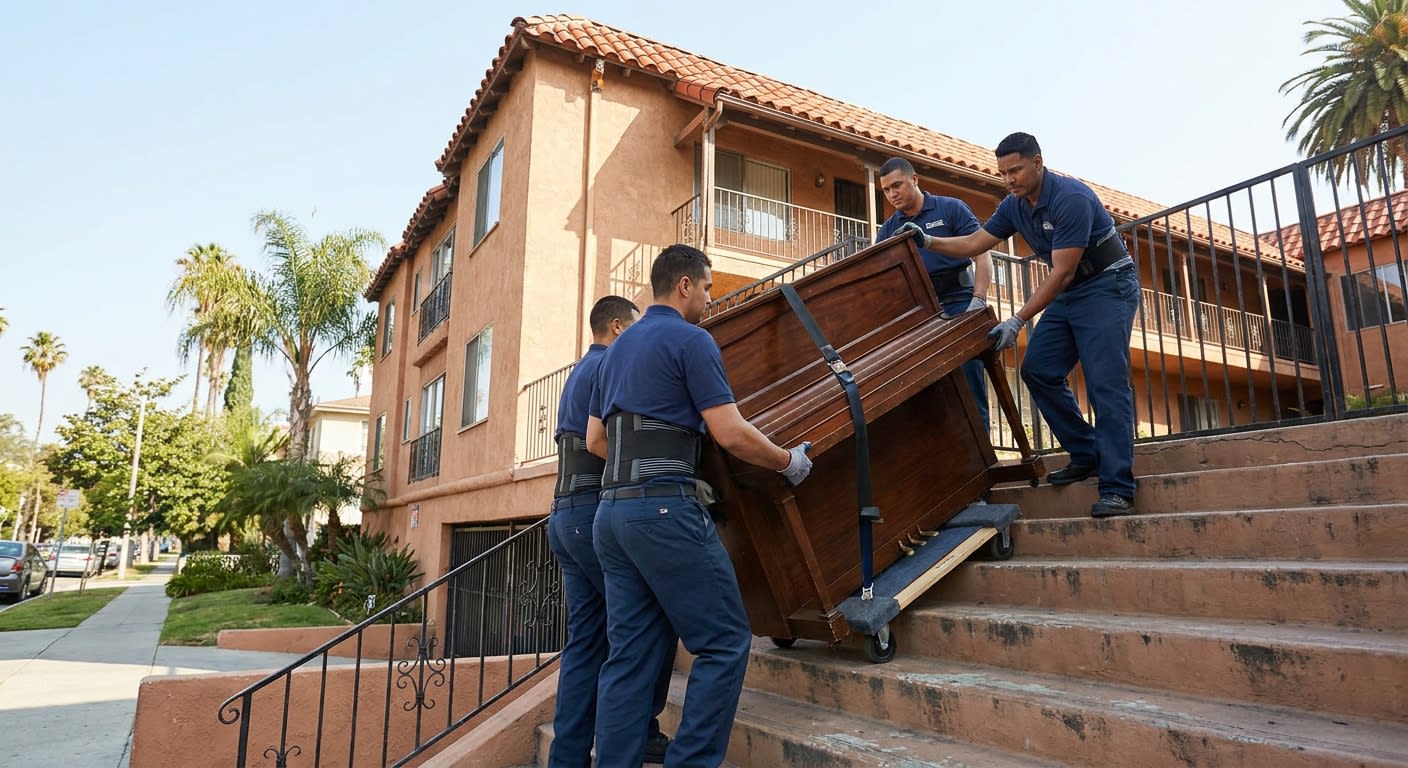




What the crew of four brings to the door:
Call 909-443-0004 between 8AM and 6PM, Monday through Sunday, and we will walk the route with you before anything is booked: the gate, the driveway, the steps, the narrowest doorway and the turn at the top of the stairs. Same-day work is possible whenever a crew of four is free.


The rest of the line items are the ones we quote on any hourly job:
One line is often mistaken for the instrument: a $150 charge covers a single item over 300 lbs handled by a crew of three. A piano is not billed that way. It goes out with four movers and the $200 add-on, and nothing else is quoted for it separately.
The city code keeps a commercial vehicle, motor truck or semi-trailer wider than 80 inches or longer than 25 feet off any public street in a residential district, and extends that ban citywide between 2:00 a.m. and 6:00 a.m. A third rule stops any vehicle standing longer than 72 consecutive hours, and the code treats a vehicle as moved only once it has travelled at least 100 feet.
Street sweeping adds its own windows. Residential streets are swept the day after trash collection, normally every other week, with 10:00 a.m. to 2:00 p.m. no-parking signs posted on Hidden Hills Road, Niguel Ranch Road and Aliso Niguel Road, and on Parc Vista, Seaglen and Tessier in the second and fourth weeks. We check the sweeping day for your block first, then pick the legal position that keeps the carry shortest.
A pod or dumpster left on a public street or sidewalk needs an encroachment permit from Public Works, review runs up to ten business days, and containers are ordered only through CR&R — on a private driveway no permit is required at all.
The city counts more than 120 homeowner associations, each governed by its own CC&Rs while remaining subject to the Laguna Niguel zoning code. Police services are contracted from the Orange County Sheriff’s Department, and the city’s own brochure sends parking and towing problems on private property back to the property owner or the association.
Gate procedure sets the start time. Bear Brand, a hillside gated community of 266 homes on Camino Del Avion and Pacific Crest, runs one entry lane for residents with a working opener and a second for everyone else; an evening guard covers the shift and the entry keypad is switched off at 9 p.m.
Ocean Ranch at Bear Brand admits guests, vendors and service personnel only on a resident’s authorization, through an Upper Gate off Golden Lantern or a Lower Gate off Camino Del Avion, and trucks are required to use the lower gate. Clear the crew with the association beforehand; a certificate of insurance costs $50 when the paperwork calls for one.
The city is bounded by natural ridgelines that form its major drainage boundaries, and runoff feeds three major watersheds — Sulphur Creek in the north, Salt Creek in the south and Oso Creek along the east side. Grades change from address to address, so the crew reads the actual driveway and walk rather than an assumption about the tract.
Built density also differs by housing form. The Housing Element puts detached residential areas near 5.2 dwelling units per gross acre and attached areas near 14.6, and nearly every sub-profile area outside the Gateway Specific Plan is already built out to its General Plan maximum.
Age matters on the carry. Most units in the city went up before 1990, roughly 6,000 of them before 1980, and in neighborhoods built in the late 1960s and early 1970s we pad thresholds, treads and handrails before a loaded board crosses them.
Crown Valley Parkway has been through an OCTA Measure M2 project covering 30 signalized intersections along its entire length, with the same signal-synchronization and equipment work budgeted for Alicia Parkway, Cabot Road and La Paz Road. Behind those arterials the network is mostly local: about 35 miles of arterial roadway against 105 miles of residential streets.
Toll rates on SR-73 and the rest of The Toll Roads are set by time of day, distance travelled and the number of axles, and all tolls are collected electronically. Crews work between 8AM and 6PM, double drive time applies past ten miles, and a four-hour minimum replaces the three-hour one once an address sits more than 30 miles from base.
Home type in Laguna Niguel and what the crew of four prepares:
| Home type in Laguna Niguel | What the crew of four prepares |
|---|---|
| Detached house, about 55% of the city’s housing stock and near 5.2 units per gross acre | Driveway position agreed instead of the curb, ramp set on the flattest ground, runners down the walk and over the threshold. |
| Attached or multi-family home, about 25% of units and near 14.6 per gross acre | Corridor, landing and lift measured first; the board stays loaded while a door or a shared turn is padded out. |
| Home inside a guard-gated community such as Bear Brand or Ocean Ranch | Resident authorization filed with the guard, the lower gate used for the truck, and the visit timed while the keypad is still active. |
| Condominium with a contracted patrol, as at Niguel Pointe | Parking is monitored by Patrol Masters and long-term parking must be safe-listed with them, so the truck slot is confirmed before arrival. |
| House from the late 1960s or early 1970s, one of roughly 6,000 units built before 1980 | Thresholds, treads and handrails padded, doorway widths taken by hand, and the descent walked once empty before the instrument follows. |
| Address on a posted sweeping street such as Hidden Hills Road or Aliso Niguel Road | Arrival planned outside the 10:00 a.m. to 2:00 p.m. window, or the truck placed off the signed frontage entirely. |














Send the crew through your association first. At communities like Ocean Ranch, guards admit guests, vendors and service personnel only on a resident’s authorization, so the owner’s name and the address have to be on the list before the truck reaches the entrance. If the association or the building asks for a certificate of insurance, that is $50 and we issue it in advance.
On the driveway whenever the driveway takes it. City code keeps commercial vehicles over 80 inches wide or 25 feet long off public streets in a residence district, bans them citywide between 2:00 a.m. and 6:00 a.m., and posted sweeping signs close some frontages from 10:00 a.m. to 2:00 p.m. We agree the truck position with you before the day so the carry starts immediately.
It runs on the same hourly clock as everything else. A crew of four is $199 an hour in cash or $209 by card Monday through Thursday, $215 or $225 Friday through Sunday, with a three-hour minimum, and the instrument adds a flat $200 to that bill. There is no second invoice and no separate rate for the piano.
Often yes, when a crew of four is open. Booking hours run Monday through Sunday, 8AM to 6PM, and drive time from our Los Angeles base counts toward the job, so an early call gives the best chance of a same-day slot. Call 909-443-0004 and we will check the board with you.
No. We move instruments and nothing else around them: tuning, valuation and disposal belong to a technician or a dealer, and we do not quote them. What we cover is the handling — the board, the straps, the pads, the stairs and the tie-down in the truck.
A piano move here is not a separate product with its own price list. It is an ordinary hourly job with a crew of four and a $200 add-on for the instrument, and the three-hour minimum that applies to every booking applies to this one too.
That structure matters more than it sounds. Because the hours are shared, an instrument that comes out first and goes in last costs the minutes it actually takes, rather than a flat figure guessed from a photo sent the week before.
Rates are the published crew-of-four numbers: $199 an hour in cash or $209 by card Monday through Thursday, and $215 cash or $225 by card Friday through Sunday. Fuel is $30 per truck, and the $50 deposit taken at booking is credited against the final bill.
Two travel rules shape the total on a South County address. Double drive time applies once the haul passes ten miles, and a four-hour minimum replaces the three-hour one when the address sits more than 30 miles from our base.
Nothing about that changes because the item is heavy or expensive. You are buying a crew and a clock, and our job is to keep the clock honest by settling the access questions before the truck is loaded.
If the instrument is the only thing moving, the day is short and the minimum usually governs the bill. If it moves with the contents of a house, it simply takes its place in the sequence.
Crew size is not negotiable on an instrument, and it is the reason the add-on exists at all. Four movers mean two people on each end of the board through a stair flight: one pair controls the descent while the other holds the weight back.
Three movers can take most single items over 300 lbs for a $150 charge, but that line does not apply here. A piano goes out with four people and the $200 add-on, and nothing else is quoted for it separately.
The add-on covers the instrument-specific work rather than the labour hours, which the clock already covers. It pays for the board, the straps, the extra pads, the blocking inside the truck and the slower measured pace on turns and landings.
Four hands are not enough on a doorway that needs the board pivoted, and five is not a standard crew. The number is fixed so that the plan you were quoted is the plan that arrives at the curb.
That also means an instrument cannot be squeezed into a two-mover booking made for a studio apartment. When a call starts as a small move and a piano appears later, the crew is resized and the add-on goes on the bill.
Ask about crew size when you compare quotes. A price that sounds lower usually turns out to be fewer movers, a longer day on the clock, or an instrument charge that only appears at the end.
Preparation starts before the instrument moves an inch. The lid and the fallboard are secured, the casters are taken out of the equation, and the body is wrapped in heavy pads so that no hardware ever meets a doorframe.
The board takes the weight, the straps hold the instrument to the board, and the crew moves one object instead of four people carrying an awkward shape. Inside the truck it stands against the wall, padded, strapped and blocked so it cannot shift on a turn.
Uprights, spinets, baby grands and full grands each change the preparation — a grand comes off its legs and travels on its side on a skid board, an upright stays upright and gets its back protected — and our piano movers service page walks through those differences in detail.
Floors and edges on the carry path get their own layer. Runners go down on hardwood, guards go on banisters and corners, and the threshold the board has to cross is covered before the first lift.
Weather rarely stops a move on this coast, but a damp walk changes the grip on a slope. The pace drops accordingly, and the pads come off only once the instrument is standing inside.
At the delivery end the sequence runs backwards, slowly. The instrument is set, the wrapping comes away, and the crew checks the legs, the pedal lyre and the casters with you before anything is signed.
Clear the route the day before, not on the morning of the move. Every obstacle the crew has to step around — a rug, a side table, planters along the walk, a car parked in the turning space — costs minutes on a clock you are paying for.
Measurements are worth taking once, calmly. We ask for the narrowest doorway on the path, the width of the stair, whether there is a turn or a landing on the way down, and a photo of the approach from the street to the door.
Access is the other half of the preparation. If your block sits in a residence district under the city code, an oversized truck cannot stand at the curb, so the driveway or the nearest legal position has to be agreed in advance.
Check the sweeping day for the street as well. The posted windows run from 10:00 a.m. to 2:00 p.m. and can take the only usable frontage out of play for exactly the hours you wanted the truck there.
Inside the house, decide where the instrument lands before it arrives. A room that is still being painted turns one set into two, and the second one is billed at the same hourly rate as the first.
Pets and small children do better somewhere else for the hour the board is moving. A crew that has to stop halfway down a flight is a crew holding several hundred pounds longer than it planned to.
The city is bounded by natural ridgelines that form its major drainage boundaries, with runoff feeding three watersheds — Sulphur Creek in the north, Salt Creek in the south and Oso Creek along the east. Approach grades vary from one address to the next.
Because of that, the crew reads the actual driveway rather than a map. A sloped approach changes how a loaded board is handled: two movers take the downhill side, the pace drops, and the truck is positioned so the ramp meets the flattest ground available.
Stairs are a separate calculation from distance. A short carry with a turn at a landing takes longer than a long flat walk, and that turn is the first thing we ask about when a flight is involved.
Attached housing brings a different set of constraints. The Housing Element puts attached residential areas near 14.6 dwelling units per gross acre against 5.2 for detached ones, and on a tighter site the corridor, the lift and the shared landing decide the sequence.
In a condominium the crew often works around neighbours rather than around furniture. Lift dimensions, the position of the loading door and the patrol rules covering the parking area are settled first, because any of them can stall a loaded board.
Older homes get an extra look before anything is lifted. Most units in the city were built before 1990 and roughly 6,000 of them before 1980, so thresholds, treads and handrails in those neighborhoods are padded ahead of the carry.
Most of the pianos we carry are part of a full household move, and the billing does not change for them. The same four movers load the boxes and the instrument on one clock, which makes the piano a sequencing decision rather than an extra invoice.
Sequence usually puts the instrument out early, while the truck is empty and the crew is fresh, and in late at the other end so the room is already clear. If the destination room is not ready, it waits on the board instead of being set twice.
Our movers in Laguna Niguel page covers the household side of the same day: crew sizes, what gets wrapped, and how the hours are counted from arrival to the last box.
A second truck, when the load needs one, is $200, and a loaded truck kept overnight is $200 as well. Both are quoted before the day rather than discovered at the end of it.
Overtime starts once the crew passes eight hours on site. On a combined day with an instrument in it, an early start is usually cheaper than a large crew, because hours are what you are actually buying.
Where the two halves of the day conflict, the instrument wins the slot. Boxes can be reloaded in any order; a piano that has to come back down a flight of stairs cannot.
Four things move the total more than anything else: the carry distance from the truck to the instrument, the number of steps on that path, the turns along it, and how long it takes to get legally parked.
Gate procedure belongs on that list in a city with more than 120 homeowner associations, each running on its own CC&Rs. A guard who cannot find your authorization will hold a crew of four at the entrance, and that wait is billable time.
Parking rules add their own minutes. With commercial vehicles over 80 inches wide or 25 feet long kept off residential public streets, the difference between a driveway slot and the nearest legal space is measured in carry length, every trip.
Traffic is the least predictable input and the easiest to plan around. Crown Valley Parkway now runs 30 synchronized signals along its entire length, with the same equipment work budgeted for Alicia Parkway, Cabot Road and La Paz Road.
Tolls deserve a thought when a route uses SR-73, where rates depend on time of day, distance and the number of axles, and everything is collected electronically. We would rather agree the route in advance than improvise it with a loaded truck.
Booking hours are Monday through Sunday, 8AM to 6PM, and nothing is scheduled overnight. Piano movers in Laguna Niguel, CA can often start the same day when a crew of four is free — call 909-443-0004 and we will check the board.