




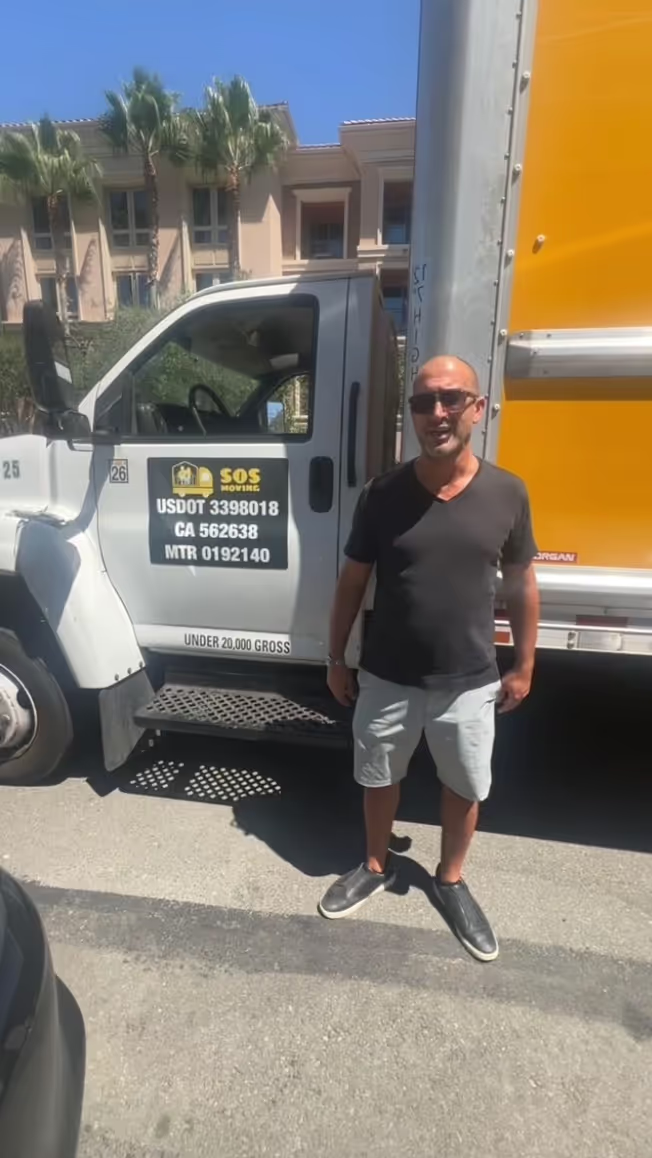



What comes off the truck before the instrument does:
One call to 909-443-0004 books it, any day from 8AM to 6PM, and a move on the same day is often possible.


Dispatch picks the approach and the standing spot first. The city keeps heavy trucks on a designated route network adopted by ordinance and publishes a truck-route map, so the last mile to your block is planned rather than improvised.
On arrival the four movers walk the route backwards, from the instrument to the tailgate. Runners go down, doors come off their hinges where the swing steals inches, and every jamb the case will pass gets padded.
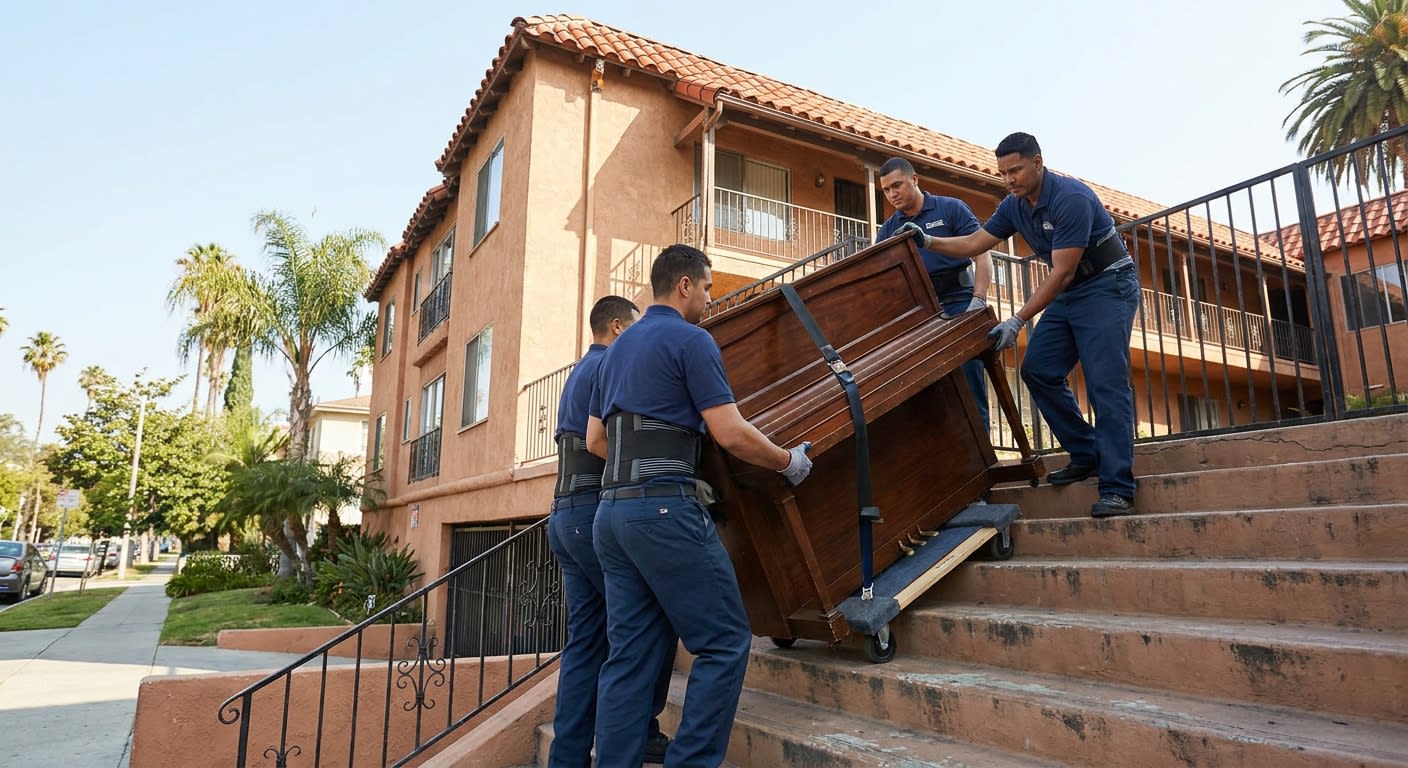
The lift itself is short. The piano goes onto the board, the board goes onto the dolly, and four sets of hands share the weight down each step; upright cases ride on their back edge, and a grand loses its legs and lyre first.
Loading is deliberate. The instrument is first into the box and strapped to the wall, and the rest of the load is built around it so nothing can shift against the case on the drive.
There is no separate tariff for instruments here. A piano rides inside the ordinary hourly rate with one flat charge on top, and these are the only numbers that apply:
The total swings on two things above all: how many steps sit between the instrument and the tailgate, and how far from the door the truck has to stand. A photo of each lets dispatch put a number of hours on the job before you book.
This city is stricter about a standing truck than most of the county. Municipal Code 8.44.080 bans parking on any city street between 2:00 and 5:00 a.m. across the whole town unless that particular block has been exempted by the City Council, and an exempted block carries signs reading “Parking Permitted 2:00 a.m. to 5:00 a.m.”
Relief is not quick to get. A Select Street Exemption needs a petition signed by a majority of the property owners on both sides of the street, and a Temporary Exemption for short-term situations such as out-of-town visitors or driveway and home-repair work is granted at the sole discretion of the Police Department Traffic Division. A Resident Only Parking Permit is no help overnight either, since those run from 7:00 a.m. to 7:00 p.m.
Daylight is therefore the working window. A yellow curb under Code 8.44.120 allows only the time actually needed to load personal property and never more than twenty minutes, from 6:00 a.m. to 6:00 p.m. on days other than Sunday and holidays, so the crew stages the instrument indoors and brings the truck in once the path is clear.
Private streets change whose permission you need. Amerige Heights is deliberately built with a mix of public and private streets, and the association tells residents plainly that the 2–5 a.m. city ordinance applies only to the public ones; the private streets run on the association’s own Parking and Vehicle Control Regulations, adopted in 2018 and administered through Action Property Management.
Geometry matters there as much as paperwork. The community uses traffic circles in place of stop signs and signals, with the island turning cars counterclockwise, and the association notes that the low curb lets oversized vehicles pass freely. The posted limit inside the community is 25 mph or slower.
So one question comes before dispatch sends a truck: is the address on a public street or a private one? From there we chase the gate contact, the lift reservation and any certificate of insurance the building wants, days ahead rather than on the morning of the move.
The older tracts here were laid out for views, not for box trucks. Brookdale Heights is a two-block district covering the 300 and 400 blocks of West Brookdale Place, built out mainly between 1926 and 1928 and described by Fullerton Heritage through its hillside lots and multi-level homes; the city applied an R-1-7.2P preservation zone to those blocks in 2005 at the owners’ request.
Skyline Park carries the same decade in a different shape: nine blocks and 114 lots from the late 1920s, bounded by Skyline Drive, Cannon Lane, North Lemon Street and Sheppard Drive, with a community meeting held in March 2025 about a preservation zone of its own.
College Park reads differently again — twelve blocks that were not platted for residential lots until 1922 and then filled in piecemeal with pattern-book California bungalows, under an R-2P zone since 1979 that leaves out the lots fronting Chapman and Commonwealth Avenues.
Whichever of them an address sits in, the crew walks the carry route before touching the instrument and sizes the board to the narrowest turn on it.
The municipal calendar sets as much of the timing as we do. Under Resolution No. 2019-50 street-sweeping signs are posted city-wide, often at the entrances to a neighbourhood, with the schedule also shown on the city’s sweeping map, and a newly signed street gets a two-week grace period of warning citations before real ones start.
Enforcement is not casual: since 2019 overnight, street-sweeping and downtown parking have been enforced under a contract with SP+. Downtown itself adds permit Parking Districts No. 1 and No. 2 over yellow-marked stalls inside the area bounded by Commonwealth Avenue on the south, Whiting Avenue on the north, Pomona Avenue on the east and Malden Avenue on the west.
Nothing is left standing overnight in any case, and a vehicle parked on a street, highway or alley for more than 72 hours can be towed. Our approach follows the routes the city designates for trucks, and the clock rules hold everywhere: a four-hour minimum at 30 or more miles from base, with travel billed double past ten miles.
Type of home in Fullerton → what the crew of four prepares. Detached houses dominate the stock — state estimates count 24,551 single-family detached units, roughly 59 percent of all single-family housing, against 47,369 occupied units and a 4.8 percent vacancy rate — and more than half of everything here went up before 1970. Preparation follows the building type:
| Type of home in Fullerton | What the crew of four prepares |
|---|---|
| Detached single-family house, the dominant type at 24,551 units | The simplest shape of the job: board out at the door, ramp over the threshold, straps tight before the first step down to the driveway. |
| Home built before 1970 — over half of everything in town | Jambs, treads and the turn at the newel are measured on arrival, and pads go on plaster and casings that pre-date current fire and earthquake standards. |
| Duplex or townhouse in the 6.1–15.0 du/ac band | Shared driveways and guest stalls decide where the box truck stands; lid and lyre come off at the door instead of in the room. |
| Condominium in the Downtown Mixed Use band, 30–60 du/ac | Lift booked with the building, pads hung inside the car, and a certificate of insurance sent to management for $50 when they ask for one. |
| Urban Center address at 30–80 du/ac | The dock window is confirmed first, then the crew of four splits: two stay on the board, two hold doors and clear the lift lobby. |
| Amerige Heights home on a private street | Regulations the association adopted in 2018 apply there rather than the city ordinance, and the circles are taken at 25 mph or slower with the long box tracking wide. |
| Hillside lot in Brookdale Heights, 300 and 400 blocks of West Brookdale Place | Multi-level homes on a graded approach: a longer carry, four hands on the straps and a controlled descent rather than a roll. |
| Pre-war house in Skyline Park or College Park | Late-1920s lots and pattern-book bungalow entries, so the board is sized to the narrowest turn and the route is walked before the instrument moves. |














Either works. The instrument is handled inside a normal hourly booking with four movers and a flat $200 piano charge on top of the hours. The three-hour minimum applies the same way whether the piano is the only item in the truck or one of two hundred.
It covers the instrument itself — the board, the ratchet straps, the pads that go around the case and the fourth pair of hands that makes the crew a crew of four. Hours are billed separately at the four-mover rate, so a short carry costs less than a long one even though the flat charge is identical.
No. City code bans parking on any street between 2:00 and 5:00 a.m. unless your block has been exempted by the City Council and posted with a sign saying so, and a Resident Only Parking Permit runs only from 7:00 a.m. to 7:00 p.m. We schedule the arrival inside the working day instead.
Tell us whether the street outside your door is public or private. The city ordinance covers the public streets there, while the private ones fall under parking regulations the association adopted in 2018, and that is whose permission we need. A gate contact and a reminder that the limit inside is 25 mph or slower handle the rest.
No. We carry it, place it where you want it and leave the room clear; tuning, valuation and disposal are separate trades and we do not offer any of them. Book your own technician for a visit once the piano has settled into its new room.
It changes the hours, not the method. Four movers, the board and the straps handle a flight of stairs or a graded approach; what grows is time on the clock. That is why the carry route is measured and walked before anyone commits to a plan for the day.
SOS Moving does not publish a piano package, and there is no separate instrument tariff to compare it against. A piano is moved inside a normal hourly job with a crew of four, and one flat charge of $200 is added for the instrument. That structure holds whether the piano is the only thing leaving the house or the last item onto a full truck.
The rate that applies is the four-mover rate: $199 an hour in cash or $209 by card from Monday through Thursday, and $215 or $225 from Friday through Sunday. Three hours is the minimum on any booking. Once the address sits 30 or more miles from our base, that minimum becomes four hours.
Travel is where hourly moving surprises people. Drive time counts double beyond ten miles, and anything past the eighth hour of a working day is overtime. Both rules are quoted before you book rather than discovered on the invoice.
A $50 deposit holds the date and comes off the final bill, and fuel is a flat $30. If a building manager wants a certificate of insurance that is $50, a second truck is $200, and a single non-instrument piece over 300 lbs is $150 on a three-mover crew.
What this structure does is keep the incentives honest. We are paid for the time a job actually takes, so the crew arriving at your door has every reason to have measured the doorway and cleared the route before the first strap is pulled tight.
A piano is not simply a heavy box. Its weight sits high and unevenly, the case is finished on every visible surface, and the parts most likely to break — the lyre, the lid, the fallboard, the legs of a grand — are exactly the parts a careless grip reaches for. That is why four movers are not optional on this job.
The board is the centre of the method. The instrument is belted to a padded piano board with ratchet straps, and from that moment it is never carried by its own structure: the board takes the load, the straps take the motion, and the movers take the board.
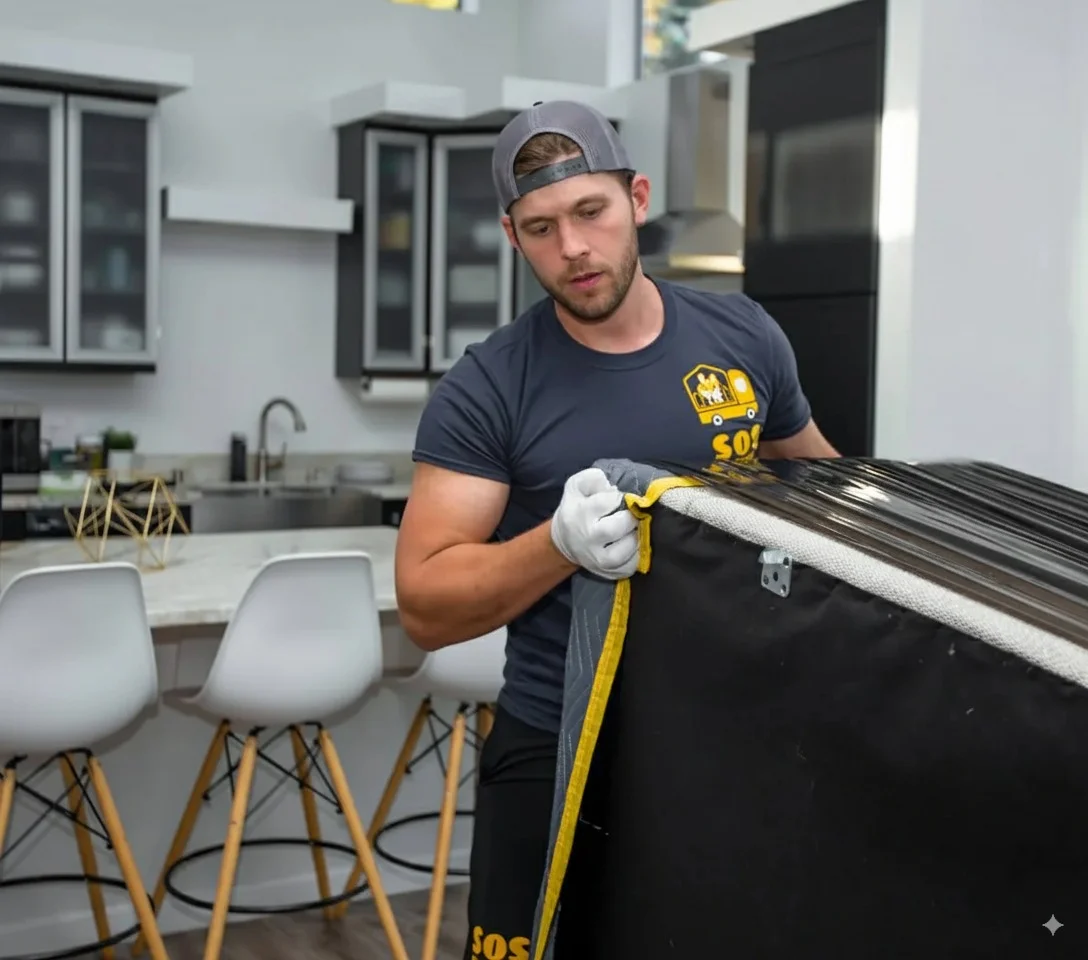
Around the case go quilted pads, stretch film over the pads, and corner protection at every point that will pass a jamb. On a grand, the legs and the lyre come off first and travel wrapped separately, which is the step that turns an awkward shape into a manageable one.
Under all of it runs the path. A low four-wheel dolly covers level ground, aluminium ramps cover thresholds and kerbs, and runners protect floors that scuff. Doors come off their hinges whenever the swing costs the inches that decide whether the case fits at all.
Inside the truck the instrument is loaded first and strapped to the wall before anything else is stacked. Everything that follows is built around it, so nothing can work loose and shift into the case on the drive.
Preparation is short, but it is worth doing, because every minute of it comes off the clock. Clear the room the instrument stands in and the whole route out of it, including the hallway corner everyone forgets and the step down at the front door.
Two numbers are worth sending with the booking: the narrowest doorway on the route and the width of the tightest turn. Photographs of the entry and of the kerb outside are more useful than descriptions, because dispatch reads them for the standing spot as well as for the carry.
Local housing stock makes this worth the effort. More than half of the homes in town were built before 1970, a bracket the city’s own housing element flags for rehabilitation needs, for lead-based paint in deteriorated condition, and for construction predating current fire and earthquake standards. Old plaster and old casings deserve pads rather than confidence.
Shut the pets somewhere else and keep children out of the route for the duration. Four people carrying a belted instrument cannot stop mid-step, and the whole plan assumes the path stays empty from the room to the tailgate.
Settle the parking question the day before rather than on the morning itself. Whether the truck stands at a kerb, in a driveway, on an association street or at a loading dock decides the first fifteen minutes of the job and sometimes the shape of the whole day.
The older neighbourhoods here sit on grades. Brookdale Heights, the two-block district on the 300 and 400 blocks of West Brookdale Place, was built out between 1926 and 1928 and is described through its hillside lots and multi-level homes; a residential preservation zone, R-1-7.2P, was applied there in 2005 at the request of the owners.
Skyline Park carries the same decade in another shape. Nine blocks and 114 lots were laid out in the late 1920s between Skyline Drive and Cannon Lane, North Lemon Street and Sheppard Drive, and the city held a community meeting in March 2025 about a preservation zone there. College Park is twelve blocks that were not platted for residential lots until 1922 and then filled in piecemeal with pattern-book California bungalows, under an R-2P zone since 1979.
Stairs change the pace, not the plan. Going down, the crew works above the instrument rather than below it, one mover controls each corner of the board, and the load is walked step by step. A slope outside does the same thing to the approach, which is why the standing spot is chosen before the instrument leaves the room.
Association streets add a different kind of delay. In Amerige Heights the public and private streets sit side by side, and the association is explicit that the city’s 2–5 a.m. ordinance applies only to the public ones, while the private streets run on regulations the association adopted in 2018.
Internal geometry there is unusual as well: traffic circles instead of stop signs and signals, an island that turns cars counterclockwise, a low curb the association notes lets oversized vehicles pass freely, and a limit of 25 mph or slower throughout. A long box truck works with all of that, provided the driver knows it is coming.
Lifts are a category of their own. Where an address sits in the downtown or Urban Center density bands — 30 to 60 and 30 to 80 dwelling units per acre — the instrument usually rides a building lift, and the building’s own rules about hours, pads and insurance shape the schedule more than we do.
Most instruments we handle are not moving alone. The piano leaves as part of a household relocation, and because everything is billed by the hour there is no second booking and no separate crew fee: the same four movers deal with the sofa, the boxes and the instrument in one continuous shift.
Sequencing is what makes that work. The instrument goes into the truck first and is strapped to the wall, so the rest of the house is loaded around a fixed point rather than squeezed in beside a piano at the end of the day.
At the far end the order reverses. The piano comes out last, which leaves the crew an empty tailgate and a clear run into the room, and it is set exactly where you want it before the first box follows it through the door.
If a house is large enough to need a second vehicle, that is $200 and the instrument stays on the primary truck. If the job runs across two days, an overnight hold on the truck costs $200 and saves handling the household twice.
Four things decide the bill more than the instrument does: the number of steps at each end, the distance from the door to wherever the truck can legally stand, the width of the tightest point on the route, and the drive between the two addresses.
Parking is the factor people underestimate. A yellow kerb gives twenty minutes for loading personal property between 6:00 a.m. and 6:00 p.m. on days other than Sunday and holidays; downtown runs permit Parking Districts No. 1 and No. 2 over yellow-marked stalls inside Commonwealth, Whiting, Pomona and Malden; and street-sweeping signs posted under Resolution No. 2019-50 show which day a block is swept, with the schedule repeated on the city’s sweeping map.
Enforcement is contracted rather than incidental. Since 2019 overnight, street-sweeping and downtown parking have been handled under a contract with SP+, a newly signed street gets only a two-week grace period of warning citations, and a vehicle left on a street, highway or alley beyond 72 hours can be towed.
Distance sets the floor under everything else. At 30 miles or more from our base the minimum becomes four hours, and travel time counts double past ten miles. We will not invent a mileage figure for your address, but we will read it off the route before you commit to a date.
The instrument type matters less than people expect, though it is not nothing. An upright, a spinet, a baby grand and a full grand each ask for a different grip, a different disassembly order and a different footprint on the board, and our piano moving service page works through all four in detail.
Ready to put a date on it? Phone 909-443-0004 between 8AM and 6PM on any day of the week, or write with your address, the floor and a snapshot of the street outside. Dispatch answers with the hours we expect to bill, and a same-day pickup is possible when a truck and a crew of four are open.