


%201.svg)



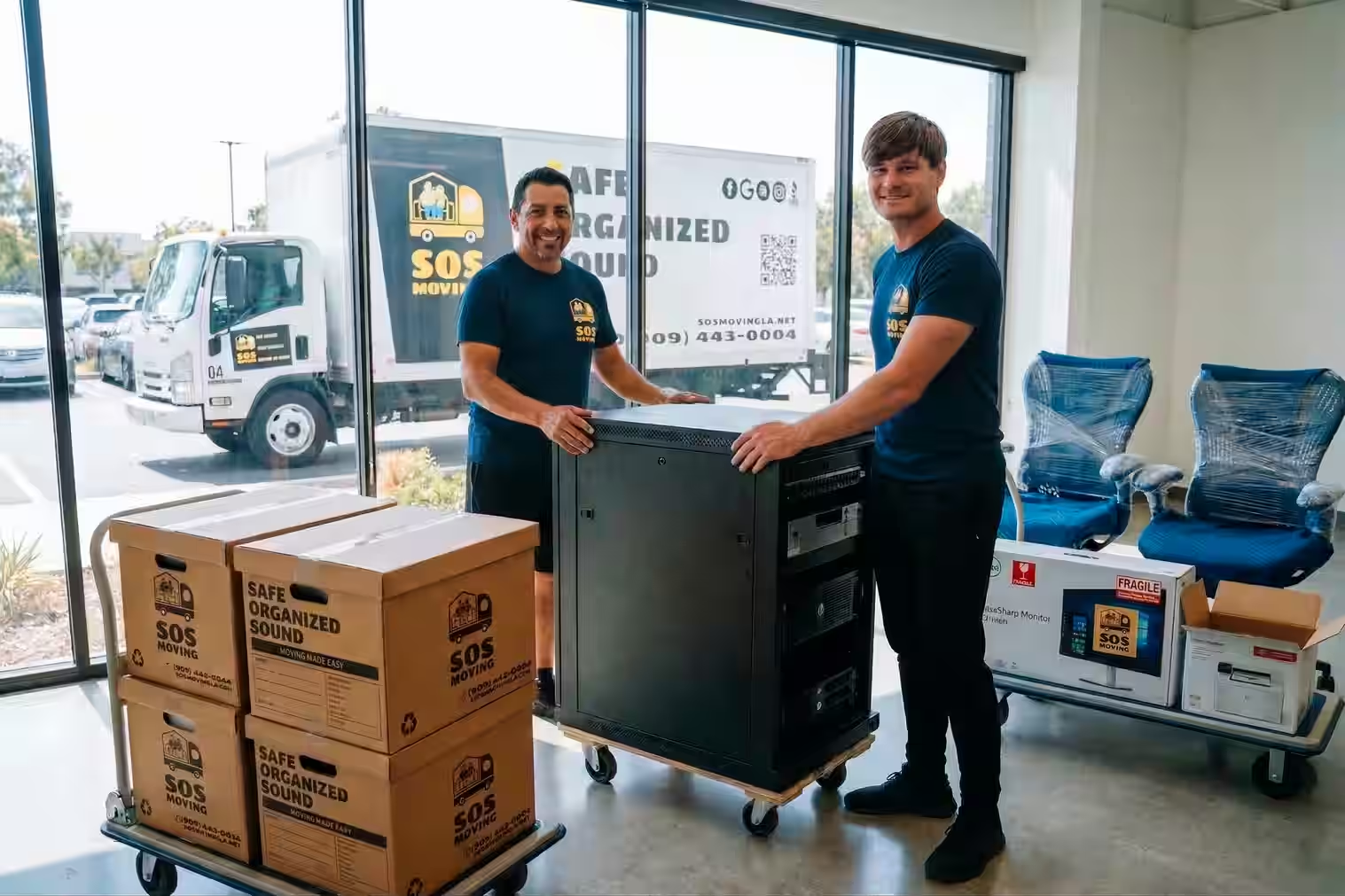

What a business here gets on the job:

Included in a commercial job:
The order we work in:
Commercial work is billed by the hour at our published rates, the same ones we quote anywhere in Los Angeles County. Crew size follows the volume and the carry distance inside the building rather than the address on the lease:
| Crew and truck | Mon – Thu | Fri – Sun |
|---|---|---|
| 2 movers with a truck | $119 cash / $129 card | $135 cash / $145 card |
| 3 movers with a truck | $159 cash / $169 card | $175 cash / $185 card |
| 4 movers with a truck | $199 cash / $209 card | $215 cash / $225 card |
Additions and minimums:
Nothing else is added after the fact. The walkthrough is what turns those rates into a figure for your suite, and the deposit is the only money that moves before the day.
The city caps kerb time for commercial vehicles at one hour in a commercial zone, unless the vehicle belongs to the property owner, and at two hours in a residential zone for anything over 7,000 pounds. We plan to that clock: the truck is staged in the tenant’s own lot or loading area and the crew carries to it, instead of holding a public kerb space all day.
Parking on any city street is prohibited between 2:00 a.m. and 4:00 a.m., Monday through Friday, without an early morning parking permit, issued from vending machines in front of the Police Department at 150 S. Glendora Ave. and at Gladstone Park. Should a container or roll-off need to sit on the street between stages, the Engineering Division at 116 E. Foothill Blvd. issues that permit; the same box in a driveway needs none.
Paperwork, not the truck, usually sets the earliest possible date. A Glendora public works permit calls for a certificate of insurance carrying the city’s own required wording plus a valid Glendora business license, and a traffic control plan is required on collector and arterial streets and for any full road closure. That file is opened as soon as a date is agreed.
Private landlords add their own list: a certificate naming the owner and the management company, a booked freight lift or overhead door, and agreed access hours. Ours costs $50 and is written to whatever wording the manager sends over. An oversize load crossing city streets is a separate Engineering permit, so that question is asked at the walkthrough rather than on the morning.
General commercial centres sit along the arterials, on Grand Avenue and Foothill Boulevard, North Glendora Avenue, East Route 66 and East Arrow Highway, and are usually anchored by a grocery or a large retail store with service tenants in the same centre. Suites like those share a parking field with the anchor’s customers, which is where staging has to be agreed first.
Regional commercial uses, meaning big box retail and automobile sales, are concentrated in the south-eastern part of the city along Lone Hill Avenue and Gladstone Street. Industrial land is scarce, roughly 68 acres in total, with some concentration near Foothill and Grand, near Arrow Highway and Grand, and along Auto Centre Drive east of the I-210, where light industrial covers business parks, corporate offices and warehousing.
Three interchanges serve the city from the I-210, at Grand Avenue, Sunflower Avenue and Lone Hill Avenue, while Arrow Highway forms the southern border. The 260-acre South Hills Park and the freeway break up travel from north to south, which runs on arterials and collectors crossing the I-210, among them Barranca, Grand, Glendora and Lone Hill Avenues.
Drivers are briefed that Baseline Road is not continuous: it ends at Glendora Avenue and picks up again at Amelia Avenue. Since the Metro A Line opened in September 2025, raised medians, red kerbing and turn restrictions apply within 100 feet of the rail corridor at every street crossing, and West Ada Avenue west of Vermont Avenue, along with Glenwood Avenue, now ends in a cul-de-sac at the tracks.
What we check before quoting, by business district or building type:
| Business district or building type in Glendora | What it changes for the crew |
|---|---|
| Centres on Grand Avenue and Foothill Boulevard | General commercial anchored by a grocery or large retail store with service tenants alongside; kerb time in a commercial zone is capped at an hour, so loading is staged from the tenant lot. |
| North Glendora Avenue and East Route 66 frontage | Small suites over street-level businesses on arterial frontage; access is agreed with the anchor tenant and the load is broken into shorter truck cycles. |
| Lone Hill Avenue and Gladstone Street, south-east corner | Regional commercial, big box retail and car sales; the circulation element rates Route 66 at Lone Hill at level of service E in the morning peak and Gladstone at Lone Hill at level of service E in the evening, so heavy loads run between the peaks. |
| Glendora Commercial Specific Plan area | Bounded by Lone Hill Avenue on the east and Gladstone Street on the south; heavy trucks and delivery vehicles are kept off direct access from Gladstone Street and follow the truck routes the plan establishes. |
| South side of Gladstone Street | Those properties are inside the city of San Dimas, so any street question there goes to a different city hall than the one that issues a Glendora permit. |
| Gladstone Industrial Park, 2001–2041 E. Gladstone St. | 119,100 sq ft of office and warehouse units from 1,000 to 10,000 sq ft, concrete block, with 10 by 10 foot overhead doors and 12 to 16 foot ceilings; the door is measured against the widest piece before the quote. |
| Business parks near Foothill and Grand or Auto Centre Drive | Light industrial space shared between offices and warehousing; most such sites are reached from Route 66 on the west side or from the I-210 in the south-east corner. |
| Suites around Foothill Presbyterian Hospital | Preferential parking District 3 applies at all hours, District 1 around Glendora High School from 7 a.m. to 3 p.m. and District 2 around Citrus College from 7 a.m. to 8 p.m.; crew vehicles go in the tenant lot. |
| Addresses near the Metro A Line corridor | Raised medians, red kerbing and turn restrictions within 100 feet of the corridor at every crossing, with West Ada Avenue west of Vermont and Glenwood Avenue now dead ends at the tracks. |














Yes. Crews work Monday through Sunday between 8AM and 6PM, so a Saturday and a Sunday give two full days in a quiet building and staff come back to finished desks. Larger floors are usually split across two weekends rather than forced into one, and the stages are agreed at the walkthrough.
We do. The certificate is $50 and is written to the wording and limits your management company sends us, naming the owner and the manager as required. Our carrier details, USDOT 3398018, MC 1153871 and CAL-T0192140, go on the same document. Forward the request as soon as you have a date and we file it before move week.
In your lot or loading area wherever that is possible. Glendora limits a commercial vehicle to one hour at the kerb in a commercial zone, and to two hours in a residential zone for anything over 7,000 pounds, so the day is built around short truck cycles rather than one long stand at the kerb. If a container has to stand on the street between stages, the Engineering Division at 116 E. Foothill Blvd. issues the permit for it.
Two movers with a truck are $119 an hour cash or $129 by card Monday through Thursday, and $135 or $145 Friday through Sunday, with larger crews priced the same way. A three-hour minimum applies, four hours when the job sits 30 or more miles from our base, and travel is billed as double drive time past 10 miles. The walkthrough turns those rates into a figure for your suite.
That is how most business relocations here are run. The archive and store room go first, then one department at a time, so each team is already working from new desks while the next one packs. Stages can sit on consecutive days or a week apart, and the hourly rate is the same for each visit.
Yes, and it is common in the older commercial centres and in office and warehouse units such as those on E. Gladstone Street, where loading runs through a 10 by 10 foot overhead door. We measure the door and the ceiling height against the widest piece on the inventory before quoting, and bring machine dollies and ramps to suit whatever the building actually has.
A move plan starts with a count, not a truck. We walk both addresses, list every desk, cabinet, screen and machine, and mark the pieces that will not leave a room in one piece. That list becomes the quote, the crew size and the order of work, and it is the one document both sides read.
Labelling is the cheapest insurance in a business relocation. Each destination room gets a number and a colour, every carton and chair carries the same tag, and a floor plan is posted at the new suite so nobody has to guess where a pallet of files belongs.
IT equipment gets a pass of its own. Screens, docks, printers and rack-mounted gear are photographed where they stand, cables are tagged before anything is unplugged, and the hardware travels padded and upright so it can be put back the way it came out.
Workstations are the slowest part of moving an office out of Glendora, so they are scheduled first. Benching and panel systems come apart into flat pieces, the fixings for each station are bagged and labelled, and the rebuild follows the new plan rather than a memory of the old one.
One more thing belongs in the plan before anything is booked: the leaving date and the opening date rarely touch. A gap of a few days changes the whole schedule, and it is better priced at the walkthrough than argued about later.
Most delays on a commercial job are paperwork rather than lifting. A property manager wants a certificate of insurance naming the owner and the management company, carrying the limits and wording they specify, and wants it in hand before a dolly touches the lobby floor.
Ours costs $50 and is written to the request you forward. Where the building also asks for carrier credentials, USDOT 3398018, MC 1153871 and CAL-T0192140 go on the same document, which usually ends the conversation in one email.
Access is the second half. A freight lift has to be booked and padded, a dock or an overhead door reserved for the window being worked, and the hours the building allows have to line up with the hours we work, which are 8AM to 6PM, any day of the week.
Where work touches a public street, the city has its own list: a certificate of insurance carrying the wording Glendora requires, a valid business license, and a traffic control plan for a collector or arterial street or any full closure. Those requests go in early, because they are reviewed by people who have never seen your lease.
Container questions come up on almost every phased job. A roll-off or POD standing on a city street needs a permit from the Engineering Division at 116 E. Foothill Blvd., while the same box in a driveway does not, and an oversize load crossing city streets is a separate permit again.
Very few tenants can empty a floor in a single push. The usual answer is a staged move: the archive and the store room leave first, then department by department, with each team already working from its new desks while the next one packs around them.
Weekends carry the heaviest stages. Two consecutive days in a building with nobody in it are worth more than four evenings, and the crew finishes with time to rebuild desks rather than stacking them in a corridor for Monday.
Short notice is workable. A same-day job is possible when a landlord shifts a handover or a suite has to be cleared quickly, and the limit is stated plainly: crews finish at 6PM, so a rush is planned to what fits inside that window and the remainder runs the next morning.
Timing inside the day matters as much as the date. The city’s circulation element puts the peak periods at 7:00 to 9:00 a.m. and 4:00 to 7:00 p.m. and rates Route 66 at Lone Hill Avenue at level of service E in the morning and Gladstone Street at Lone Hill Avenue at level of service E in the evening, so loads through the south-east corner are timed between them.
Rail changed a few habits too. Metro A Line trains have run through the city since September 2025, roughly from 4:00 a.m. to 1:00 a.m. every day and every eight to ten minutes in the weekday peaks, and seven at-grade crossings remain in the city, which is enough to make a route briefing worth five minutes.
Furniture is where a commercial crew earns its hours. Executive desks, conference tables, shelving runs and filing systems come apart with their own fixings kept in a labelled bag, go into blankets and shrink wrap, and ride on machine dollies instead of being dragged across a floor somebody else owns.
Lateral files travel loaded only where a building allows it. Where it does not, drawers are boxed in order and indexed, so an accounting or legal team can put a hand on a file the same afternoon rather than the following week.
Heavy single pieces are priced openly. Anything over 300 lbs is $150 with a three-mover crew, and a piano in a lobby or a staff lounge is $200 and moves only with four movers, both decided at the walkthrough instead of on the day.
Reassembly follows a plan agreed in advance. Desks go up first, then seating and screens, then the shared pieces, and the last part of a stage is spent on the small adjustments that otherwise become a fortnight of complaints.
Not everything should make the trip. A walkthrough is the moment to decide what goes to storage and what is disposed of, because paying a crew to carry a broken cabinet into a new suite is the most avoidable line on any quote.
Where a suite sits changes a plan more than its size does. Centres along Grand Avenue and Foothill Boulevard, North Glendora Avenue, East Route 66 and East Arrow Highway are anchored by a grocery or a large retail store, so a crew shares the parking field with that anchor’s customers for the whole day.
In the south-east corner, regional commercial along Lone Hill Avenue and Gladstone Street means big box retail and automobile sales, with wider approaches and heavier traffic. The Glendora Commercial Specific Plan area sits there, bounded by Lone Hill Avenue to the east and Gladstone Street to the south, and its provisions keep heavy trucks and delivery vehicles off direct access from Gladstone Street, routing them onto the truck routes the plan establishes.
A detail catches carriers out: properties on the south side of Gladstone Street lie inside the city of San Dimas. A question about that kerb goes to another city hall, which is worth knowing before a permit clerk explains it on a Friday afternoon.
Industrial and flex tenants face a different constraint. Of roughly 68 acres of industrial land in the city, most sites are reached from Route 66 on the west side or from the I-210 in the south-east corner, and light industrial there covers business parks, corporate offices and warehousing under one roof.
Unit specifications decide the loading method. An office and warehouse unit at Gladstone Industrial Park on E. Gladstone Street runs from 1,000 to 10,000 sq ft in concrete block, with 10 by 10 foot overhead doors and ceilings of 12 to 16 feet, and that door is measured against the widest item on the inventory before a price is quoted.
A commercial job is not over when the truck is empty. The old suite is swept, packing debris is taken away, and the manager walks it with us, which keeps the deposit conversation short and factual.
Storage covers the gap when a new floor is not ready on the day the old one has to be handed back. A night in the truck is $200, and longer gaps are easier to plan than a second short-notice move squeezed into a busy week.
Then the small things. Cartons are collected once departments unpack, furniture is adjusted where a plan met a wall, and one number stays live: 909-443-0004, Monday through Sunday, 8AM to 6PM.
Rates, crew sizes and the full service list live on our commercial movers page, and residential work in the same city is covered by our Glendora moving page. Packing help for archives, glassware and IT gear is booked through packing services at the same time as the crew.