



%201.svg)








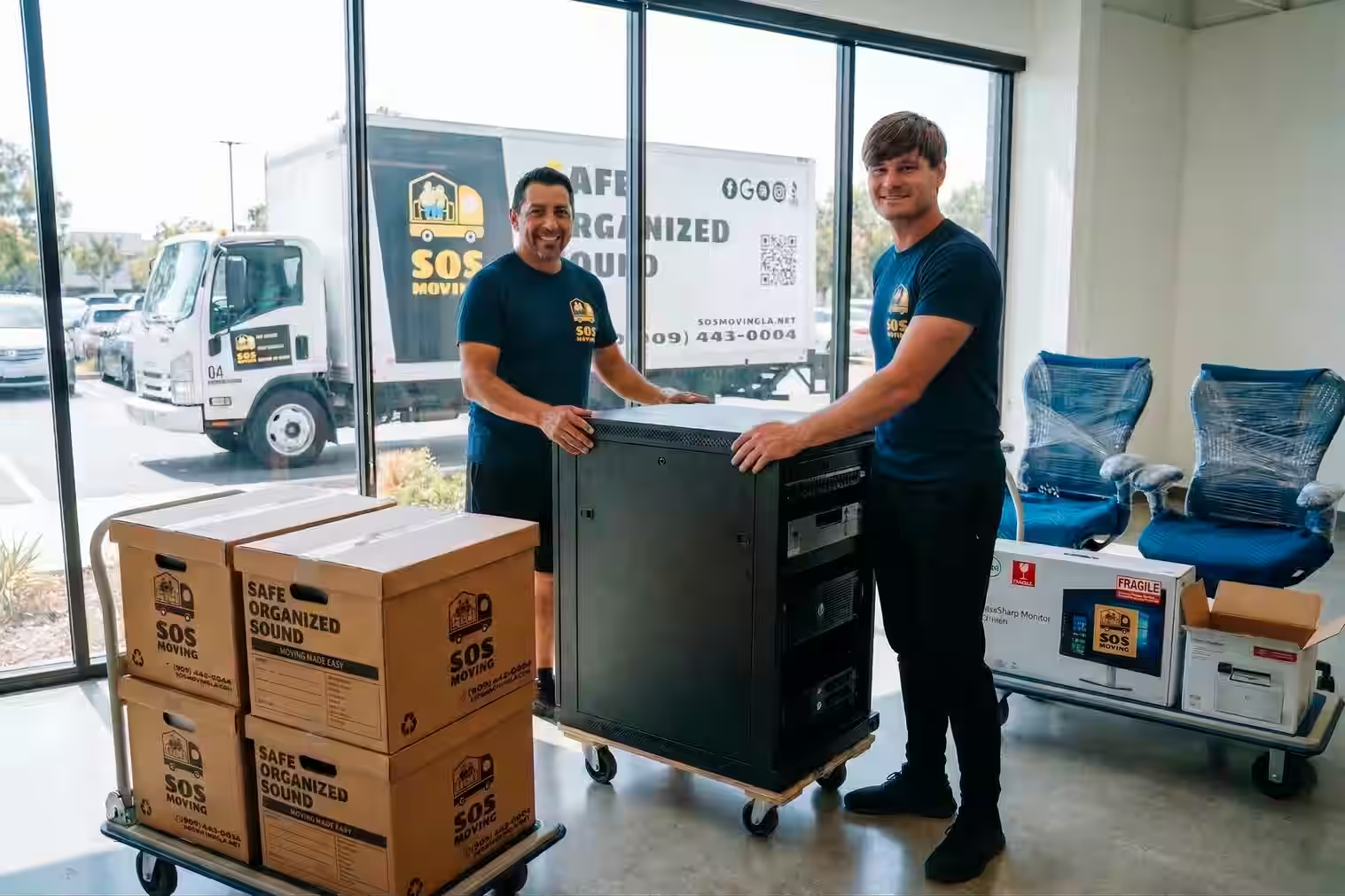

What comes with a business booking here:

What the crew handles on a working floor:
How a staged relocation is put together:
What a flex-space or small warehouse move includes:
Hourly rates, crew and truck included:
Everything else that can reach a business invoice:
Temporary No Parking signs are issued to residents and businesses to reserve on-street spaces when off-street parking or loading spaces are not large enough. The steps have to be completed no less than 24 hours before the reservation starts, and Traffic Services has to inspect the posted signs inside that window — an inspection with under 24 hours to go will not be enforceable.
Once inspected by SMPD Traffic Services the signs mark a tow-away zone, curb space for a moving truck can be held for a maximum of 72 hours, and non-metered reservations are done in increments of 30 feet. We measure the truck against those increments when the estimate is written, and the signs go up the day before rather than on the morning of the move.
Municipal Code Section 9.28.030 is the source of the Parking and Loading Operations Plan, which is submitted to the Director for review and approval. A plan of that kind gives the dimensions of all passenger and freight loading spaces, the path of travel from the loading space to the locations it serves, and the loading operations themselves: hours, frequency and timing of use, truck sizes and circulation patterns.
It also records driveway gates, parking ticket dispensers, gate arms and payment booths, any valet or attendant operations, and the hours of operation for all users. Where a property keeps one on file, our coordinator asks the management office for those numbers instead of guessing from photographs, and the $50 certificate of insurance goes across in the same email.
Santa Monica Business Park at 3420 Ocean Park is a creative office campus of more than 45 acres, 21 properties and 1.18 million square feet, sitting beside the Sunset Park and Ocean Park neighborhoods. Colorado Center at 2401 Colorado Avenue holds six properties on 15 acres and 1.14 million square feet, with about 3,100 parking spaces in a three-level underground garage arranged around a central courtyard.
Addresses of that shape are priced by walking distance rather than by street frontage, because the carry from the nearest legal truck position to the suite door is where the hours go. Our surveyor paces that route, notes lift positions and courtyard gates, and turns the walk into a number before anything is signed.
The city truck route dataset, drawn from Municipal Code 3.12.680, keeps vehicles over three tons gross weight on designated routes, with a deviation allowed only by the shortest possible route to a pickup or delivery. Primary routes are the Santa Monica Freeway, Olympic Boulevard, Pacific Coast Highway and Lincoln Boulevard from Olympic to the southern city limits.
Secondary routes, meant for loads with a local origin or destination, include Santa Monica Boulevard, Colorado Avenue, Broadway, Pico Boulevard, Ocean Park Boulevard, Cloverfield Boulevard, Stewart Street, Exposition Boulevard and Neilson Way. Dispatch plans the approach along those streets, and anything needing an Oversize Load Permit is flagged early, since the city asks for one to three business days to process one.
Business area or building type in Santa Monica, and what to plan for:
| Business area or building type in Santa Monica | What to plan for |
|---|---|
| Santa Monica Business Park, 3420 Ocean Park | A creative office campus of 45-plus acres, 21 properties and 1.18 million square feet beside the Sunset Park and Ocean Park neighborhoods: we confirm which property the suite sits in before hours are quoted. |
| Colorado Center, 2401 Colorado Avenue | Six properties on 15 acres, 1.14 million square feet and roughly 3,100 spaces across a three-level underground garage set around a central courtyard, with Bergamot Station next door for the rail link to Downtown LA. |
| The Water Garden, 1620 26th Street | Three subterranean parking levels, more than 4,000 spaces and direct access into each building lobby; the garage is run by a parking facility manager from ABM rather than the office landlord, so we check who to call first. |
| A suite with no dock, loading from the street | Temporary No Parking signs requested and inspected at least 24 hours ahead, a tow-away curb once inspected, a 72-hour ceiling on the reservation and non-metered space booked in 30-foot increments. |
| Oversize pieces: wide crates, tall racks, long loads | An Oversize Load Permit covers anything over 8 feet 6 inches wide, over 14 feet high, over 40 feet as a single vehicle or 65 feet as a combination, or over 80,000 pounds gross; the certificate of insurance is uploaded and the driver carries the permit during the haul. |














Yes. Crews run Monday to Sunday between 8AM and 6PM, so a weekend stage is an ordinary booking rather than a special arrangement. Weekend hours cost more than midweek ones: two movers with a truck are $135 an hour in cash Friday to Sunday, against $119 Monday to Thursday.
A COI is $50 and we write it in the wording your management office supplies, naming the entities they list. Send the sample certificate or the requirements page from the building handbook as early as you can, and we will have it back with them before the date is confirmed.
Curb space is held with Temporary No Parking signs, which have to be requested and inspected at least 24 hours before the start time to be enforceable. After inspection the reserved curb is a tow-away zone, non-metered space is booked in 30-foot increments, and the reservation can stand for up to 72 hours.
That is how most business relocations on the Westside are run. Each stage is sized to finish inside the 8AM to 6PM working day, and every booking carries the standard three-hour minimum. If a loaded truck has to hold between two stages, overnight storage is $200.
By the hour, by crew size and by the day of the week. Two movers with a truck are $119 cash or $129 card Monday to Thursday, three movers $159 or $169, four movers $199 or $209, with higher Friday to Sunday rates. Fuel is a flat $30, the $50 deposit comes off the total, and double drive time applies past 10 miles.
The same crews move stock, shelving, benches and archives out of flex units and small warehouse suites. Single items over 300 lbs are $150 with a crew of three, and a second truck running alongside the first is $200 when one load will not hold the volume.
A business move is sized by what is in the rooms, not by the square footage on the lease. The first pass is a list: workstations, chairs, monitors, printers, cabinets, crates, the contents of the store cupboard, and the pieces nobody claims until the week before.
Walk the suite with a floor plan and mark every item that will travel, every item that will be sold or recycled, and every item that belongs to the landlord and stays. That third column saves more money than any negotiation over an hourly rate, because furniture that stays is furniture nobody pays to carry twice.
Once the list exists, crew size stops being guesswork. Two movers and a truck suit a small studio; three suit a full floor of desks; four suit a move with heavy pieces or a tight deadline. The list also tells you whether one truck will do the job or whether a second, at $200, will save more hours than it costs.
Give department heads a deadline for their own sections of the inventory. People know their own drawers better than any surveyor, and a list signed off by the people who use the room is the list that survives moving day.
Photograph the rooms while the list is being built. A dozen pictures of a server cupboard, a storeroom and a reception wall settle more arguments about what was where than any spreadsheet, and they give the crew a reference when a piece has to go back the way it came.
Every box, chair and machine needs two pieces of information: who owns it and where it lands. A simple scheme is a room number on the new plan plus an employee code, printed large enough to read from the tail of a truck.
Print the new floor plan at A3 and tape it beside both doors, with the room numbers matching the labels exactly. Crews do not guess when a plan is on the wall, and the questions that usually stop a move in the corridor get answered before anyone asks them.
Color is worth using where departments share a floor. One colour per team, one number per room, and the unload runs in the order the labels come off the truck instead of in the order the boxes were packed.
Personal items are the exception worth making. Ask staff to take laptops, keys, badges and anything irreplaceable home for the night of their stage, and the crew never has to account for the one bag nobody labeled.
Order packing materials against the inventory rather than by instinct. Archive cartons for paper, monitor cartons for screens, bubble and blankets for anything framed: running out of boxes at four in the afternoon costs more in waiting time than the boxes ever cost to buy.
Two buildings are involved in a relocation, and both will have requirements. Ask each management office for the same short list: the certificate of insurance wording, the lift and dock booking procedure, the access hours, and the route from the truck position to the suite door.
The certificate is the item that most often holds up a date. Ours is $50, written to the entities the building names, and it is easier to issue two weeks out than two days out. Where a property keeps a Parking and Loading Operations Plan on file, the dimensions of the loading spaces and the path of travel are already written down, and reading them beats measuring twice.
Lift time is the second item. A goods lift shared with a hundred other tenants is a queue, and a booked window turns that queue into a schedule the crew can work against.
Third comes protection. Most offices expect jamb guards, floor runners and lift blankets, and it is quicker to agree that at the walkthrough than to argue about it with a security desk at eight in the morning.
Dock and curb time are booked in the same conversation. A building with its own loading bay will give you a slot; a building without one sends the truck to the curb, and that space has to be reserved a day ahead rather than found on the morning.
The point of staging is that nobody sits at an empty desk during working hours. Archives, storerooms and spare furniture travel first, because nobody needs them to answer a phone. Desks and machines follow group by group, so each team loses part of one day rather than everybody losing two.
Stages work best when they are booked as whole blocks inside the 8AM to 6PM day rather than as an overnight sprint. A Saturday stage gives a quiet building, a free lift and a full Sunday in hand if something has to be finished, and staff walk in on Monday to a floor that is already working.
Decide in advance what counts as done for each stage. Desks reconnected, network gear powered, monitors on their arms and boxes off the floor is a clear definition; "mostly moved" is not, and it is the state that eats a second day.
Keep one person from your side reachable for the whole window. Questions about which room a cabinet belongs to are cheap to answer in the moment and expensive to answer twice.
Connectivity is the one dependency a moving crew cannot solve. Order the circuit, the handover and the phone numbers at the new address weeks before the first stage, because a floor of reconnected desks with no line into the building is still a floor nobody can work on.
Most office furniture travels in pieces. Benching systems, panel walls, conference tables and shelving come apart, the hardware is bagged and tagged against the item it belongs to, and the panels travel flat where they take far less truck space than they do standing.
Reassembly is where the new floor plan earns its keep. A crew rebuilding to a plan puts the benching back in the right orientation the first time, and the difference between a plan and a verbal description is usually an hour per room.
Filing cabinets are a judgment call. Lateral files can travel loaded where the building and the equipment allow it, and they are emptied into numbered cartons where they cannot. Either way the drawers are secured before the piece leaves the room.
Heavy single items get their own line in the estimate. Anything over 300 lbs is $150 with a crew of three, and a piano in a reception area or a staff lounge is $200 with a crew of four, because the weight decides the crew rather than the other way round.
Leave a punch list at the end of the last stage. Two or three items usually remain — a monitor arm short of a bolt, a cabinet key in the wrong drawer, a box in the wrong room — and writing them down while the crew is still on site is what turns a move into a finished move.
Technology moves best when someone has already switched it off properly. Agree a shutdown time with your IT people, photograph the back of anything with more than three cables, and let the people who own the network decide the order in which it comes down.
On the day, screens come off arms, cables are tagged to their machines, and everything padded travels upright in cartons rather than loose on a blanket. Rack equipment is treated as its own stage, with its own window, because it rarely shares a lift trip politely with desks.
Paper records need a chain that can be audited. Cartons are numbered against the inventory, sealed, and checked off at the far end, so a file room can be rebuilt in the order it came apart and nothing is "somewhere in the middle of the truck".
Confidential material is worth moving in a single stage rather than spread across three. One trip, one list, one signature at each end is simpler to explain to a compliance officer than a week of partial loads. Where records have to sit between addresses, storage is the cleaner answer.
Access decides the hours more often than distance does. Campuses such as Santa Monica Business Park at 3420 Ocean Park spread a creative office campus of 45-plus acres across 21 properties, so the walk from a legal truck position to the right suite is a real number, not a rounding error.
Underground garages change the plan again. Colorado Center at 2401 Colorado Avenue puts roughly 3,100 spaces on three levels around a central courtyard, and the Water Garden at 1620 26th Street runs three subterranean levels with over 4,000 spaces feeding directly into each building lobby, under a parking facility manager who is not the office landlord.
Where a building has no dock, the curb becomes the dock. Temporary No Parking signs hold that space, with the request and the Traffic Services inspection both completed at least 24 hours before the start, a tow-away zone once inspected, a 72-hour ceiling and non-metered reservations taken in 30-foot increments.
Route planning finishes the picture. Vehicles over three tons gross are kept to the designated truck routes under Municipal Code 3.12.680, leaving them only by the shortest possible route to a pickup or delivery, and an Oversize Load Permit adds one to three business days whenever a load runs over 8 feet 6 inches wide, over 14 feet high or over 40 feet long as a single vehicle.
Commercial work is billed by the hour with the crew and the truck included, which keeps an estimate honest: fewer hours on the clock is the only way the number goes down, and everything we do on site is aimed at that.
Rates run from $119 an hour in cash for two movers Monday to Thursday up to $225 on card for four movers Friday to Sunday, with the midweek and weekend bands set out on this page. A three-hour minimum applies, four hours once the job is 30 or more miles from our base, double drive time applies past 10 miles, and overtime starts after eight hours.
Additions are short and predictable: $30 for fuel, $50 for the certificate of insurance, $200 for a second truck, $200 if a loaded truck has to stand overnight. The $50 deposit that holds a date is credited against the final total rather than added to it.
Packing can be part of the same booking or kept separate; our packing services exist for archives, glassware and lab or studio kit that nobody on staff wants to wrap. Send a floor plan and a target date to 909-443-0004, and the schedule is built backwards from the morning you have to be open again.