


%201.svg)




What comes with an office job here:

What the crew takes apart and puts back:
How the job is put together:
What a staged office relocation looks like:
Cargo we load every week:
Crew rates, cash or card:
Everything else that can appear on the invoice:
Hourly work starts at a three-hour minimum, which becomes four hours once an address lies more than 30 miles out from the base. Past 10 miles the travel clock runs at double, and anything beyond eight hours in one day is overtime.
That distance is measured from our Los Angeles office to your street before we quote, never guessed at, and the $50 deposit forms part of the total instead of sitting on top of it.
Curb space is the first thing we check. The city code prohibits parking a commercial vehicle over 10,000 pounds gross vehicle weight on any street, highway or alley in the city between 8:00 p.m. and 6:00 a.m., so a part-loaded truck ends its stage in your own lot, in a secured yard or back at our base.
Downtown there is a second option. The city’s Vehicle Parking District regulates 25 public lots with timed, permit and lease parking, enforced by Pomona PD, and permits are sold at the Public Works counter in City Hall at 505 South Garey Avenue. That counter is closed on Fridays and commuter permits for lots 5, 10 and 12 do not cover the street, so the paperwork is handled early in the week.
Management offices ask for the same three things: a certificate of insurance with their entities named, a booked freight lift or dock, and the hours a crew may use them. The $50 COI is issued with the exact names the landlord supplies and sent before the date is confirmed.
Campus and expo addresses add a layer. Cal Poly Pomona states that permits are required on campus with no grace period, sells the daily digital permit through PayByPhone on the day it is used, and wants reserved spaces or directional signage requested five business days ahead and traffic control fifteen, with a 20% late fee for late submissions.
Three kinds of address produce three kinds of job. In the Arts Colony blocks along West Second Street the Downtown Pomona Owners Association runs the district from 119 West 2nd Street with private security, two dedicated Pomona Police Officers around the clock and a crew that cleans and pressure-washes sidewalks seven days a week, so our loading footprint stays off those sidewalks.
Innovation Village describes itself as a corporate research and technology park operated by Cal Poly Pomona Enterprises, with tenants such as Southern California Edison and a regional American Red Cross headquarters. Fairplex is stricter again: a vehicle may stand only long enough to unload, must display its move-in or move-out credential and then goes straight to a public lot.
Section 58-291 requires vehicles over three tons gross weight to stay on the signed truck routes, leaving them only by direct route to pick up or deliver at a building on a restricted street. Section 58-293 allows a tow off those routes where removal signs are posted, with the same exception for loading and delivery, so the last mile is drawn from the nearest route to your door.
The approach matters too. The SR-57/SR-60 confluence, a two-mile shared stretch between Diamond Bar and the City of Industry, carries more than 356,000 vehicles a day, about 26,000 of them trucks, and its $444 million third phase is scheduled to run until July 2028 with closures published week by week. Dispatch checks the current notice and adds buffer to that leg.
Where your office sits in Pomona, and what the crew plans around:
| Where your office sits in Pomona | What the crew plans around |
|---|---|
| Downtown blocks on and around West Second Street | A managed district with its own patrols and daily sidewalk cleaning: the truck works from a district lot or a side street, and the carry route stays off the sidewalk and clear of neighbouring doorways. |
| An address on Garey Avenue between Aliso Street and Monterey Avenue | The rehabilitation project's new bike lane eliminates parking along Garey Avenue, so loading shifts to a side street, an alley or a Vehicle Parking District lot and the longer carry goes into the estimate. |
| A building on the Cal Poly Pomona campus | Permits are required with no grace period; the daily digital permit is bought through PayByPhone that same day, reserved spaces and directional signage are requested five business days out and traffic control fifteen, with a 20% late fee for late filings. |
| Innovation Village, the corporate research and technology park | Operated by Cal Poly Pomona Enterprises, with tenants such as Southern California Edison and a regional American Red Cross headquarters; we confirm the entrance, gate and dock with site management before the date. |
| An expo or event building at Fairplex | Floor plans reach Fairplex 45 days before the first move-in day for the Los Angeles County Fire Department Area 8 bureau; fire lanes stay 26 feet wide and 32 feet at corners, aisles 10 feet clear, and freight arriving early is refused and returned to its origin. |
| Industrial and warehouse space on Arrow Highway, Holt Avenue, Mission Boulevard, Valley Boulevard, Towne Avenue, Indian Hill Boulevard or Reservoir Street | These are the city's signed truck routes, so a vehicle over three tons is legal all the way to the dock and leaves the route only for the address it is working. |
| A date inside the LA County Fair run, 6–31 May 2027 | The fair takes over 1101 W. McKinley Avenue in Pomona for those weeks, so the move either shifts outside the run or takes the earliest start in our 8AM – 6PM day. |














Yes. Crews work Monday through Sunday inside an 8AM – 6PM day, so a weekend stage is the usual way to keep a business open. We do not run night shifts, and a job too large for one day is split into stages instead.
Yes, for $50 per building that asks for it. Send the exact entity names the management office requires and the certificate goes out before the date is locked. Most offices want the freight lift or dock booked in the same conversation, and we handle that call with them.
That spot is chosen before move day. Heavy trucks may not stay on Pomona streets overnight, and downtown the Vehicle Parking District regulates 25 public lots with timed, permit and lease parking. Where curb space has gone, as on Garey Avenue, we load from a side street, an alley or one of those lots.
Hours, crew size and the day of the week set the rate. A two-mover crew with a truck runs $119 in cash from Monday to Thursday and $129 on a card, rising to $135 and $145 between Friday and Sunday; three- and four-mover crews go from $159 up to $225 on the same pattern. A $30 fuel charge applies, and the $50 deposit comes off the total.
Yes, and most business jobs here are. Every stage is billed for the hours worked, against a three-hour minimum that becomes four once an address lies over 30 miles out. If the load stays on the truck between stages, overnight storage is $200.
Same-day work is possible when a crew is free, although a staged relocation is better booked once the building has confirmed lift and dock access. Ring 909-443-0004, describe the suite and name the date, and the crew size and the expected hours come back to you in writing.
Most business moves come apart on details nobody priced: a freight lift that turns out to be booked, a curb with no legal space for a 26-foot truck, a server rack nobody agreed to touch. The cure is dull and it works, which is to settle every one of those questions on paper before the first carton is taped.
Three things move at once on a job like this. The building you are leaving has its own rules, the building you are entering has different ones, and the street between them answers to the city’s parking and truck-route code.
Our walkthrough covers both ends. The crew measures doorways, lifts and the carry distance from the legal standing spot to your suite door, because those three numbers set the hours, and the hours set the price.
What follows is sequencing: which department moves first, what has to be working on Monday morning, and which items are being left behind for the landlord or sold before the date.
An office is sized by what sits in it, not by its square footage. A count of desks, chairs, cabinets, screens and storage units decides the crew size and the number of trucks, and it is the one document that makes two competing quotes comparable.
Walk the suite with a list and mark three columns: what moves, what is sold or scrapped, and what goes into storage until the new floor is finished. That third column usually saves the most money, because hours spent carrying furniture nobody wants are billed at the same rate as everything else.
Labelling is the other half of the work. Each carton, chair and machine takes the name of its owner and the room it lands in, written large enough to read from the tail of a truck, and colour by floor beats numbering when the new address has more than one.
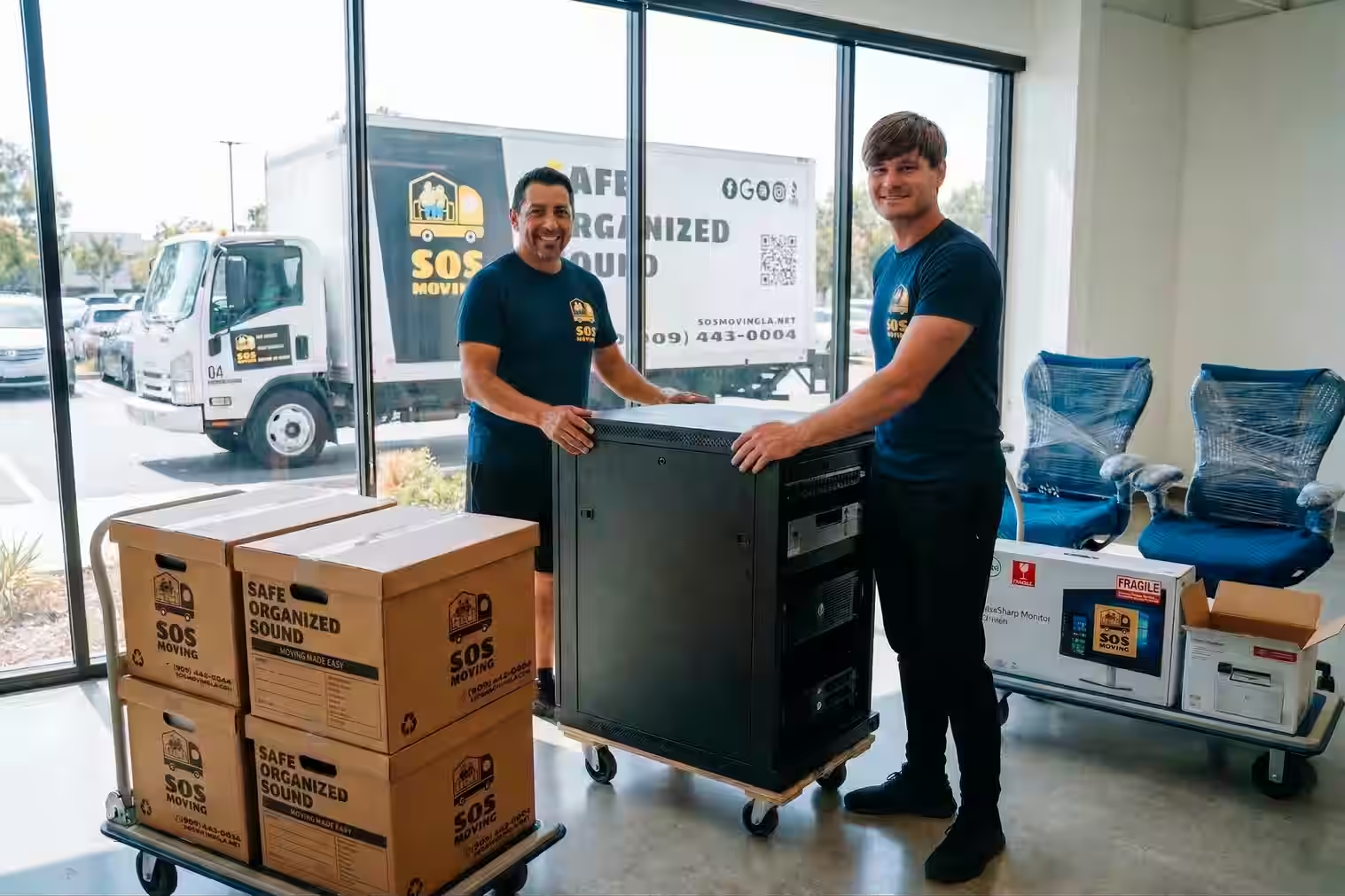
Technology deserves a list of its own. The crew disconnects, wraps, boxes and carries, keeping rack hardware upright and each bundle of cables with the machine it belongs to, and reconnects the machines at the new desks; data, passwords and settings stay with your IT team.
Ask for the move-in package at both ends as soon as the lease is signed. It will name the certificate of insurance, the entities to list on it, the procedure for booking the freight lift, and the hours a crew is allowed to use the dock.
Our certificate costs $50 per building and carries the exact names the management office gives us, which is why we ask for them in writing rather than copying something off a website.
Campus and event addresses are stricter than an ordinary office park. Cal Poly Pomona requires permits on campus with no grace period and sells the daily digital permit through PayByPhone on the day it is used, while reserved spaces and directional signage have to be requested five business days ahead and traffic control fifteen, with a 20% late fee for late submissions.
Fairplex adds another layer. Floor plans are due forty-five days before the first move-in day so they can be forwarded to the Los Angeles County Fire Department Area 8 bureau, fire lanes have to stay twenty-six feet wide and thirty-two feet at corners, and aisles ten feet clear.
Timing there is unforgiving as well: freight arriving before the first contracted move-in day is refused and sent back to its point of origin, anything left after the contracted move-out time counts as abandoned, and nothing ships to the grounds without the assigned event manager approving it first.
Very few companies can empty a floor and reopen the next morning without losing a working day, so the job gets split. A common split puts storage, archives and spare furniture in the first stage, the working desks in the second, and leaves the third for rebuilding and reconnecting.
Crews run Monday through Sunday between 8AM and 6PM. That makes the weekend the natural slot for the stage that empties the working area, with staff walking into a finished suite on Monday. Night shifts are not part of the service, and nobody will promise you one.
City parking rules shape those stages more than people expect: the overnight ban on heavy trucks means a truck still holding cargo at the end of a stage goes to your own lot, a secured yard, or back to our base.
When the load stays on the truck between stages, that is the $200 overnight storage line on the invoice, and it is normally cheaper than paying a second crew to unload and load the same furniture twice.
Office furniture travels in pieces. Desk tops come off their frames, conference tables lose legs and cable trays, storage walls come apart shelf by shelf, and each set of hardware travels bagged and taped to the piece it belongs to.
Cubicles are the part that eats hours. Panel systems come down in a set order, travel flat on carts and go back up against a layout drawing somebody has signed; without that drawing the crew ends up building the floor twice.
Filing is simpler than it looks. Lateral cabinets often travel loaded when the lift and the floor allow it, and everything else goes into archive cartons numbered against a list, so the sequence survives the trip.
Two rules cover the heavy end of the invoice. A single item over 300 lbs is handled with a crew of three and adds $150, and a piano in a lobby or staff lounge is handled with a crew of four and adds $200.
Everything else follows the clock: three hours minimum, four once the address lies over 30 miles out, doubled travel time past the 10-mile mark, and overtime once a day passes eight hours.
Where an office sits changes the plan more than what is inside it. In the Arts Colony blocks around West Second Street the Downtown Pomona Owners Association runs the district from 119 West 2nd Street with private security, two dedicated Pomona Police Officers and a maintenance crew that cleans and pressure-washes sidewalks seven days a week.
Along the campus corridor the tenants look different. Innovation Village presents itself as a corporate research and technology park operated by Cal Poly Pomona Enterprises, listing names such as Southern California Edison and a regional American Red Cross headquarters among its occupants.
Fairplex is its own world. A vehicle may stand there only long enough to unload and must display its move-in or move-out credential before going straight to a public lot, move-out access is granted only at the time printed on that credential, and no vehicle is driven inside an exhibit building.
Truck routes decide the last mile for anything over three tons. Section 58-294 lists them: every state highway in the city, Arrow Highway across it, Holt Avenue east of Indian Hill Boulevard, Indian Hill Boulevard from Holt up to the I-10, Mission Boulevard east of Reservoir Street, Reservoir Street from the south city line north to Mission, Towne Avenue between the I-10 and Route 66, and Valley Boulevard from the west city line east to Route 71.
A truck leaves those corridors only by direct route to load or unload at a building on the street it is working, and section 58-293 allows a tow off-route where removal signs are posted, with that same exception for pickups and deliveries written into the code.
The approach from our Los Angeles base is a variable of its own. The SR-57/SR-60 confluence between Diamond Bar and the City of Industry carries more than 356,000 vehicles a day, roughly 26,000 of them trucks, and ranks as the seventh worst bottleneck in the nation and the worst in California for freight delay and truck collisions.
Its $444 million third phase began in July 2023 and is scheduled to run to July 2028, with lane and connector closures published week by week, so dispatch reads the current notice before setting a start time. One more date belongs on the calendar: the LA County Fair occupies 1101 W. McKinley Avenue from 6 to 31 May 2027.
SOS Moving is a licensed carrier under USDOT 3398018, MC 1153871 and CAL-T0192140, working out of one office at 5530 Jillson Street in Los Angeles. Around the office job we also handle packing services for archives and glassware, storage for the gap between two leases, and long distance moving when a business crosses a state line.
Call 909-443-0004, send the floor plan and say when the suite has to be empty; the answer comes back as a crew size, a number of hours and the paperwork each building will want.