





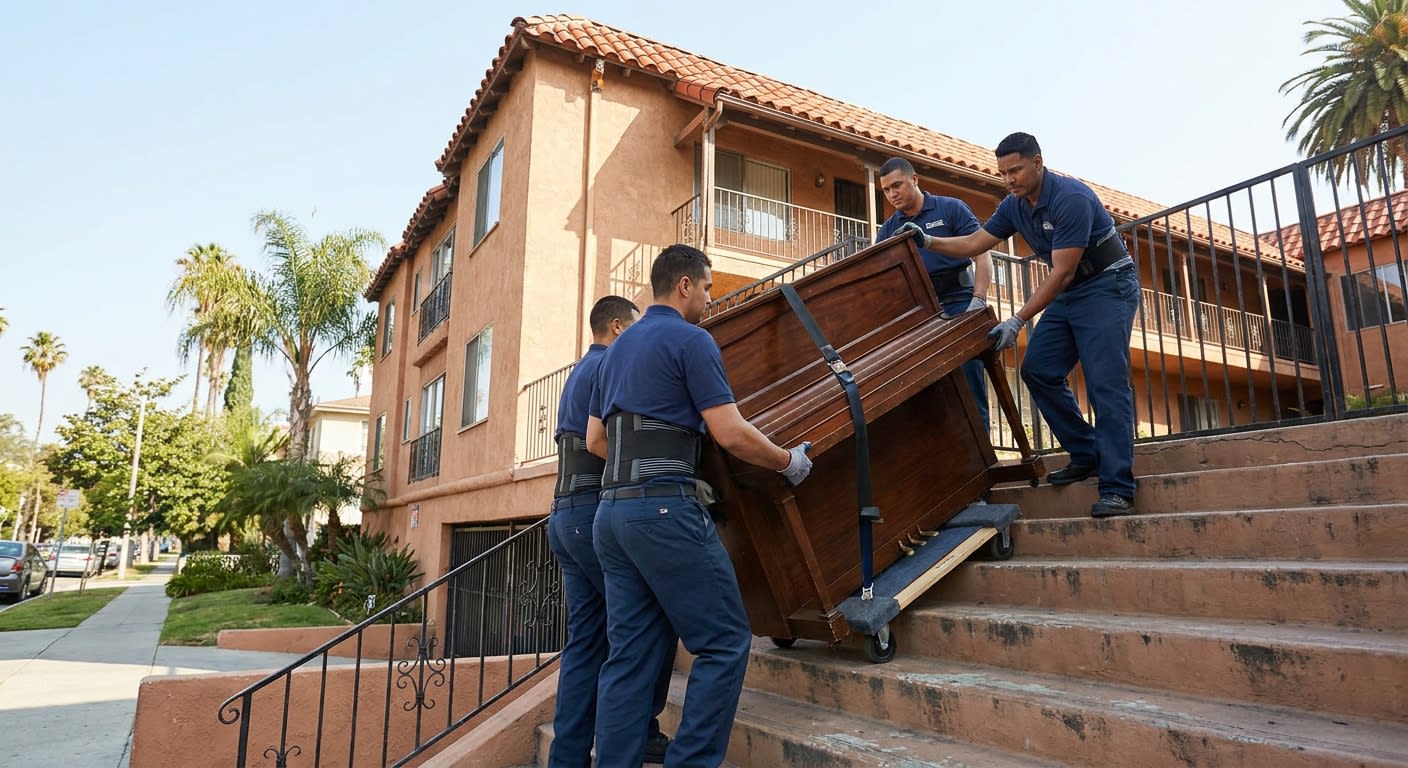




Booking piano movers in Torrance with SOS Moving buys a crew of four on an hourly clock, not a separate instrument delivery. How the case is padded, boarded and belted is set out on our piano moving service page, the parent page for this work across the county. Beds, boxes and wardrobes ride with the same four movers — that side of the job lives on our general moving page for the city.
What the crew of four brings to the address:
There is no piano price list here and no piano truck of its own. The instrument is one line on an ordinary hourly move, handled by the crew that carries everything else you own.


The crew walks the route in both directions before anyone lifts. Four movers measure the doorway the case has to clear, the turn at the end of the hall and the drop at the threshold, then agree out loud who takes which corner and who calls the count.
Dressing the instrument comes next. Blankets go over the case, wrap goes over the blankets, and extra padding lands on whatever corner the route cannot avoid. The board slides underneath, the straps close, and the piano rolls out instead of swaying.
Load order matters as much as the lift itself. The case goes into the truck first, tight against the wall and belted there, so the household load is built around the instrument rather than stacked on top of it.
At the second address the sequence runs backwards. The piano lands in its room before the boxes come off the ramp, legs and pedals go back on, the case is uncovered, and only then does the crew turn to the other rooms.
Every instrument job is billed at the crew-of-four rate plus one flat line for the piano:
Nothing further is charged for the instrument itself, and we publish no flat piano price. The hours depend on the way out and the way in, and those are read at your door rather than on a web page.
This city writes its truck rules in dimensions. The municipal code counts any vehicle longer than twenty feet, wider than seven feet or taller than eight feet as oversized and keeps such vehicles off public streets, with exceptions that include commercial vehicles delivering goods or providing services to a residence.
The city’s resident permit is tied to one vehicle rather than to an address. It asks for a California licence or ID, a property tax or utility bill, and DMV registration showing the vehicle is registered here, with the plate number written into the permit. Parking or standing without a valid permit where one is required exposes a vehicle to citation, towing or both.
Our answer is timing, not paperwork. We agree the closest legal stop with you before the date, bring the ramp to it, and clear the street once the piano is indoors.
Association buildings set the clock for move day, so the crew plans around their rules before it plans around the street. New Horizons South Bay shows the scale of that question locally: roughly 600 units, built in 1963 and 1964, a community for residents aged 55 and over.
At a property of that size we treat the building’s own rules as the binding constraint. Three things get asked before the date: which hours a move is allowed, whether a certificate of insurance is required and in whose name, and which entrance and lift the crew may use.
The COI costs $50 and is issued to the party the building names. Booking the lift stays on your side, and the crew of four works to whatever window you are given.
Grade matters more than mileage on the western side of town. The Hillside Overlay, adopted in 1977, adds protection against overbuilding on top of ordinary single-family zoning in the Hollywood Riviera, Seaside, Hillside and West Torrance areas.
Height and size are held to a one-story baseline there, and anything beyond it goes through the Precise Plan process. Read that as a zoning fact rather than a promise about your driveway: what the crew actually reads is your own entry, the steps up to it and the floor the instrument is going to.
On those appointments we plan a walk rather than a roll. The board comes off the truck first, two movers take the low end, and the count is called at every step instead of at the end of a flight.
Arrival is measured in signals rather than in miles. The 4.8-mile run of Hawthorne Boulevard between Pacific Coast Highway and Redondo Beach Boulevard is a surface arterial — as many as eight lanes, crossed at grade, posted at 40 mph — so the last leg down from our Los Angeles base is stoplight driving, not freeway driving.
Crews work Monday through Sunday, 8AM to 6PM, and a piano date is booked inside that window. Same-day work is possible when a crew of four is open, and travel time bills double past the ten-mile mark, which is why an early start pays for itself on South Bay addresses.
You get a window rather than a minute. The lead calls when the truck is loaded and rolling, so nobody spends an hour waiting at an open door.
Housing here did not arrive in one wave, and the crew packs for the era it is walking into:
| Kind of home in Torrance | What the crew of four gets ready |
|---|---|
| Old Torrance, the Olmsted Tract — laid out in 1912 by Frederick Law Olmsted Jr. as 109 blocks with residential, commercial and industrial sub-districts around an axial landscaped centre | Doorway, hall turn and porch measured before the truck is loaded. Board and skid come off first, and the roll-in is treated as a carry until the tape says otherwise. |
| Streets built during the boom that took the city from about 7,300 residents in 1930 to nearly 101,000 by 1960 | Ramp straight off the tailgate, runners laid from the threshold to the room, and two movers held back for the tight opening rather than the driveway. |
| Hillside Overlay addresses, where the baseline is one story and anything larger goes through the Precise Plan process | Photographs of the approach before the date, the fourth mover placed below the load on every step, and rest points agreed before the piano leaves the wall. |
| Large 1960s condominium communities such as New Horizons South Bay — roughly 600 units, built in 1963 and 1964 for residents 55 and over | COI issued at $50 in the name the building gives, the lift window confirmed by you, and corridors padded so a neighbour can still get past. |














Yes. The piano add-on is sold only with a crew of four, whatever the instrument is. Three movers can take a heavy piece of furniture, but a piano wants a hand on every corner and someone free to call the route, hold a door and set the board.
One clock covers all of it. The crew of four bills by the hour from arrival, the instrument adds a flat $200, and the three-hour minimum applies to the job as a whole. Nothing is invoiced twice because the piano and the sofa shared a truck.
Wherever the code allows it and the ramp still reaches your door. Vehicles longer than twenty feet, wider than seven or taller than eight are treated as oversized and kept off public streets by the city code, with exceptions that cover commercial vehicles serving a residence. We settle the stop with you before the date so nobody is hunting for space on the morning.
Yes. A COI costs $50 and is issued in the name the building gives us, so send their requirements together with your booking. With the paperwork accepted in advance, the crew of four starts at the lift instead of at the front desk.
No. We move the piano and set it exactly where you want it, take the covers off and check the legs and pedals, but tuning is a technician’s trade and is booked separately once the instrument has settled in its new room.
Often, yes. A same-day date depends on a crew of four being open, and our hours run Monday through Sunday, 8AM to 6PM. Call 909-443-0004 early and we will tell you straight away whether the day holds.
SOS Moving does not sell a piano relocation as its own product. The instrument is a line inside an ordinary hourly move: the same crew, the same truck and the same clock that carry your wardrobe and your boxes. What changes is the size of the crew and one flat add-on.
Anyone comparing piano movers in Torrance, CA runs into two billing models. A flat per-instrument price has to guess at the route, so it is padded for the worst case and charged to everybody; an hourly job charges for the hours the work actually takes.
That clock starts when the crew arrives and stops when the last piece is in place. Three hours is the minimum on any job, four hours when the address sits 30 or more miles from our base, and travel time doubles beyond ten miles.
Booking is a short conversation rather than a survey. We ask what the instrument is, what stands between it and the truck at both ends, and which day you want. Everything else the crew reads on site.
Payment happens at the end, when everything is in place, in cash or by card at the rates set out above. The deposit that held your date is already off the total by then.
The four-person crew is not an upsell, it is the condition under which the add-on exists. Four movers means every corner of the case has a hand on it, with one of them free to call the route, hold a door or set the board down.
On the invoice you will see the crew rate and the $200 piano line, and nothing else attached to the instrument. Monday through Thursday four movers with a truck run $199 an hour in cash or $209 by card; Friday through Sunday that same crew is $215 in cash or $225 by card.
Two other numbers sit on almost every job. Fuel is $30, and the $50 deposit that holds your date comes straight off the final bill rather than sitting on top of it.
Gear travels with the crew, not as a separate rental. Blankets, stretch wrap, corner padding, the board with its skid, straps and the ramp all arrive on the truck, and the instrument is dressed before it moves an inch.
One crew rule is worth knowing in advance. Because the add-on exists only alongside four movers, an instrument job cannot be trimmed down to two or three of them, whatever the piano weighs.
Preparation is mostly about clearing the lane the instrument will travel. Rugs rolled back, low furniture pushed aside, a hall table carried into another room — each of those saves minutes that would otherwise be billed.
Doors are the second thing worth checking. If a door can come off its hinges the crew will take it off, but knowing in advance which opening is the tight one lets them choose the approach instead of discovering it with a piano already on the board.
Sheet music, the bench, the metronome and anything standing on the lid should be boxed before the day. The case travels bare under blankets, and loose items on top of it are the quickest route to a scratch.
Two further requests protect the clock. Decide where the instrument is going in the new home before the truck is unloaded, and keep pets and small children out of the carry lane while the crew is working.
A photograph or two helps more than any description. Send the front steps, the doorway and the room the piano is leaving, and the crew leader knows what to load before the truck sets off.
If the building needs anything from us, say so at booking. A certificate of insurance costs $50 and takes a little lead time, and a lift reservation is the one thing a board will want from you rather than from the carrier.
This is not one kind of address, and the piano route changes with the era of the house. The original townsite, the Olmsted Tract, was laid out in 1912 as 109 blocks divided into residential, commercial and industrial sub-districts around an axial landscaped centre; on those blocks the crew measures the doorway, the hall turn and the porch before the truck is loaded rather than after.
Postwar growth filled the rest of the map quickly — the population went from about 7,300 in 1930 to nearly 101,000 by 1960 — and those streets read differently on move day. The crew still measures, but the plan usually starts at the ramp instead of at the steps.
Hillside and coastal addresses carry a rule of their own. The Hillside Overlay, adopted in 1977, adds a layer of protection against overbuilding on top of ordinary single-family zoning in that part of the city, holds the baseline at one story and sends anything larger through the Precise Plan process.
For a crew that translates into a walking job. Two movers take the low end of the board, the count is called at every step rather than at the end of a flight, and rest points are agreed before the instrument leaves the wall.
Condominium buildings turn the problem inward. A community such as New Horizons South Bay — roughly 600 units, built in 1963 and 1964 for residents 55 and over — is a question of corridors, lift windows and neighbours rather than of curbs, and the crew works to whatever schedule the building hands you.
Most of our instrument jobs are not instrument jobs at all: they are household moves with a piano inside them. That is also the cheaper way to do it, because one crew, one truck and one clock cover both halves of the work.
Sequence is what keeps the bill down. The piano loads first against the truck wall and is belted there, the household load is built around it, and at the new address the case comes off before anything else so it can be placed while the hallway is still empty.
Splitting the work across two dates costs more, not less. A second visit restarts the three-hour minimum and adds a second lot of travel time to the invoice, so unless the new home is not ready we suggest keeping everything on one day.
Two addresses on a single day also mean one drive-time charge instead of two. Past the ten-mile mark that time counts double, and paying it once rather than twice is usually the largest saving on the whole invoice.
If the load genuinely does not fit, a second truck is $200 rather than a second booking. The crew reads that on site, and you hear about it before it happens.
Four things move the clock on a piano job, and none of them is the weight of the instrument. Distance between the two doors, the number of steps at each end, the width of the tightest opening, and how ready the house is when the crew arrives.
Street conditions come next. A stop the truck can actually use, with the ramp reaching the door, is worth more than any shortcut inside the house, which is why the parking question gets settled before the date.
Buildings add their own share of the total. A lift window that opens at ten leaves a crew standing until ten, and a certificate of insurance nobody requested can stop a job at the front desk.
Overtime is simple enough: past the eighth hour the rate changes, which on a whole-house move with an instrument is worth planning around. An early start is the practical answer, and our day opens at 8AM, seven days a week.
Instrument type matters too, though less than people expect. An upright, a spinet, a baby grand and a full grand each want a different approach on the board and in the truck, and a grand comes apart before it travels; that discussion lives on the piano movers service page, where every type is covered in detail.
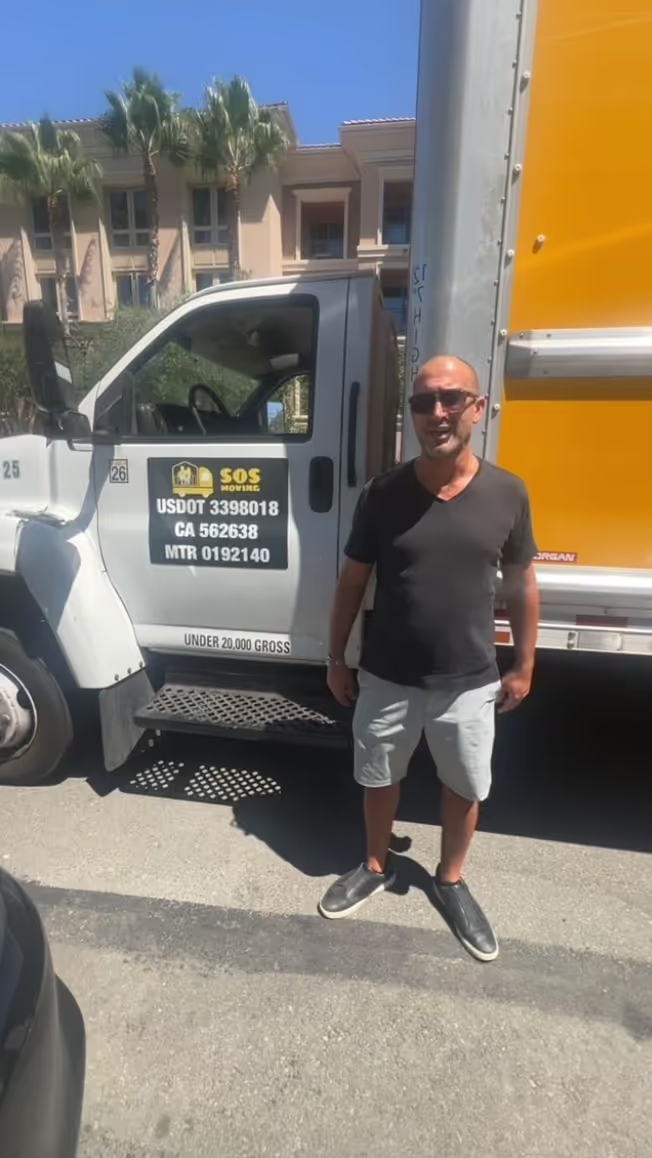
Anything still unclear before you book is worth a phone call. The line is 909-443-0004, crews work 8AM to 6PM, and the licences behind the truck are USDOT 3398018, MC 1153871 and CAL-T0192140.