






What the piano crew brings to the valley:
The valley is on our calendar Monday through Sunday, 8AM to 6PM. If a four-person crew is free, the piano can move on the same day you call.


Our only base is 5530 Jillson Street in Los Angeles, so the distance rules deserve a question for any valley address. The office runs both of your addresses through them while it prepares the quote and names the minimum before you pick a date. If your association asks for a certificate of insurance, it costs $50.
Santa Clarita treats its residential streets as public parking. Anyone, the neighbor across the road included, may legally leave a car in front of your house, and the city code only asks that a parked vehicle be moved every 72 hours (SCMC 15.44.220.A.12). On move day, then, the curb at your door belongs to whoever reaches it first.
We suggest parking one of your own cars there the evening before and moving it away when the crew calls to say the truck is turning onto your street. Keep the driveway empty as well, because that is where the board and pads get laid out. A piano travels on a board carried by four people, and every car length between the truck and your front step is billed time, so tell us at booking if your block is usually full.
At the Valencia Lakeshore condominiums, every visitor vehicle needs a guest parking pass from the homeowners association, and one pass is valid for up to 48 hours, which comfortably covers a single move day. Each owner holds one pass; extra or extended passes come from the association office, which is open on weekdays only and closes at noon on Fridays.
For a weekend piano move, sort the pass out during the week. Up at Tesoro Highlands, the newest part of Tesoro del Valle, most subdivisions sit behind shared gates, while the 55+ neighborhoods have gated entrances of their own, so let us know which gate the truck should use. When an association wants proof of insurance, SOS issues a certificate naming it for $50.
Westridge, west of I-5 in Valencia, is a hillside community laid out around The Oaks Club golf course, and parts of it are guard-gated: Westridge Estates, with custom homes south of Valencia Boulevard at Heritage View, and Oakmont, where one- and two-story homes line the course. For those gates we give you the crew leader's name and the truck's description the day before, so the guard has them when we pull up.
Sand Canyon is different ground. The city made it a Special Standards District to keep its rural, equestrian character, and it is known for custom estates on large lots rather than tract homes. On a big lot the walk from truck to room can be long, so the crew goes over the whole path first and pads every threshold on it.
Our trucks leave 5530 Jillson Street in Los Angeles and usually reach the valley on I-5, the Golden State Freeway, or SR-14, the Antelope Valley Freeway, which meet at the Newhall Pass interchange. Metro describes I-5 there as a major commuter route from the Santa Clarita Valley into the Los Angeles area to the south, so the crew plans its departure around that traffic and gives you an arrival window rather than a promise to the minute.
Every job has to fit our 8AM – 6PM day, Monday through Sunday. Distance shows up on the hourly bill in two ways: 30+ miles from our base the minimum rises to 4 hours, and driving time past the first 10 miles counts twice. Calling in the morning for a piano that has to go that afternoon is fine, as long as a four-person crew has an open slot.
What the four movers get ready, by type of Santa Clarita home:
| Where the piano lives in Santa Clarita | What the four-person crew gets ready |
|---|---|
| Guard-gated custom home in Westridge Estates | The crew leader's name and a description of the truck reach you the day before, for the guard; photos of the path from the street to the piano room; runners on the floors and pads on the door frames. |
| One- or two-story home along the course in Oakmont | The floor the piano stands on is confirmed at booking; for an upstairs instrument, every stair turn is measured from your photos before move day. |
| Gated subdivision or 55+ neighborhood in Tesoro Highlands | The exact entrance is agreed in advance, the shared subdivision gate or the neighborhood's own gate, so the truck does not circle the community looking for it. |
| Custom estate on a large lot in Sand Canyon | The whole carry is walked before the lift, rest points for the board are picked along the way, and each threshold on the route is padded. |
| Condo at Valencia Lakeshore | An HOA guest parking pass is arranged on a weekday before the move and stays on the truck's dashboard for the whole job. |
| House on any public street in the city | One of your own cars holds the curb overnight, and the driveway stays clear so the board and pads can be laid out next to the truck. |














Only if the space is free when we arrive. City streets count as public parking, so a neighbor may legally leave a car at your curb. Park one of your own cars there the night before and move it when the crew calls to say they are close.
A guest parking pass for the truck, issued by the homeowners association and valid for up to 48 hours. The association office works weekdays only, so collect the pass before a weekend move. If the association asks for insurance, we issue a COI naming it for $50.
You clear us with the guard or the association, and a day early we give you the crew leader's name and the truck's description to pass on. In Tesoro Highlands, tell us whether the truck should use a shared subdivision gate or the separate entrance of a 55+ neighborhood. Minutes spent waiting at a gate run on the hourly clock.
Nothing in the model changes: you pay four movers and a truck by the hour, plus the flat $200 piano charge and $30 for gas. The minimum and the drive time are what can differ. Addresses 30+ miles from our Los Angeles base raise the minimum from 3 hours to 4, and driving past 10 miles is counted at double time; the office tells you which rule your addresses trigger.
It can if a four-person crew still has room that day, so call 909-443-0004 as early as possible. Crews work Monday through Sunday from 8AM to 6PM, and the whole job has to fit that window.
No. We move pianos and nothing more: no tuning, appraisal, repair, storage or disposal. Let the instrument settle in its new room for a while, then call a tuner of your choice.
A piano job in the valley is settled on the phone well before anyone lifts. The office wants to know what kind of piano you own, where it stands now, how many steps lie between it and the street, and whether a guard, a gate code or an association office has to let the truck in. Each answer shapes the plan for the day, and a missing answer usually costs time on it.
Then come the two addresses. Every SOS crew starts from 5530 Jillson Street in Los Angeles, so the pickup and delivery points decide which minimum applies and how much drive time reaches the bill. The office reads the real route between them and tells you the result before you settle on a date.
Photos save more time than anything else you can send. Photograph the piano, its room, the exit door, every staircase on the way out and the stretch of curb where the truck should stop. For a gated tract, add a shot of the entrance the truck will use. The crew leader studies the set before the truck is loaded, and a handful of pictures often answers what would otherwise need a site visit.
Be open about what you do not know. If you are unsure whether the new side gate is wide enough or how steep the path to the back door is, say so: a doubt mentioned on the phone gets a backup plan, while a surprise found on arrival costs minutes to solve.
The add-on pays for handling the piano as a special item inside an ordinary hourly job. It exists only with a crew of four and brings three things to the door: moving pads for the case, a padded board with straps for every carry, and tie-downs in the truck so the instrument cannot slide on the freeway.
Before the lift, the lid and fallboard are closed and the case is wrapped. An upright stays upright on its board and leans only as far as a step requires. A grand has to be taken down before it moves. Its lid, pedal lyre and legs are removed, and the body is laid on the board on its straight edge. At the new house the crew reverses those steps and assembles the grand in the room you picked.
The type of piano matters more than the brand. Short verticals such as spinets and consoles pivot around hallway corners without much trouble; tall uprights carry their weight high and need care on every stair; and for a grand, the narrowest turn on the route matters more than the width of the entry. The differences between types are set out in more detail on the SOS page for piano moving across Los Angeles County.
The add-on does not grow with the size of the instrument. A compact console and a parlor grand carry the same $200; what separates them is how long the carry takes, and that shows up in the hourly part of the bill.
Everything else in the house rides the same truck with the same crew on the same hourly clock. The 3-hour minimum covers the whole job, not the piano alone, so an instrument added to a full household move does not start a separate clock. For every crew size and the weekday and weekend prices, see the SOS hourly rate table for local moves; a piano job always uses the four-mover row.
Minutes the crew spends clearing a path are minutes on your bill, so an evening of preparation pays for itself. Most of it is simple:
Leave the piano itself where it is. Do not roll it toward the door on its casters and do not remove the legs of a grand; the crew does both on the board, where the weight stays under control.
Think about the new house as well as the old one. Decide the exact wall where the piano will stand, keep that spot empty until it arrives, and make sure nothing blocks the way from the entry to that room. If the new address is a condo or a gated tract, check its visitor rules too.
Floors are covered along the whole route. Runners go over hardwood, tile and stone, pads go on door frames and banister posts, and the board carries the weight so the small casters never roll across a finished floor.
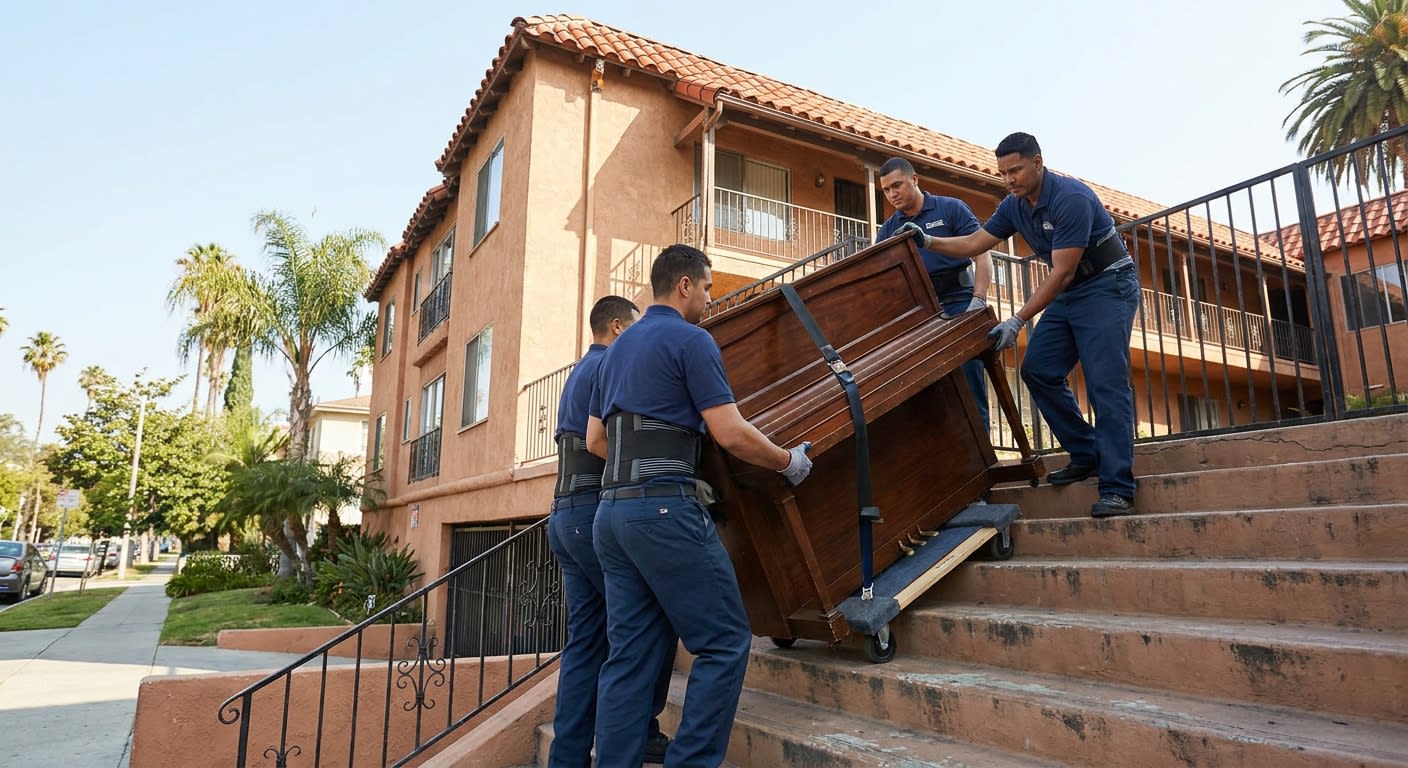
The valley mixes flat tract streets with hillside communities such as Westridge and with estate land such as Sand Canyon, and a piano job is planned around the ground it has to cross. A slope does not rule out the move; it changes the pace. On an incline or a flight of outdoor steps, all four movers carry the board, two of them on the downhill side, and they reset their grip at every landing.
Long carries are the other pattern here. On a large lot the truck may stand far from the door, and a piano cannot be hurried across a lawn or a gravel path. The crew chooses places along the way where the board can rest and lays runners over any finished surface. If a side gate or a service path shortens the walk, tell us when you book.
Weight on a slope is managed, never raced. The board goes up the truck ramp with movers at both ends and comes down the same way at the new house; nobody lets the piano run on its own.
Pianos on the upper floor of a two-story house need one more piece of planning. The turn at the top of the stairs usually decides whether the carry is quick or slow, so we ask for its width and a photo taken from the bottom step. With those in hand, the crew knows before arrival which end of the piano should lead.
For a closer look at stair work, our guide on carrying a piano up a staircase safely explains how landings and turns are handled and which shortcuts tend to damage the instrument or the stairs.
Piano moves that touch Santa Clarita come in two shapes. Some stay within the valley, for example from a Valencia condo to a house in Westridge. Others cross the Newhall Pass and carry the instrument between the valley and a home elsewhere in the Los Angeles area.
Both kinds are priced the same way, with an hourly four-mover crew, the flat $200 for the piano and $30 for gas. What differs is how the distance rules land. The office checks each address against the 30-mile minimum rule and the 10-mile drive-time rule and quotes the result, instead of applying one figure to every valley address.
Moves between two gated communities need preparation at both ends. If the piano leaves a guarded street in Westridge for a subdivision in Tesoro Highlands, both gates should expect the truck, and the crew leader carries the names of the residents who cleared it in case a guard asks.
For a trip over the pass, the piano rides strapped against the truck wall for a longer freeway run, and the arrival window at the far end allows for commuter traffic on I-5. On a move inside the valley the drive between the two homes is short, so the carry at each end takes a larger share of the day.
Most people who call about a piano are moving a whole house, and the piano is its heaviest single item. Booking both together means the gate hears about one truck, the curb is held once, and one invoice covers the day. Furniture, appliances and garage shelving are planned on the same quote by our movers serving Santa Clarita.
The crew decides early where the piano will ride, because it needs a place against a truck wall where it can be strapped. At the new house it usually comes off among the first items, while the path to its room is still open.
If you would rather not pack the kitchen and closets yourself, packing help in Santa Clarita can be booked alongside the piano, so the boxes are ready by the time the truck is loaded.
Heavy pieces other than the piano follow their own rule. An item over 300 lbs, such as a safe, carries a $150 charge with a crew of three. List each heavy piece when you call, so the office can size the crew and the truck correctly.
An hourly bill follows the clock, and here the clock follows access and distance. These factors move it the most:
The same console can cost two very different amounts in this valley. Leaving a single-story tract house with an empty driveway, it takes little of the clock; carried from an upstairs room to a truck parked down the block, it takes far more.
Big households bring one more rule into play: hours past the eighth are billed as overtime. With a piano and a full house on one truck, a morning start keeps the day comfortably inside our 8AM – 6PM schedule.
Weekday and weekend prices differ as well. Four movers cost less per hour from Monday to Thursday than from Friday to Sunday, so a flexible date is one of the simplest ways to lower the total.
The fixed parts of the bill are known in advance: the $200 piano charge, the $30 for gas and the $50 deposit, which is subtracted from the total rather than added to it. On the day, the only open number is time.
Our work ends when the piano stands in its new spot with the pads off. Tuning, appraisals, repairs and refinishing are outside our work, and so are storing pianos and hauling away instruments nobody wants. Give the piano time to settle in its new room before a tuner sees it.
We book piano work seven days a week, from 8AM to 6PM, and each job must finish inside those hours. When a four-person crew still has room, the piano can move the same day you call 909-443-0004.
Santa Clarita piano movers from SOS bring the board, the straps and the pads. Your part is the curb, the gate and a clear path, and with those three settled the day runs on schedule.