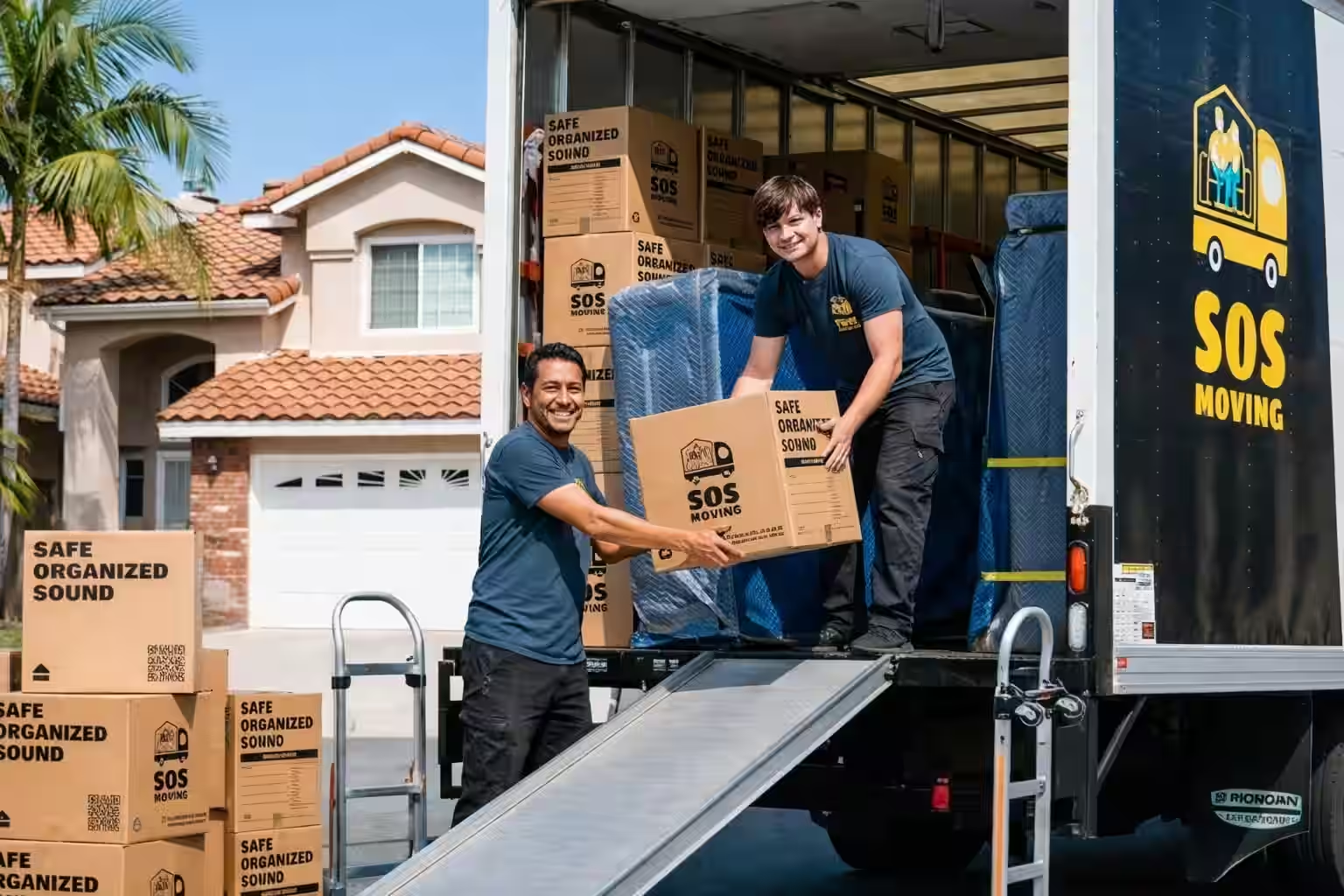



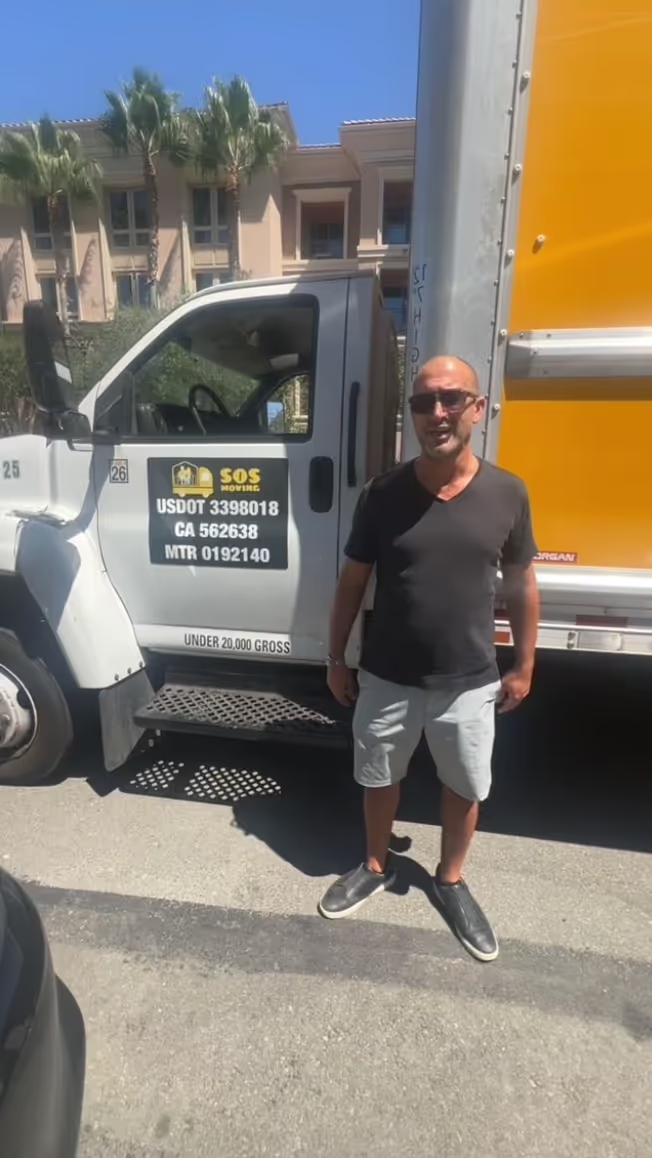
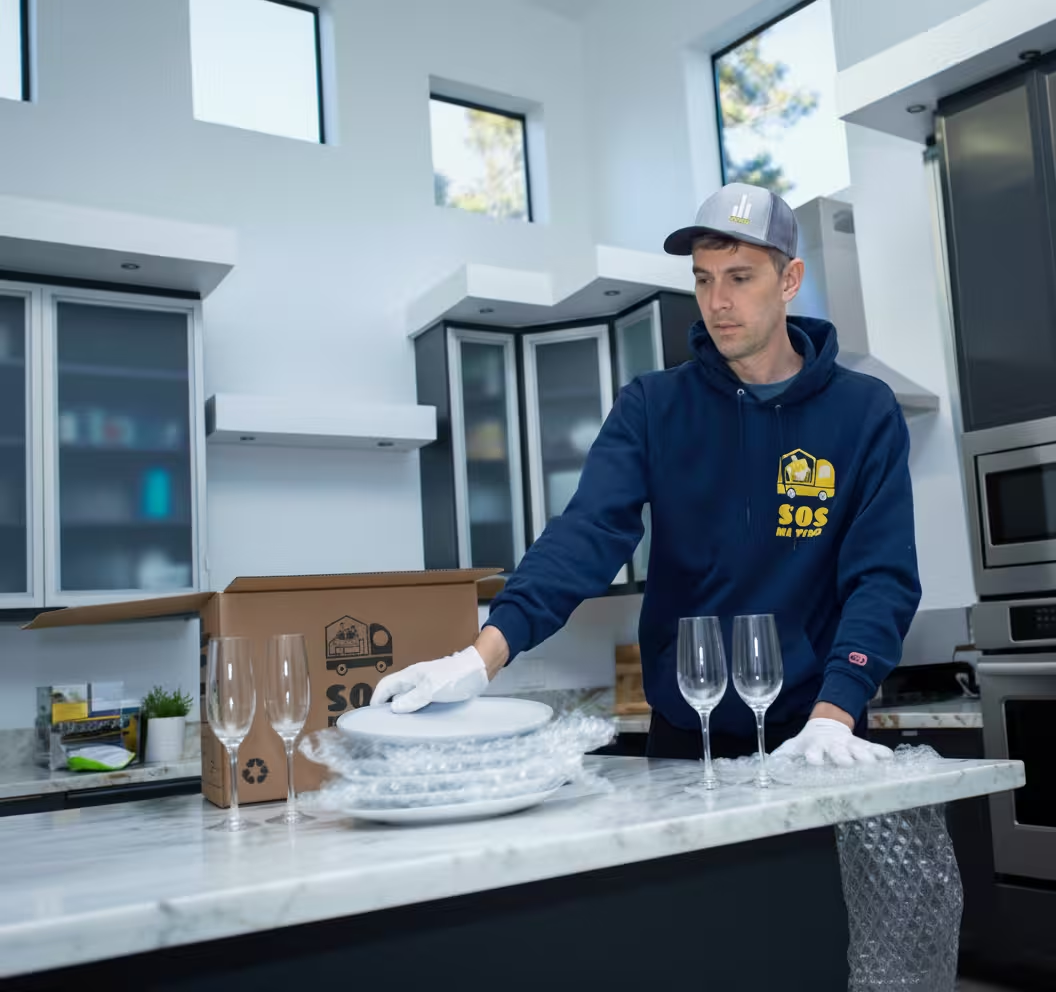



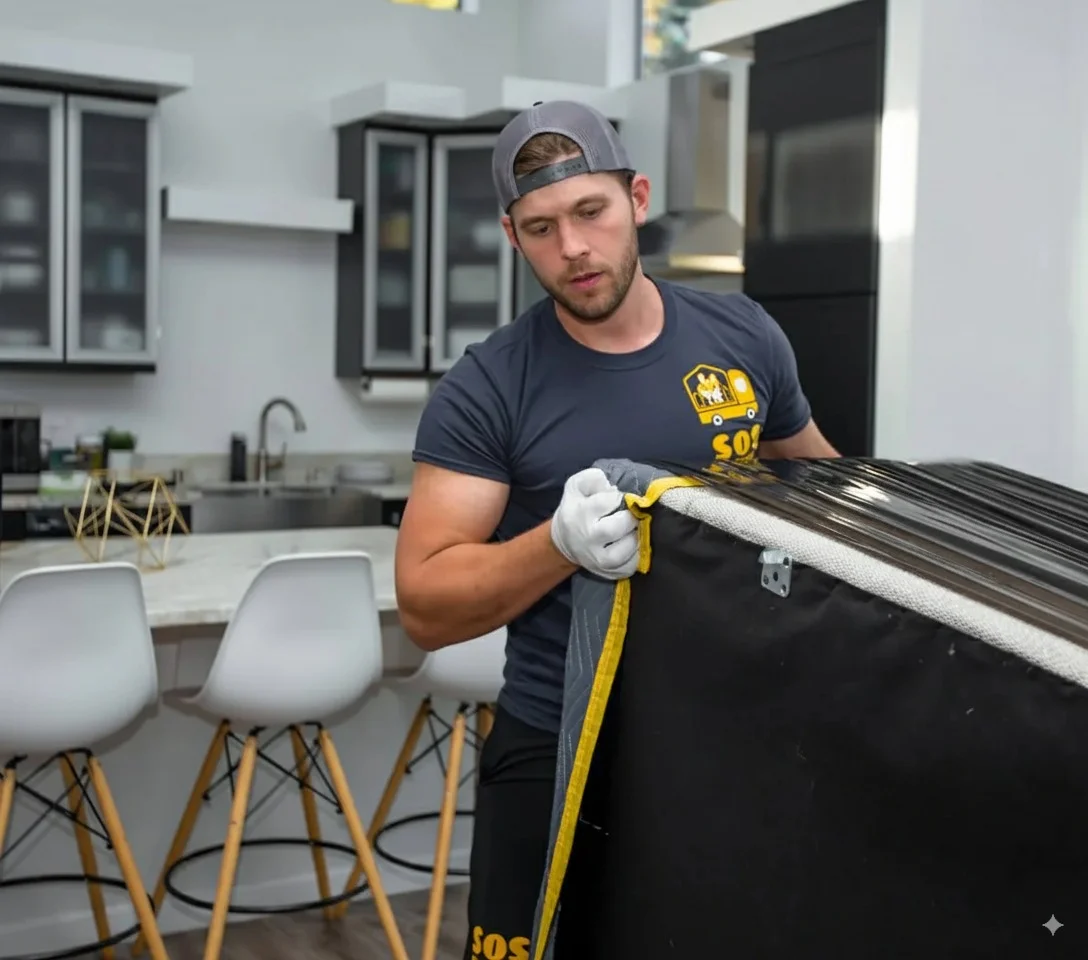
People searching for gun safe movers in Orange County rarely have only the safe to think about. Usually a slate pool table sits in the bonus room, a canvas hangs above the fireplace, and a marble-top console waits in the hall. SOS Moving takes that whole list in one visit, and the scope of the service is set out on our white-glove moving service page. If the beds, boxes and sofas are going too, they can ride on the same truck; see our movers in Orange County for the household side of the job.
What the crew does with each piece:
Before anything is lifted, the lead mover walks from each heavy piece to the truck and back. Door widths, stair turns, thresholds and the pitch of the driveway decide whether an item leaves whole or in parts, and which floors get runners before the first dolly rolls.

Every Orange County job starts with a drive from our base at 5530 Jillson Street in Los Angeles, so two distance rules come into play. Drive time is counted double once the trip runs past 10 miles, and a job 30 or more miles from the base carries a 4-hour minimum instead of the usual 3 hours. We check which rule fits your two addresses while preparing the quote; overtime begins after the eighth hour.
On a heavy-item job the spot where the truck stops matters more than on an ordinary move, because every extra yard between the garage and the truck is a yard of rolling a safe over pavers, grass or a sloped drive. Curb rules in Orange County are set city by city and, inside private communities, by the association, so we do not guess at them.
Before the date we ask you to find out whether your street needs a temporary no-parking sign or a permit, to keep the driveway empty that morning, and to warn us if the drive is steep. The rest is ours: a truck that fits the street, parked nearest the door the safe or table will leave through, and a protected path from that door to the truck.
Emerald Bay, on the coast by Laguna Beach, is a guard-gated community of about 500 homes on both sides of Pacific Coast Highway, with Crystal Cove State Park along its eastern edge. A moving truck gets through a gate like that only when the guards expect it, and the association’s vendor rules reach a resident faster than a moving company, so we ask the homeowner to put SOS Moving on the gate list for the date and to tell us which name to give at the booth.
Many associations also want a certificate of insurance before a crew works on the property; we issue one for $50 once you send the exact wording they require. In a condo building, a heavy safe also means asking management to reserve and pad the elevator and to confirm the load it may carry.
Laguna Beach grew up as an artists’ colony in the early 1900s. Plein air painters including William Wendt, Frank Cuprien and Edgar Payne settled there, and within a few years about half of the roughly 300 permanent residents were artists. Payne opened a gallery in 1918 that later became the Laguna Art Museum, one of the first art museums in California, and the Festival of Arts staged its first show downtown in 1932, with the Pageant of the Masters growing out of it.
When a client tells us a canvas comes from that tradition, the crew treats it the way a gallery would: held by the frame and never by the stretcher, wrapped face-in, crated or boxed upright, loaded last and taken off first.
Every Orange County job begins at our Los Angeles base, so the drive is part of the day’s arithmetic. Crews work Monday through Sunday between 8AM and 6PM, and we schedule heavy pieces early in that window, while the crew is fresh and the return trip is not squeezed against the end of the working day.
Drive time counts double beyond 10 miles, and addresses 30 or more miles out carry a 4-hour minimum, which is why it pays to add the art, the antiques and the rest of the house to one visit instead of booking two short trips. If you call in the morning and a crew is free, the job can happen that same day.
Item or home in Orange County → how our crew works:
| Item or type of home | How the crew works |
|---|---|
| Gun safe in the garage of a house behind the Emerald Bay guard gate | SOS Moving on the gate list before the date; firearms and ammunition taken out by the owner; three movers, a dolly and straps; $150 surcharge when the safe is over 300 lbs. |
| Slate pool table in a hillside home in Emerald Bay | Table taken apart in the room; legs, rails and each slate section wrapped separately and carried down the grade one piece at a time, then rebuilt in the new room. |
| Mid-century cottage set into the bluff terrain of Emerald Bay | Path from the door to the truck measured at the walk-through; large furniture taken apart before the narrowest point instead of being forced through it. |
| Plein air canvas from the art-colony years of Laguna Beach | Held by the frame, wrapped face-in, crated or boxed to size, kept upright on the truck and loaded last so it comes off first. |










No. Firearms are on the list of items our crews do not carry, so the safe has to be emptied of guns and ammunition before we arrive, and you transport them yourself. An empty safe is also easier to control on steps. If it weighs more than 300 lbs, a crew of three moves it and the $150 surcharge applies.
Yes. The crew removes the legs, rails and pockets, lifts out the slate, wraps every part separately and rebuilds the table in the room you choose at the new address. A slate table almost always passes 300 lbs, so it goes to a crew of three with the $150 heavy-item surcharge. Replacing worn cloth is work for a billiard technician.
Yes, as long as the gate expects us. Add SOS Moving to the guest or vendor list for the date and tell us which name to give at the booth. If the association asks for a certificate of insurance, we issue one for $50.
You pay the hourly rate for the crew, and beyond 10 miles the drive time is counted double. An address 30 or more miles from our Los Angeles base has a 4-hour minimum instead of 3 hours. We tell you which of these rules apply to your two addresses before you book.
Yes. One crew can wrap and crate the paintings, take apart the furniture and carry the heavy pieces during a single booking. Give us the full list on the first call so the crew size matches the heaviest item.
If a crew is free, yes. Same-day jobs run inside our normal hours, Monday through Sunday from 8AM to 6PM. Heavy items need three movers, so call early in the day.
A gun safe is the hardest object in most houses to move, and the lock has nothing to do with it. The steel has no handles, the footprint is small for the weight, and the mass sits high. Tilt it onto a dolly carelessly and it wants to keep going, so every step of the job is planned around keeping it upright and under control.
Weight comes first. Anything heavier than 300 lbs is carried by at least three movers and adds a $150 surcharge, and most full-size gun safes are past that mark. If you are not sure of the figure, the model name inside the door or on the purchase papers usually answers it. A photo of the safe with a tape measure held against it tells us the rest.
The path comes second. We want to know every change of level between the safe and the truck: the lip of a garage floor, one step down to a side yard, a staircase from an upstairs study. On each of those the safe is walked down on straps instead of rolled, and each one adds minutes to the estimate.
Placement at the new address matters just as much. A heavy safe belongs on a ground floor or a garage slab, and the exact spot should be settled before the truck is unloaded, because shifting it a few feet later means another careful tilt. Our crew sets the safe square in the place you mark; if you want it bolted down again, arrange that with whoever you hire for the anchoring.
Weight classes and the legal side of the job are covered in more depth in our longer guide to moving a gun safe.
The owner's share of the preparation is short. Empty the safe completely. Firearms and ammunition are on the list of things our trucks do not carry, so they travel with you. Take out documents, jewelry and cash as well, and keep them in your own car for the day.
Then check how the safe is fixed in place. If it is anchored to the slab or to the floor framing, the bolts have to come out before the crew can tilt it. The door stays closed and locked for the ride, and the combination or key stays with you, never with the crew.
Three small things make that morning faster:
Why three movers rather than two? On a heavy safe, two people carry and steer while the third holds the angle of the tilt and calls out every step. That third person is the reason floors, door frames and stair nosings come through the day without marks.
A slate pool table never moves in one piece. The slate is heavy, its edges chip easily, and on most tables it is cut into sections that rest on a frame built to hold them only while the table stands still. So the table is taken apart right where it stands.
The sequence does not change from job to job. Pockets and rails come off first, then the slate sections one by one, then the legs and the frame. Each slate section is wrapped on its own and carried on edge, never laid flat under other parts. Bolts and brackets go into labeled bags, and the bags ride with the frame so nothing gets lost between houses.
At the new house the order runs in reverse: frame and legs, slate, rails, pockets. If the cloth was already worn, this is a good moment to have a billiard technician replace it, since the slate is exposed anyway. Our part is the disassembly, the move and the rebuild.
Before the crew arrives, take the balls, cues and wall racks off the table and out of the room. Small accessories pack faster in one carton than when they are scattered across a game room.
Most people who hire pool table movers in Orange County for a game room end up adding a few more heavy or awkward pieces to the same visit. Since every job has a minimum number of hours, putting those pieces on one booking is usually the cheaper plan.
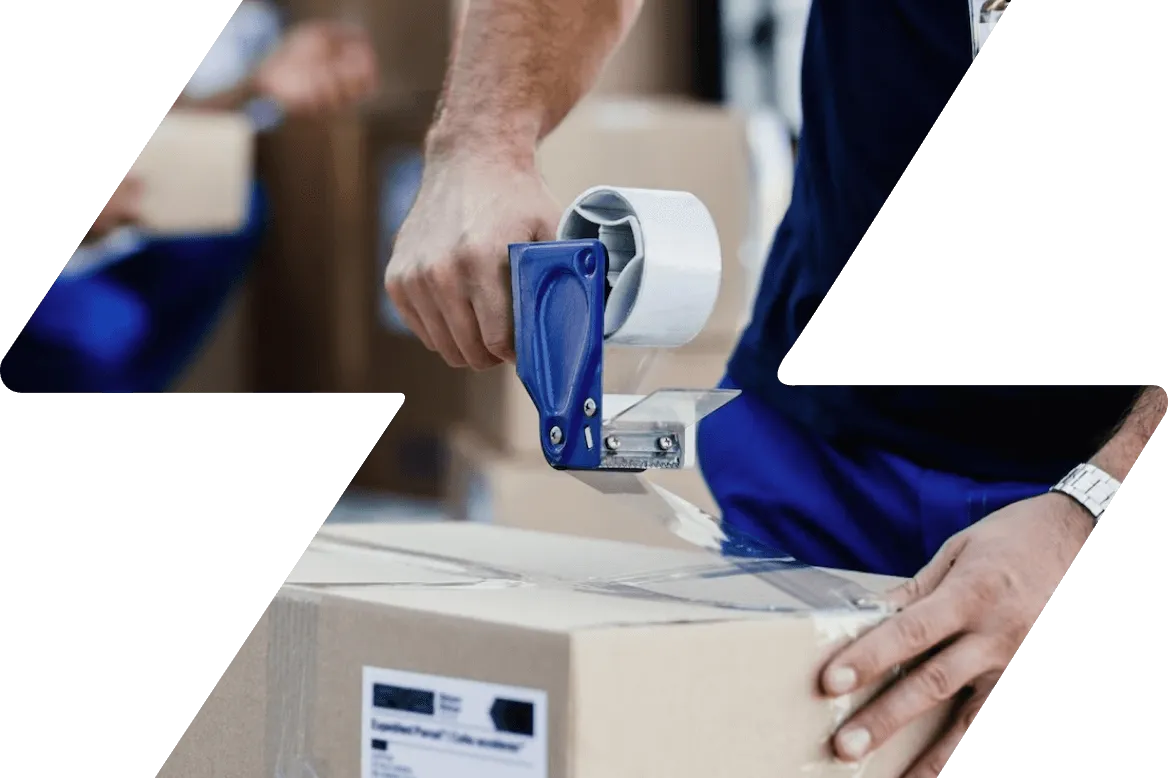
White-glove packing starts from the object, not from the box. A framed oil, a stone figure and an antique side table each get a different wrap, and none of them shares a carton with anything else.
Photograph each valuable piece before packing day, front and back, and keep any appraisal or gallery paperwork with you rather than in a box. Those records stay yours, and they are the quickest way to show what condition a piece was in before it traveled.
Crates are built for pieces a carton cannot protect: oversized mirrors, big canvases, stone tops, glass panels. Each crate is made to the size of its object, and the object inside is blocked so it cannot slide.
Art that has hung in one place for decades brings risks of its own. Old hanging wire, dried-out frames and loose glass are checked before the piece comes off the wall, and anything fragile is marked on the inventory before it is loaded.
A lot of modern furniture is designed to be assembled once. Platform beds, modular sofas, glass shelving and long dining tables come apart at only a few points, and the hardware is often specific to the maker. Our crews bring the tools to take these pieces down and rebuild them, with each set of screws bagged and marked with the piece it belongs to.
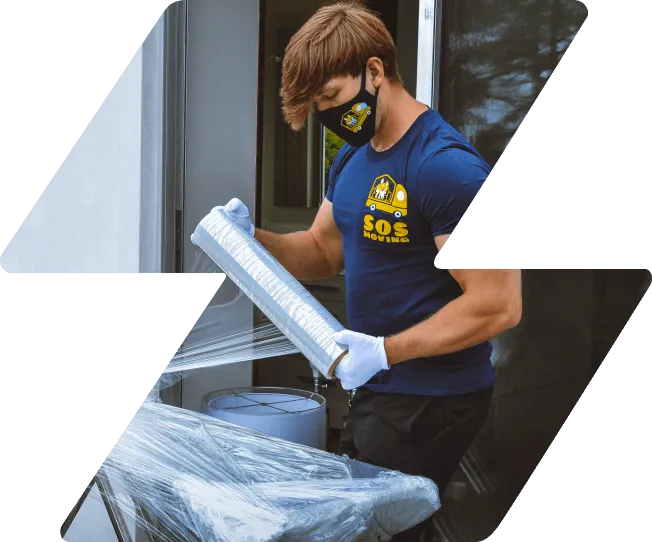
Upholstery goes under blankets and a layer of stretch wrap; leather and suede are padded first so plastic never touches them. High-gloss and lacquered surfaces are never taped directly. Legs and feet come off wherever the design allows, because those are the parts that snap in doorways.
Mirrors and glass-fronted cabinets get the same care as framed art: corners protected, glass taped, carried upright. Lamps travel with their shades removed and wrapped on their own, since a shade crushes more easily than anything else in the room.
At the new home, tell us where each piece goes. Setting a heavy cabinet or a long table in its final spot is part of the service, and it saves you from dragging it across a fresh floor later.
The work is billed by the hour, and three things set the total: crew size, time on site and the drive. Crew size follows the heaviest item. Art and furniture alone can go with two movers; a safe or a slate table needs three; a full household plus heavy pieces often needs four.
Time on site depends on how much packing and crating is on the list and on access at both ends. A safe that rolls from a ground-floor garage straight onto the truck takes far less time than one that comes down a staircase. Crates add time as well, because each one is built around its object.
The drive is where an Orange County job differs from one in Los Angeles. Drive time counts double beyond 10 miles from our base, a 4-hour minimum applies at 30 miles or more, and overtime starts after the eighth hour. Tape and stretch wrap are included in every estimate at no charge, while the $150 heavy-item surcharge, the $30 gas fee and, if your community asks for one, the $50 certificate of insurance appear as separate lines.
The $50 deposit holds your date and is subtracted from the final bill. Card payments run $10 an hour above the cash rate at every crew size, so decide how you will pay before the quote is written.
The quickest route to an accurate number is a list with photos: every heavy piece, everything that needs a crate, and the stairs at both addresses. With that in hand, the estimate names the crew size and the rules that apply before you commit to a date.
Closings slip and renovations run long, and a safe or a crated painting should not sit in a garage waiting for new floors to dry. Our storage is secured and climate-controlled, holding temperature and humidity steady all year, for a few days, a few weeks, or a month and longer.
The crew that packs the pieces takes them to storage and brings them back when the new rooms are ready, and the term can be extended without a penalty if the work runs over. Heavy items return the way they left: with three movers and the same straps.
Tell us at booking if storage is likely, even when the dates are not firm. Knowing it ahead lets the crew label the pieces for a longer stay and load the heavy items where they can come off first on the return trip.
A white-glove booking does not have to stand alone. When the whole house is moving, the safe, the pool table and the paintings can ride on the same truck as the beds and boxes, loaded by the same crew. The household side is described on the page about full-house moves across Orange County, and the complete list of special handling is under what our white-glove service includes.
Pianos are the one heavy item with rules of their own: a crew of four and a $200 add-on on an hourly move. Those details are on the page for piano moves in Orange County. If you would rather not pack closets and the kitchen yourself, packing help in Orange County can be booked ahead of the white-glove crew, so it arrives at a house that is ready.
For a household move that is mostly boxes with one or two heavy pieces, the better answer is often a crew of three for the whole day rather than a separate white-glove visit. We will say which makes more sense once we see your list.
Whatever the mix, give us the whole list on the first call. The crew size, the truck and the loading order all depend on the heaviest and the most fragile items, and planning them together costs less than adding them on the morning of the move.