








What the hourly job covers once an instrument is on the list:
Two floors apply to every date: the job is billed for at least three hours, and an address 30 or more miles from our Los Angeles base starts at four. Gas is a flat $30, and a $50 deposit holds the slot and comes off the final bill.
How the day runs:
The lead mover walks the route before anything is lifted: the room the instrument stands in, every doorway on the way out, the porch steps, and the stretch of curb the truck can legally hold. Widths and turns get measured, not guessed.
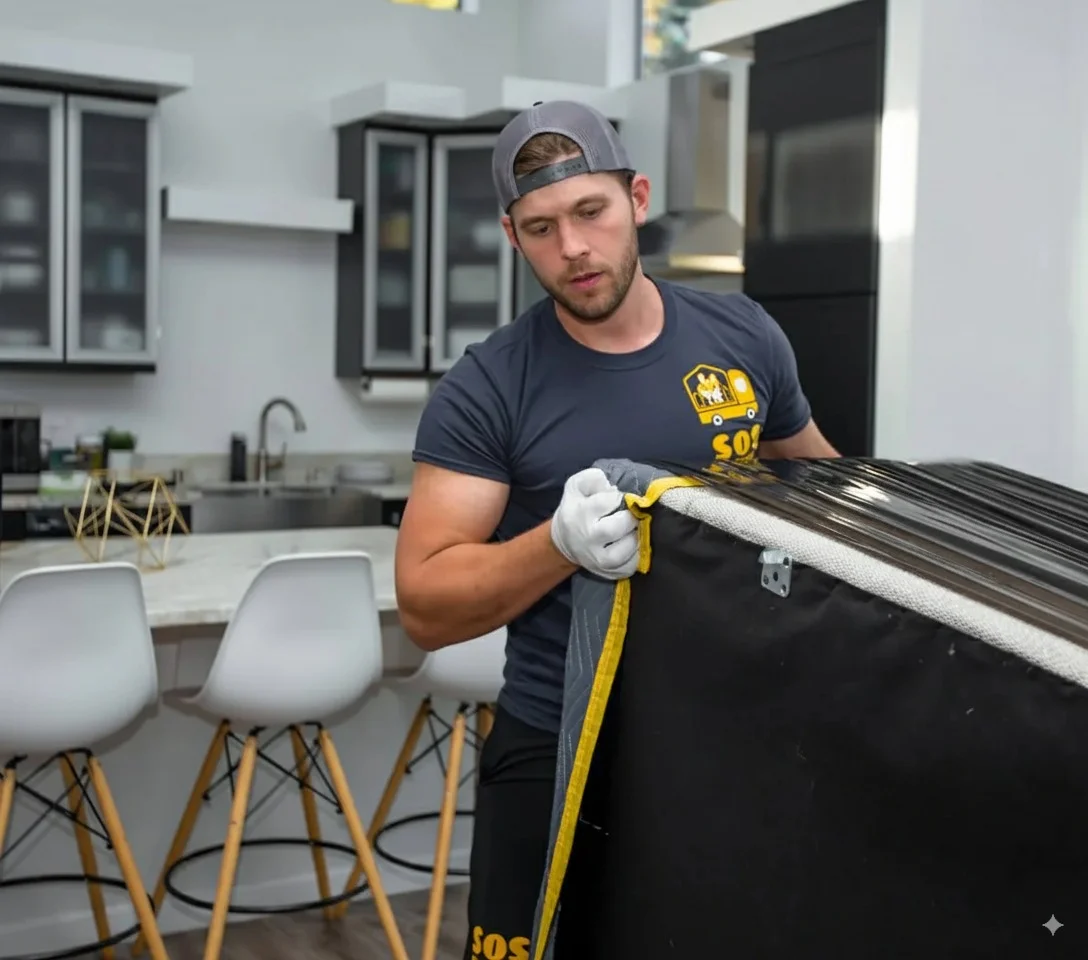
Wrapping comes next. Legs, lyre and pedal assembly come off a grand and travel separately, while an upright keeps its body and gets blankets over the top, the back and the key end before the straps go on.
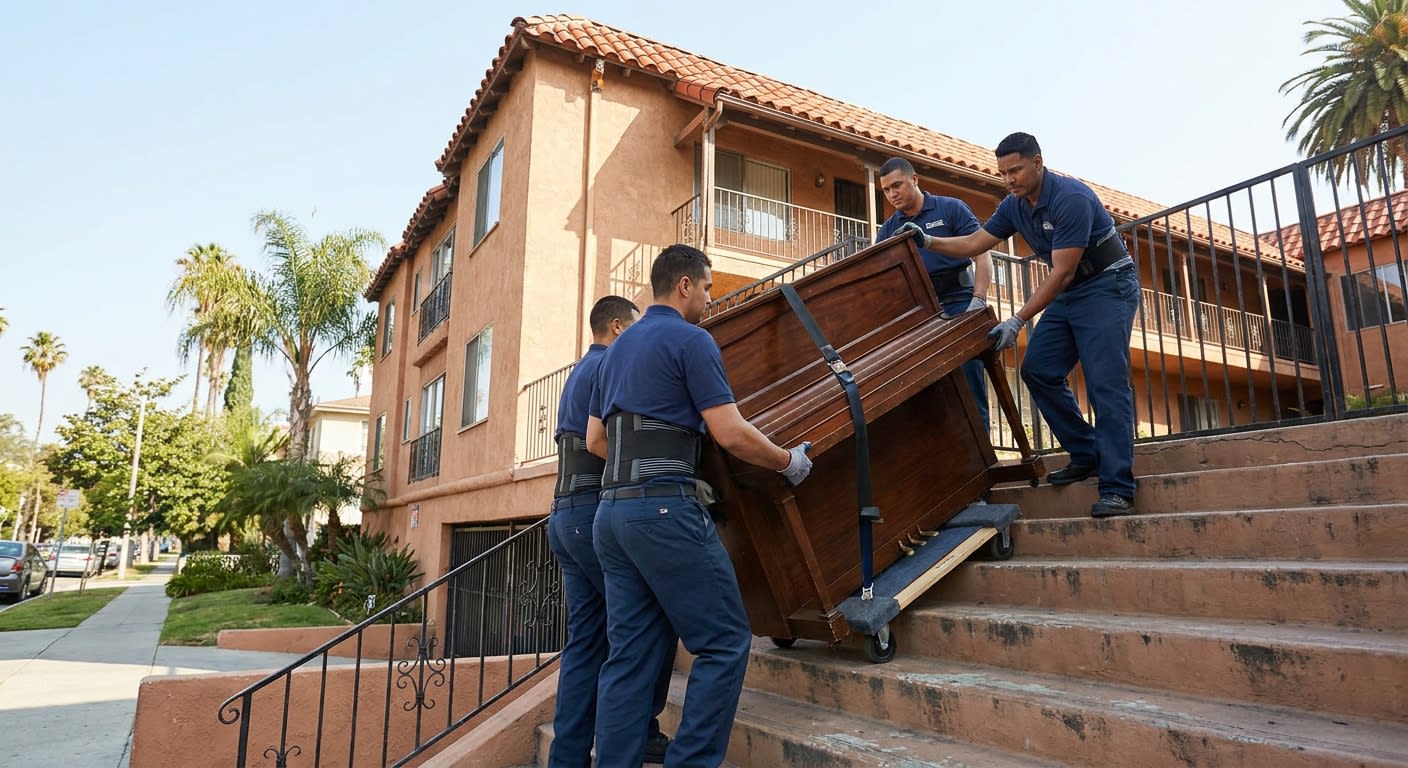
Four pairs of hands then take the weight down the steps. The instrument goes into the truck first, stands against the wall on tie-downs, and boxes and furniture are built around it; at the new address that order simply runs backwards.


Distance is measured from our base at 5530 Jillson Street in Los Angeles. Travel time counts double once the run passes 10 miles, an address 30 or more miles out starts at a four-hour minimum instead of three, and overtime begins after the eighth hour. Our line at 909-443-0004 is open Monday – Sunday, 8AM – 6PM, and a free crew can often take the job the same day.
Santa Ana Municipal Code 36-145 bars a commercial vehicle rated at 10,000 pounds GVWR or more from parking or standing on a street in a residential district for longer than two hours. The same section exempts a vehicle making pickups or deliveries of goods to or from a building on that street, so the two-hour clock is aimed at a truck left idle rather than one being loaded.
A second rule, SAMC 36-145.5, lets the executive director of public works prohibit stopping, parking or standing by any vehicle six feet or more in height including its load within 100 feet of an intersection; outside alleys it takes effect only where signs have been posted. Our driver reads the signs on arrival and sets up on the closest legal curb to the door the instrument will leave through.
Parts of the city lie inside permit parking districts created by City Council resolution, and there a permit is what buys you the curb. A single-family household may hold up to three permits plus 75 guest permits a year, and each guest permit is good for one use, expires at noon the following day, and may not have its date altered.
Buildings of two to four units get one permit per dwelling unit and no guest permits at all, and the districts are enforced on holidays as well. Ask the office or the association for the guest permit early, send us the gate code and the elevator hours, and we will have the certificate of insurance issued for $50 before the crew rolls out.
French Park sits just northeast of downtown and is one of the oldest neighborhoods in the city: roughly 20 square blocks of Victorian, Neoclassical, Craftsman bungalow and Colonial Revival houses on lushly landscaped streets. It has been on the National Register since 1999 and also carries a zoning overlay of its own, Specific Development 19.
Floral Park was listed in 2023, the most recent of the three National Register districts the city keeps. On blocks like these the crew measures the porch, the turn in the hallway and the doorway on arrival instead of assuming a standard opening.
Bristol Street is in the middle of a 3.9-mile improvement that raises capacity from four lanes to six, with three through lanes in each direction. The work runs in phases along the corridor, so the stretch under construction moves from one year to the next and we check the current phase before routing the truck.
That last phase narrows the through lanes from 12 feet to 11 and adds six-foot protected bike lanes on each side, so a corridor address is worth flagging when you book. We build the drive from Los Angeles into the schedule, count travel time double past 10 miles, and open at a four-hour minimum when an address is 30 or more miles from the base.
Type of home in Santa Ana → what the crew of four prepares:
| Type of home in Santa Ana | What the crew of four prepares |
|---|---|
| Single-family house inside a permit parking district | The household books the guest permit in advance; the truck works under the pickup-and-delivery exception to SAMC 36-145 rather than standing idle; blankets, dolly and straps are carried in from the nearest legal curb. |
| House in an RE, R1, R2, R3 or R4 district | SAMC 41-607 keeps a truck off the premises unless it sits inside a fully enclosed garage, and off-street complaints go to Community Preservation, so the crew parks at the street and walks the drive. |
| Historic house in French Park, on the National Register since 1999 and inside the SD-19 overlay | Porch, hallway turn and doorway measured before the first strap; porch edges and planting beds padded; the instrument carried down the steps by four people instead of rolled. |
| Custom home in Floral Park, listed on the National Register in 2023 | Route walked with the owner first, boards laid over thresholds, and a four-man lift used on every run of steps rather than a dolly. |
| Mid-rise condo such as Legado at the Met, 200 E. First American Way | Six stories with lofts and 278 units sit over a four-level, 617-space garage with three levels below ground, so we ask for the elevator to be reserved and the clearance confirmed, and the truck usually loads from street level. |
| Address beside the Bristol Street work | Arrival timed around the Phase 3A and Phase 4 construction limits, an approach chosen off the closed lanes, and the posted height restriction under SAMC 36-145.5 checked on the block before the ramp goes down. |














No. The instrument rides on the hourly rate of the crew that carries it, with a flat $200 added for the piece itself. A crew of four is required, the job is billed for at least three hours, and an address 30 or more miles from our base starts at four hours instead.
Yes, and that is how most of these jobs run. The same four movers load the bedrooms, the kitchen and the instrument on one clock, so there is no second crew to schedule and no second trip to pay for. Just tell us at booking that an instrument is on the list.
As close to the door as the code allows. The city limits a commercial vehicle of 10,000 pounds GVWR or more to two hours on a residential street, with an exception while it is loading or delivering, and some blocks also post a height restriction within 100 feet of the intersection. Our driver reads those signs before setting up.
Reserve the elevator and check the garage clearance against a moving truck. A building like Legado at the Met stacks 278 units over a four-level garage with three levels below ground, so the truck normally works from street level and the carry starts there. Should the association want a certificate of insurance on file, ours costs $50.
No. We move it and set it down where you want it standing, and that is where our part ends. Tuning and valuation belong to a technician once the instrument has settled into the new room.
Often yes. The line at 909-443-0004 is answered Monday through Sunday, 8AM to 6PM, and when a crew of four is free we can take the job that day. Dates that need a guest parking permit or a reserved elevator are better booked ahead.
Companies that sell instrument transport as its own product usually quote a flat figure for the instrument and a second, unrelated figure for everything else in the house. We do not split the day that way. A crew of four arrives, the clock starts, and the upright or the grand is one of the items that crew handles between the first lift and the last.
That has a practical consequence for anyone comparing quotes from piano movers in Santa Ana, CA. If the instrument is the only thing leaving, you still pay for a crew of four and a three-hour minimum, because the weight sets the crew and the crew sets the rate. If the whole home is leaving, the instrument costs the flat addition and whatever extra minutes the carry takes.
It also changes how the date is planned. There is no second truck circling back later and no coordination between two companies with two arrival windows. One dispatcher, one crew, one bill at the end of the day.
Worth saying plainly: the hourly clock covers the labour, the truck, the blankets, the straps and the wrapping. What sits outside it is a short list of flat items, and every one of them is published rather than discovered at the end.
Four movers is not a marketing number. An average upright runs several hundred pounds in an awkward shape, and a grand spreads its weight over a curved case that cannot be gripped the way a dresser can. Two people can tip such a load; four can hold it level on a stair run, which is where damage usually happens.
On the bill that appears as the crew rate for four movers with a truck, plus the flat $200 for the instrument. That addition covers the equipment the piece takes: a dolly rated for the load, straps long enough for four people to share the weight, a skid board once the legs and lyre come off a grand, and blankets enough to cover a case on every face.
Inside the truck the instrument is not simply parked. It goes in first, stands against the wall, and is tied down so it cannot shift when the driver brakes. Boxes and furniture are then built around it rather than against it.
Anything else in the home over 300 lbs deserves a mention at booking. A safe or a stone table is handled by a crew of three under a $150 surcharge of its own, and hearing about it in advance is what keeps the day from running long.
Almost every hour lost on a move day is lost before the first lift, and most of it is avoidable. Clear the route the instrument will travel: the rug in front of it, the side table in the hall, the pots on the porch steps. A crew that has to shift your furniture to reach the instrument is spending your clock doing it.
Take the sheet music, the metronome and anything else off the lid yourself, then close and latch the fallboard. A grand music desk should come out if it lifts free without tools. Nothing loose should be sitting on or inside the case when the blankets go on.
Paperwork the building wants is worth handling early. If your block sits inside a permit parking district, the guest permit is a household errand and it expires at noon the day after it is used, so collecting it on the morning of the move is cutting it fine. Where a certificate of insurance is required, send us the wording and we issue one for $50.
Be blunt about the hard parts when you book. A porch with seven steps, a hallway that turns twice, a driveway that climbs, a lift out of service that week — each of those changes what goes on the truck that morning. None of it is new to our crews; all of it is a problem if we hear about it on arrival.
Housing here is not one thing, and neither is a carry. French Park, just northeast of downtown, has been on the National Register since 1999 and holds a zoning overlay of its own, Specific Development 19, across roughly 20 square blocks of the oldest housing in the city. Floral Park joined the register in 2023, the newest of the three districts the city lists.
On streets like those the crew measures first and lifts second. Porch edges and planting beds are padded, thresholds are boarded over, and four people carry the instrument down the steps instead of rolling it. Where a drive climbs, the dolly stays off the slope entirely.
Condo work runs on different constraints. A mid-rise such as Legado at the Met, on the northeast corner of MacArthur Boulevard and MacArthur Place, holds 278 units across six stories with lofts over a four-level, 617-space garage with three levels underground, so the elevator and the walk from the loading point matter more than any staircase.
Street rules finish the picture. SAMC 41-607 keeps a truck off the property itself in the RE, R1, R2, R3 and R4 districts unless it is inside a fully enclosed garage, and those off-street complaints go to Community Preservation rather than to a patrol officer, so the truck holds the curb and the crew walks the distance.
Four things move the clock more than anything else, and the make of the instrument is not among them. First comes the path: a ground-floor room with a straight run to a wide front door is a different job from a second-floor room reached by a turning stair. Second is everything else going on the truck, because the instrument is rarely travelling alone.
Distance is the third. Every crew leaves from 5530 Jillson Street in Los Angeles, and travel time counts double once the run passes 10 miles. Addresses 30 or more miles from that base open at a four-hour minimum rather than the usual three, and overtime begins once the eighth hour is reached.
Street conditions make up the fourth. The Bristol Street widening is running in phases and lanes shift as each one opens, so an address near that corridor can cost the driver minutes before the ramp is even down. A block posted under the height rule near an intersection can push the truck further from the door, and every extra yard of carry is time.
All four can be shortened. Take an early slot, keep the driveway empty, have the permits in hand, and put the whole home on one job instead of splitting it across two dates.
The four common shapes are handled differently. A spinet or a console is the lightest of the uprights and usually travels standing on a dolly under blankets, while a full-size upright is taller and top-heavy, so the straps matter more than the wheels. A baby grand and a concert grand both come apart before they travel.
Which one you own changes the wrapping and the lift, not the way the day is priced. The full breakdown of each type, what comes off and what goes back on, lives on our piano movers page; here it is enough to say that the crew of four and the flat addition stay the same either way.