



%201.svg)









A quote starts with a walkthrough of the floor you are leaving and the floor you are taking. Buildings, not furniture, decide how long the day runs, so elevators, docks and door widths are measured before anyone talks about hours.
What we carry on a typical office job:
Anything past 300 lbs — a safe, a plotter, a heavy press — is quoted at $150 and handled by a crew of three. Those pieces are flagged at the walkthrough, so the price you approve already covers them.

Disconnecting and reconnecting computers is part of the move rather than a separate invoice, and the crew that pulls a workstation apart is the crew that rebuilds it. Ask your Moving Coordinator to put the service on the estimate when the date is set.
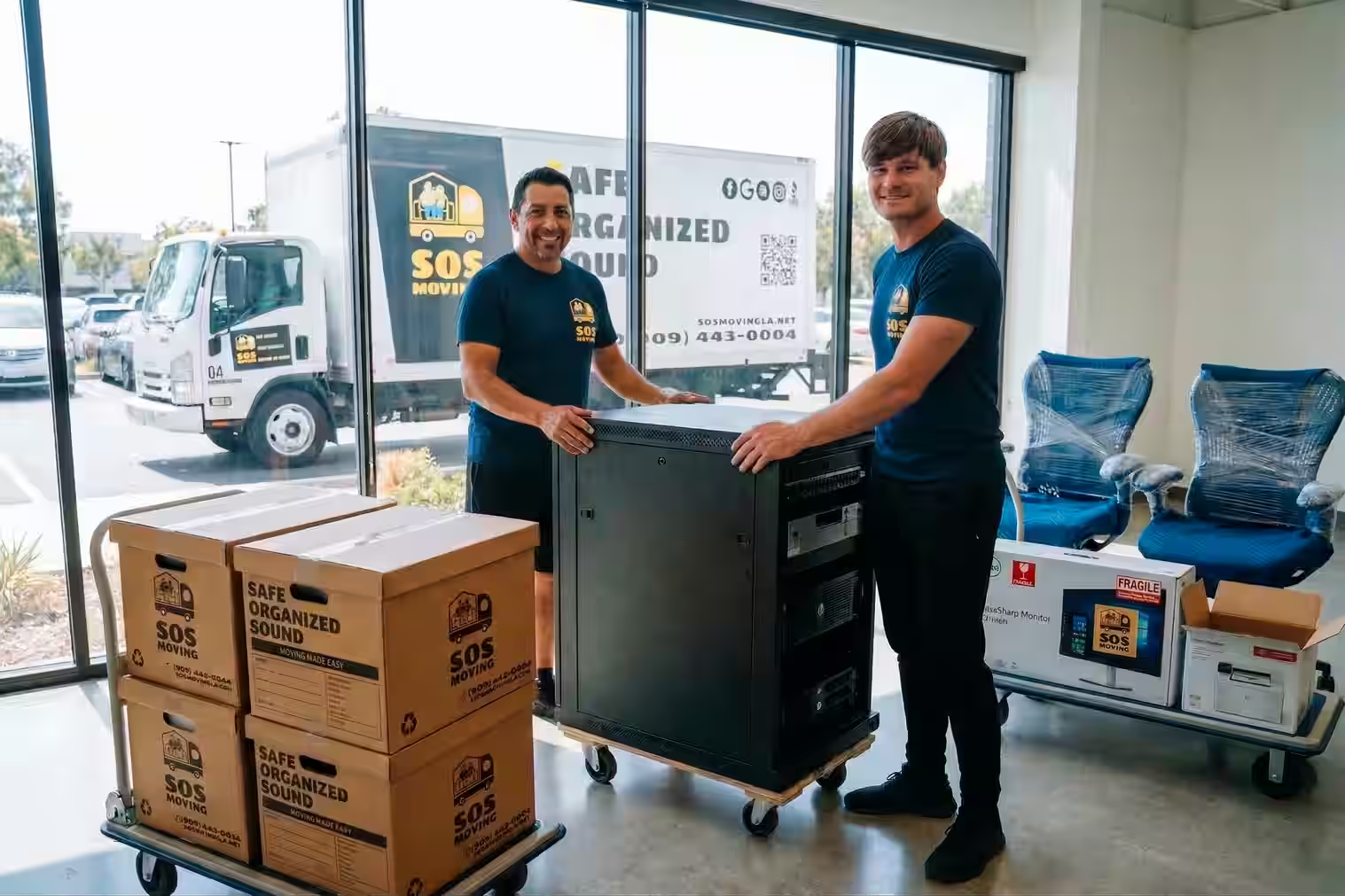
Servers, switches and racks come down once your own engineers have shut them off. They ride upright and wrapped, go back in the order they were pulled, and your team brings the network up — we handle the physical side of the hardware, not your configuration.
Screens and small electronics ship in cartons instead of loose on a cart, and cables travel in bags marked with the desk number they came from. A department of twenty seats can be pulled, moved and rebuilt inside one shift when the freight elevator is ours for the window we booked.
Stage one takes archives, spare furniture and stockroom contents, which clears floor space and shortens every later trip. Stage two moves departments in the order you choose, and stage three is the working desks.
Crews run any day of the week inside our hours, Monday – Sunday, 8AM – 6PM. Friday through Sunday costs more per hour, so bulk stages usually sit on a weekday and the weekend carries the floors that cannot be emptied while staff are at their desks.
One coordinator holds the whole plan: the access window, the elevator booking, the certificate of insurance and the crew size for each stage. You call one number, 909-443-0004, from the walkthrough to the last rebuilt desk.
Hourly rates for a crew with a truck:
| Crew | Mon – Thu, cash / card | Fri – Sun, cash / card |
|---|---|---|
| 2 movers and a truck | $119 / $129 | $135 / $145 |
| 3 movers and a truck | $159 / $169 | $175 / $185 |
| 4 movers and a truck | $199 / $209 | $215 / $225 |
Added to the hourly line where they apply: $30 for gas, $50 for a certificate of insurance, $150 for a single item over 300 lbs with a three-mover crew, $200 for a second truck, and $200 when loaded goods stay in the truck overnight. A $50 deposit holds the date and comes off the final bill.
Billing rules are the same at every business address: a three-hour minimum, four hours once the job sits more than 30 miles from our Jillson Street base, drive time charged double past 10 miles, and overtime after eight hours on site. Same-day work is possible whenever a crew is free.
Addresses a mile apart behave nothing alike here. Four things get checked before a date is confirmed: where the truck stands, what the building demands on paper, what the surrounding district does all day, and how the hours fall.
Downtown has city garages the crew can use. Marketplace, Exchange and Orange Street give 90 minutes free to every visitor, then charge $3.00 per hour with a daily maximum of $15.00, so personal cars go there for the shift while the truck keeps the loading zone or the dock.
On the street, and in some off-street lots, payment runs through multi-space meters that cover 8–10 spaces each and are tied to the space number rather than the vehicle. Our crew notes that number on arrival and keeps the receipt, because a van arriving later pays for its own space.
Businesses in Montrose carry an extra layer: the city runs a Montrose/Sparr Heights employee parking permit program with its own application and map. We ask which permits your staff hold before settling on where the truck stands.
Downtown high-rises hold corporate headquarters including Age of Learning, ServiceTitan, Whole Foods, Cisco and Avery Dennison, and management offices in that class of building treat paperwork as a condition of entry. A certificate of insurance costs $50, follows the wording your property manager sends over, and reaches them ahead of the date rather than on the morning.
Elevator time is booked, never assumed. We ask which freight car is available, what its inside height is, and whether pads and Masonite belong to the building or come on our truck; dock rules follow.
Converted storefronts and ground-floor suites bring the opposite problem, because there is no dock at all and the whole job crosses a public sidewalk. The route is planned, frames and floors are covered, and the walkway stays passable while the crew works.
Montrose is a shopping district of close to 200 businesses, with parklets used for street dining under the city Al Fresco program. A retail move there is a tight-quarters job: limited frontage, foot traffic all day, and stock that has to leave without blocking a neighbor entrance.
Kenneth Village, established in 1923, mixes shops, eateries and service providers in the same storefront format, while Adams Square sits at the base of Adams Hill as a historic business district and neighborhood center in south Glendale. Brand Boulevard of Cars adds a regional concentration of 21 auto dealerships.
Tower work is a different trade from any of these. We size the crew to the building and its access rules, not to the square footage written on the lease.
The city has synchronized signal timing for up to 50 intersections along five downtown corridors: Central Avenue, Brand Boulevard, Glendale Avenue, Broadway and Colorado Street. Those are the streets a full-size truck actually wants, so arrival and departure are planned on them and turns stay off the narrow residential blocks.
Hours are the other half of the plan. Crews work Monday – Sunday, 8AM – 6PM, every job carries a three-hour minimum, and drive time doubles past 10 miles, so a stage that starts late costs more than the same stage started early.
Where a business cannot pause at all, the work is cut into stages and spread over two or three dates, with the heaviest run booked for the day your floor is emptiest:
| Business district or building type in Glendale | What to plan for |
|---|---|
| A managed downtown high-rise | Corporate headquarters share these towers, so plan on a COI for the management office, a booked freight elevator, a named access window and lobby protection before the first cart rolls. |
| Glendale Galleria, a three-story regional center with over 200 stores and over 30 million visitors a year | Tenant moves follow the center management timetable and run through service corridors; stock is staged off the shop floor and our stages fit inside 8AM – 6PM. |
| The Americana at Brand | Upscale retailers and internationally recognized restaurants: the route is set by management, and fixtures are wrapped before they cross a public walkway. |
| Montrose, a shopping district of close to 200 businesses with parklets used for street dining | Short curb frontage and foot traffic all day; ask staff about the Montrose/Sparr Heights employee parking permit and the city Montrose parking map before choosing where the truck stands. |
| Brand Boulevard of Cars, a regional concentration of 21 auto dealerships | Where the truck stands is agreed with the dealership, and office contents leave through service doors rather than across the display floor. |
| Kenneth Village, in business since 1923, and Adams Square at the base of Adams Hill | Storefront businesses without a dock: everything crosses a sidewalk, so door frames and floors are protected and the crew loads in short runs. |
Send us the building handbook, the suite number and the floor when you ask for a price. Half of the answers above come straight out of that document, and the rest we collect at the walkthrough.














Yes. The certificate costs $50, is written to the wording your property manager sends over, and reaches the management office before move day rather than on the morning. Forward us the building requirements as soon as your date is set.
Crews work Saturday and Sunday inside our normal hours, Monday – Sunday, 8AM – 6PM. Friday through Sunday runs at a higher hourly rate, so many clients keep the bulk stages on a weekday and save the weekend for floors that cannot be cleared while staff are working.
Two movers and a truck are $119 an hour in cash or $129 by card Monday through Thursday, and $135 or $145 Friday through Sunday. Three- and four-mover crews step up from there, gas adds $30, and every job carries a three-hour minimum with drive time doubled past 10 miles. The firm figure follows a walkthrough.
At the loading zone or dock your building assigns, booked in advance with management. Crew cars go to a city garage such as Marketplace, Exchange or Orange Street, where the first 90 minutes are free and the rate runs $3.00 an hour up to $15.00 a day, and on-street parking is paid at a multi-space meter by space number.
Often, yes. Same-day work depends on a crew being free, so call 909-443-0004 early in the day. A suite of a few desks usually fits an existing schedule, while a full floor needs a walkthrough, a certificate of insurance and a booked elevator first.
Yes. Panel systems are dropped, carried flat and rebuilt to the new floor plan by the same crew, and workstations go back together at the new address. Disconnecting and reconnecting computers is included once your Moving Coordinator adds it to the estimate.
The first document is a list, not a quote. Walk both floors with a notebook and count desks, chairs, cabinets, screens, server racks, storage rooms and whatever lives in the corridor, because that total decides crew size, truck count and the hours you end up paying for.
Numbering comes straight after the list. Each desk gets a number matching a position on the new floor plan, every carton and cable bag carries the same number, and the crew places furniture by that number instead of asking where things go.
A purge before move day is the cheapest part of the project. Archives that only need to exist rather than be reachable can be boxed and stored, and broken chairs or dead monitors are better disposed of than carried, since everything in the truck is billed by the time it takes to handle.
Equipment deserves its own pass. Photograph the back of each machine, label the ports, note which screens belong to which seat, and agree with your own engineers what they will shut down and what our crew will carry.
Lead time closes the planning stage. A small suite can often move the same day a crew is free, while a full floor with a booked elevator and a certificate of insurance wants its date set well ahead.
Notices belong on the same checklist as cartons. Carriers, utilities, the alarm company, the cleaning contractor, signage and anyone who delivers to you all need the new address and the switchover date, and that list is far easier to write two weeks out than on the last afternoon.
Paperwork opens the door. Most managed buildings want a certificate of insurance naming the landlord and the management company before they release a freight elevator, and ours costs $50 and follows the wording your property manager supplies.
Downtown towers hold corporate headquarters — Age of Learning, ServiceTitan, Whole Foods, Cisco and Avery Dennison among them — and access rules in that class of building are written down and enforced. Expect a named access window, a booked elevator, protection for lobbies and corridors, and a dock slot measured in hours rather than days.
Shopping-center tenants work to a different timetable. Glendale Galleria is a three-story regional center with over 200 stores and over 30 million visitors a year, so a tenant move there runs through service corridors on the center management schedule, and our own stages are planned inside 8AM – 6PM.
Smaller buildings ask for less, though never for nothing. A converted storefront may have no dock and no service lift, and then the real constraints are the sidewalk, the front door and how long a truck may hold the curb.
Request the building handbook early. It is a quicker read than discovering on move day that elevator pads are the tenant responsibility.
Downtime is the true cost of a commercial move, and it never shows up on the mover invoice. A staged plan keeps most of your people working while the building empties around them.
Stages are ordered by how little the contents are needed day to day: storage and archives first, then departments that can work from laptops for a shift, then the desks that must be live the next morning.
Weekend stages take the parts that cannot move while staff are seated. Crews work Saturday and Sunday inside the same hours as any other day, and the higher Friday-to-Sunday rate is worth spending only on the stage that genuinely needs it.
Phones, printers and meeting rooms travel last. A floor without a working conference room loses less than a floor without desks, so the schedule protects the seats first and the extras afterwards.
Someone should own the plan on your side as well as ours. When the building manager, the IT lead and the crew all deal with the same two people, a stage that slips by an hour becomes a phone call instead of a lost day.
Two shorter dates often beat one long one. Splitting a floor across a weekday and a weekend keeps the hourly rate down on the bulk of the load, leaves a buffer if a freight elevator is released late, and gives your team a working office on both sides of the gap.
Office furniture is built to come apart, and it survives the trip better that way. Benching frames, sit-stand desks, panel systems and conference tables are stripped, wrapped, carried flat and rebuilt at the new address by the crew that dismantled them.
Filing is decided by the building rather than by preference. Lateral cabinets can be rolled loaded where a dock and a lift allow it, and get emptied into numbered cartons where the route runs through a lobby and out a front door.
Electronics travel packed, not stacked. Monitors go in cartons, cables into labeled bags, rack hardware upright, and disconnecting and reconnecting computers joins the estimate when your coordinator adds the service.
A few items change the crew instead of the packing. A safe, a plotter or any single piece over 300 lbs is quoted at $150 and handled by three movers, a second truck is $200, and goods that must stay loaded overnight are $200.
Protection is the quiet part of the day. Masonite on lobby floors, pads on door frames and guards on corridor corners are what the building remembers long after the furniture has gone.
A short list of items never goes on the truck. Solvents, aerosols, fire extinguishers, gas cylinders and similar hazardous goods stay with you or go to a specialist, and we hand over the full list during planning so nothing is discovered at the loading dock.
This is not one business district but several, and each changes the loading plan. The downtown core is high-rise and managed, with corporate headquarters sharing lobbies and elevators with far smaller tenants.
Retail addresses behave differently again. The Americana at Brand gathers upscale retailers and internationally recognized restaurants, while Montrose holds close to 200 businesses with parklets used for street dining, and both mean limited frontage and a public walkway between truck and door.
Older neighborhood centers keep their own habits. Kenneth Village has been trading since 1923, Adams Square sits at the base of Adams Hill in the south of the city, and storefronts in both were built long before loading docks were standard.
Vehicle-heavy sites are a different case again. Brand Boulevard of Cars is a regional concentration of 21 auto dealerships, where the loading point is agreed with the dealership before the date.
District aside, the same four questions shape every quote: how the truck reaches the door, who authorizes the crew to enter, what has to keep running while the job goes on, and how many hours the contents will take to handle. The answers change street by street, which is why the walkthrough happens before the number.
Driving between them is a plan of its own. Signal timing has been synchronized for up to 50 intersections along Central Avenue, Brand Boulevard, Glendale Avenue, Broadway and Colorado Street, and those corridors carry a loaded truck far better than the residential grid on either side.
A price quoted over the phone, with nobody having seen the space, tells you very little. We walk both addresses, count what moves, check elevators and docks, then put a crew size and an hour count on paper.
The estimate names the rate for your days, the $30 gas charge, the $50 deposit that comes off the total, and any extra that applies: a certificate of insurance, a second truck, an overweight item, a night with goods left loaded. Nothing arrives later that was missing from that sheet.
Licensing is worth checking with anyone you call. SOS Moving operates under USDOT 3398018, MC 1153871 and CAL-T0192140 from a single office at 5530 Jillson Street in Los Angeles, and the crew on your floor works for us.
Once the plan is agreed the deposit holds the date and the coordinator takes over. Call 909-443-0004 with the address, the floor and the date you have in mind, and we will tell you what the building is likely to ask for.